October 27, 2025
Health Risks Associated with 7-OH
Summary
- The recent increased availability and use of 7- hydroxymitragynine (7-OH) pose significant health risks including dependence and/or addiction.
- Reporting of adverse reactions requiring immediate clinical intervention among users of products containing 7-OH has increased.
- Isolated 7-OH is currently untested in humans, unregulated, not proven safe or effective for any use, and sold to the public without restriction.
- Until safety data is available for human consumption, Missourians are advised to avoid these products.
7-OH Background
7-OH, pronounced “seven-hydroxy,” is an abbreviation referring to the chemical compound 7-Hydroxymitragynine. It is a potent isolated psychoactive substance that exists naturally in very small amounts in the kratom plant. Both 7-OH and kratom have been marketed as “natural” promoters of alertness and remedies for pain, anxiety, and/or opioid withdrawal. However, isolated 7-OH products marketed and sold in Missouri have a far higher concentration—and therefore far higher potency--than natural kratom. Research data reveals 7-OH has 13 times the potency of morphine at the opioid receptors.
Products containing isolated concentrated 7-OH are sold in stores such as smoke shops, gas stations, convenience stores, and online shops. They can be gummies, candies, imitation ice cream cones, liquid shots, tablets or powders. It is sometimes sold as if it were the same product as kratom, but it is far more addictive.
In July 2025, the U.S. Food and Drug Administration announced steps to restrict access to 7-OH products due to its strong opioid-like effects. Kratom and 7-OH do not have an FDA-approved medical use, and products containing 7-OH have not been proven to be safe or effective. Because 7-OH is unregulated, the potency, purity, and safety of products can vary widely, making it difficult to safely gauge dosage.
7-OH Clinical Effects
Symptoms
Symptoms reported after 7-OH use include but are not limited to:
▪ Nausea and vomiting
▪ Agitation
▪ Confusion
▪ Sweating
▪ Anxiety
▪ Insomnia
▪ Gastrointestinal distress
▪ Depression
▪ Rapid heart rate
▪ High blood pressure
▪ Trouble breathing
▪ Sleepiness or loss of consciousness
▪ Seizures
▪ Withdrawal symptoms such as restlessness, body aches, fatigue, irritability, and cold sweats
▪ Dependence and addiction
▪ Poisoning
▪ Death
Overdose
▪ Because 7-OH acts on opioid receptors, it can cause respiratory depression, overdose, and death.
▪ Combining 7-OH with other substances increases the risk of overdose. Using 7-OH in combination with alcohol, other sedatives, illicit substances, or certain prescribed medications can amplify the risk for severe respiratory depression, and in some cases, even death.
Poison Control
▪ From January 1 through September 30, 2025, the Missouri Poison Center has received 47 reports of exposures involving kratom or another product containing 7-OH, compared with 25 in 2024 and 19 in 2023.
▪ The Missouri Poison Center began tracking isolated 7-OH use within the last three months, with three reports of exposures to 7-OH. Of the three reported during that time, one was evaluated in a health care facility.
Treatment
▪ Acute overdose:
o Anyone who suspects an overdose should call 911 immediately and administer naloxone if available.
o Opioid overdose (including overdose elicited by 7-OH which targets opioid receptors in the body) can be reversed with naloxone, a medication that restores normal breathing.
o It is important to recognize that naloxone prevents only opioid-related overdose. If 7-OH is mixed with other drugs or alcohol, then naloxone may not fully reverse the effects of those other substances.
o Naloxone can be administered through the nose or as an intramuscular injection to save a person’s life. Both methods are equally effective.
▪ Chronic Substance Use Disorder due to 7-OH Use
o Patients suffering from dependence or addiction to 7-OH should reach out to a healthcare provider to seek recovery support.
Missouri DHSS Recommendations
▪ Avoid 7-OH products.
▪ Read labels carefully when buying candies or supplements.
▪ Keep 7-OH products away from children and pets.
▪ Talk to children and teens about the risks of 7-OH.
▪ Stay informed about overdose risks and keep naloxone available in case of an emergency.
▪ Consult a health care provider before using any supplements, especially anything marketed for pain, energy or mood.
▪ Seek medical care or call the Poison Help Line at 1-800-222-1222 if you have concerns about 7-OH.
▪ If someone is unresponsive, nearing unresponsiveness, or acutely ill:
o Call 911 immediately!
▪ If there is not an overdose or medical emergency, seek help for 7-OH dependence or addiction:
o Call 988
o Call Missouri Dept of Mental Health (573) 751-4942 or (800) 575-7480
o Go online to find treatment locations, some of which are available immediately or same-day: https://dmh.mo.gov/behavioral-health/treatment-services/locating-services-treatment
Additional Information and Resources
▪ Missouri Poison Center
▪ Hiding in Plain Sight: 7-OH Products, U.S. Food and Drug Administration
▪ Time2Act – Stop Opioid Misuse in Missouri
▪ Order FREE Naloxone at Get MO Naloxone
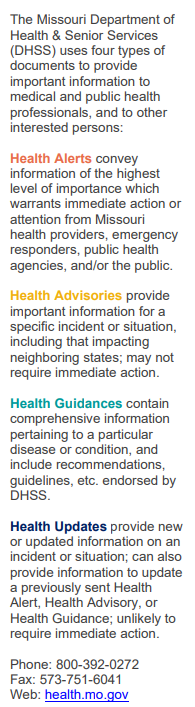
Please contact the DHSS’s Bureau of Community Health and Wellness at 573-522-2820 with questions regarding this Health Advisory.
References
▪ US Food & Drug Administration, News Release (July 29, 2025), “FDA Takes Steps to Restrict 7-OH Opioid Products Threatening American Consumers.”
▪ Food and Drug Administration (July 29, 2025), “Preventing the Next Wave of the Opioid Epidemic: What You Need to Know About 7-OH.” https://www.fda.gov/media/187900/download
▪ Midwest High Intensity Drug Trafficking Area (HIDTA), Quarterly Drug “Hot Sheet”, third Quarter,
2025.”7- OH Bulletin.”
|