|
Happy official start to the summer! Regardless of the type of summer activities you enjoy, I wish you sunshine, relaxation and space to make memories. Below are a few updates I have for you.
Budget Update
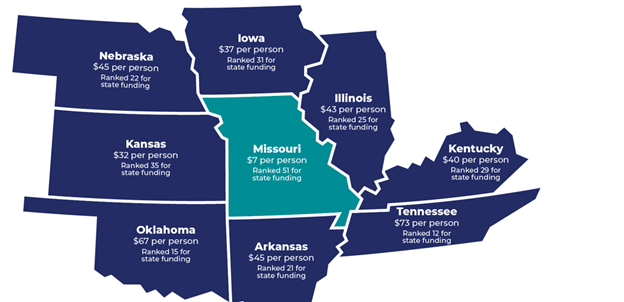
The department is closely following state and federal budget processes, priorities, and policy. Today’s fiscal outlook is quite different from the recent past, both on the state and federal levels. The state’s cash reserves have dwindled as numerous special projects have been funded and fiscal policy changes have gone into effect. Some recent changes to state policy will further impact future revenues requiring a responsive and committed approach to spending. While no formal announcements or direction has been given, we anticipate the department may need to evaluate and even scale back on state spending. This could be difficult for DHSS. The department’s use of federal dollars for core public health already exceeds that of state funds, and Missouri already ranks the lowest among all states for per capita spending of state dollars on public health according to data provided by State Health Access Data Assistance Center.
 |
This doesn’t mean that public health isn’t valued. All too often the outcomes resulting from effective public health policy goes unnoticed. It is expected to have access to safe drinking water, that measures are in place to reduce infections and the spread of disease, that food and other establishments receive inspections, that there is reasonable access to quality care, and many other things are in place to keep us and our loved ones safe. It is easy to lose sight of the work performed by the department and the extensive cast of community partners, like local public health departments, state associations, medical providers, community interest groups and others who help perform the work. In addition, health isn’t something bestowed upon us by a state department. Health is an active commitment to things like nutrition, immunization, following safe practices, managing one’s disease to minimize poor outcomes, and many other factors. Nonetheless, the programs, services and community partners supported by the department do not operate without expense.
On the federal front, the department is tracking the Administration and Congress’s priorities to gauge what programs and services may be impacted by reductions and eliminations. The Association of State and Territorial Health Officials website offers a compilation of federal budget documents that state health leaders can access to provide insight into current fiscal actions and key priorities. Additional information can be found here for those interested in a refresher on the framework and timetable for the federal budget. Right now, we anticipate the department could see a $50M decrease in funding that supports core public health and laboratory services. This represents about a thirty percent decrease in federal funding for those services or about eighteen percent of the department’s entire core budget. The department was recently notified we would not be receiving over $2.5M in Public Health Emergency Planning funds, the majority of which funded local public health emergency response readiness. Dollars directly supporting local public health department efforts. There are other Notices of Award that are delayed, postponed, or for which we have not received expected communication. It seems the day-to-day awareness of significant changes will continue.
There are dedicated teams of fiscal and program staff in every division of DHSS working to keep the department operating smoothly as well as keep the Director’s Office apprised of new developments. Without these dedicated and knowledgeable individuals, it would seem an impossible situation. Unfortunately, we have yet to see and truly feel the anticipated cuts. However, unlike other states, we are taking a much more deliberate approach to the current environment. Many states with greater reserve than Missouri, have already taken more drastic measures reducing programs and staff by significant amounts. At DHSS, division leaders are meeting routinely to discuss potential impacts and problem-solve across division lines. It has been truly remarkable collaboration. We are evaluating all programs and services for opportunities to minimize the impact of cuts and maintain core public health and other services valued and expected by our citizens. The specific programs or services, funding amounts, or extent of fiscal impact cannot be finalized until a budget is passed and we know if there will be changes at the state level. The Office of Administration is tracking anticipated federal service and funding cuts which includes areas like emergency preparedness, communicable disease, environmental, laboratory, assessment and surveillance, and others.
Strategically, the department has taken proactive steps to clarify and strengthen processes, communicate with key state leaders, and work with national groups to better inform future decisions. On May 9, other senior leaders and I met with the Governor’s Office to provide a full brief on the impact stemming from potential federal cuts. Numerous departmental changes aimed at strengthening our response have occurred through fiscal consolidation and more are to follow with transforming many of our fiscal processes. Last week, we also met with the State’s Budget and Planning Office to inform them and discuss how to approach the FY27 budget. Other department directors and I attend weekly national calls to understand how other states are being impacted andthe actions they are taking, and in turn, inform them on how changes may impact Missouri. We have sought the help of other Missouri departments to partially fund positions like our Policy Director, Health Economist, and Chief Health Information and Data Strategy Officer. These actions are pertinent because these positions collaborate across department lines and reduce support needed from grants and general revenue which helps keep programs running. Additionally, I have been meeting with ASTHO to learn if there are fiscal policies we could enhance or implement to maximize our federal draw.
If possible, the department is not planning a “funding cut/service cut” approach. We are conducting a full departmental evaluation to prioritize existing programs and services. Division directors and assistant division directors will spend two upcoming days working collaboratively to identify potential solutions based on various scenarios. In the coming weeks, we expect to learn more about the federal budget as well as receive state guidance in developing the FY27 budget. Since coming to the department in February, I’ve met with division leaders as a group for two hours each week. We have also had numerous individual program meetings to truly understand the work of the department. I am glad to meet with any colleague, as are the division directors, to address questions to the extent we know the answers. Please understand, there will be what seems like quick decisions without full awareness to some. This can be a risk of making thoughtful decisions that take longer rather than knee-jerk reactions. If what we anticipate with federal and state changes comes to fruition, we will experience reductions in some divisions.. I can also assure you that I will continue to work diligently to try to minimize the impact within the department, maintain good community partnerships, and ensure citizens have a strong health department.
Government at the Speed of Business
Recently, some colleagues asked what I meant by “government at the speed of business.” That’s a fair question! “Government at the speed of business” is a concept that advocates for government agencies to adopt practices and efficiencies found outside of state government in the private sector to improve effectiveness and responsiveness. This is not a new or novel idea. Streamlining processes and using private sector models can lead to faster service delivery, reduced costs, and a more positive experience for citizens and partners. It means decreasing bureaucratic and outdated processes. The department has implemented a number of changes to support this work, including the expanded partnership with other agencies to support data modernization and sharing of data, key policy impact positions working across departmental lines, and changes to fiscal operations. I’ve heard multiple stories from team members about unnecessary red tape. We have so many more opportunities. I bet each of you could identify areas for improvement!
With that said, there are challenges to this concept. Government serves all citizens unlike businesses that can choose markets. Government operates on macroeconomics (fiscal policy) while private businesses operate on the principle of microeconomics (supply and demand). We have more budget constraints (i.e., we may have the funding but not the authority to spend it), legacy operating systems, and complex regulations.
Ultimately, it’s the desire to be more agile and customer-focused while acknowledging the unique role and responsibility of public service. This is consistent with my messages of finding efficiencies, being customer service focused, and modernizing data.If you have suggestions for the department to improve performance utilizing this principle, I’d like to hear from you. Please submit suggestions here.
People and Relationships Are Our Greatest Assets
I have shared during our internal town halls and introductory meetings the importance I place on our people and relationships, internally and with our partners. It seems inherent to desire an environment where we are challenged in our work, are trained to accept those challenges, have clear lines of communication, receive fair pay and benefits, and feel valued. There are many things that have occurred within the department in last four months, such as approving pay increases where individuals are paid significantly less than at other departments, approving a plan to pay banked time while we have the resources to do so, securing partnerships to continue certain positions, bringing human resources and organizational health together to begin to develop a comprehensive people experience moving forward, establishing a bi-monthly directors message to improve communications, taking the time to thoughtfully plan, communicate and roll out modified policies, and more.
Our community partners also receive our bi-monthly communication. I have met with numerous partners to address more immediate concerns like financial and contractual issues as well as hear gratitude for the department. We are actively assembling a stakeholder group for suggested changes to our contracts to reduce language that presents barriers for public health partners. I have also been meeting with long-term care partners and plan to meet with assisted living partners on needed regulatory changes. There was legislation filed last year that we can change through regulation. Where we can make regulatory change, we should. It is our goal to have regulation changes filed by the end of the year. We have also begun pre-posting regulations we are planning to create, rescind or amend. This is giving community partners a chance to provide input prior to public comment. It is imperative that we have reliable communication channels on health and safety related topics with the public, providers and partners. Our communications team is working to help us get our GovDelivery platform maximized. This will allow citizens and partners to sign up for communications important to them as well as allow the department to send targeted communications more reliably. Additionally, our Central Office Medical Review Unit (COMRU) has suggested a way to reduce wait times on Pre-Admission Screening and Resident Review by working with the Department of Mental Health. They are leading on this change. Also, the department’s Division of Community and Public Health convened the first meeting with baccalaureate nursing schools from around the state to discuss collaborations, provide a workforce update, and seek ideas to help address some of our nursing and maternal health workforce issues. These are just a few things that have been accomplished or are in progress over the past couple of months. It speaks to the great work of our colleagues and desire to “get to yes.” While these items are notable, there is still much to do.
 |
|
Elder Abuse Awareness and Prevention
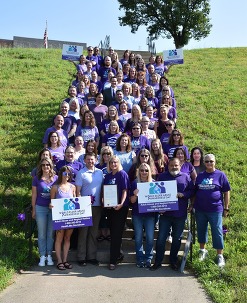
Two weeks ago, our department and partners united in purple to raise awareness of elder abuse by participating in World Elder Abuse Awareness Day. Abuse, neglect and exploitation of vulnerable populations needs to end. Last year, DHSS received and investigated more than 41,000 reports. Anyone who suspects a senior or disabled Missourian is being abused, neglected or exploited should report to our hotline at 1-800-392-0210 or online at health.mo.gov/abuse.
|
|
Tornado Recovery Efforts
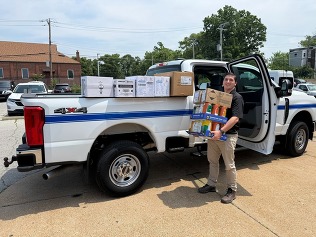
The May 16 tornado in St. Louis left many Missourians needing support from their community. We are proud of our team members and our Office of Emergency Coordination for responding to the urgent call to help St. Louisans recover their resilient home.
|
|
 |
National Terrorism Advisory System Bulletin
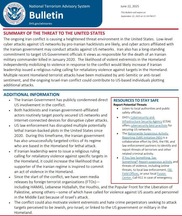
The Department of Homeland Security has issued a National Terrorism Advisory System Bulletin that we want to help share as the department and our regulated entities are at risk. Below is a summary of the threat to the US. You can read the full bulletin by clicking the image to the left.
The ongoing Iran conflict is causing a heightened threat environment in the United States. Low-level cyber attacks against US networks by pro-Iranian hacktivists are likely, and cyber actors affiliated with the Iranian government may conduct attacks against US networks. Iran also has a long-standing commitment to target US Government officials it views as responsible for the death of an Iranian military commander killed in January 2020. The likelihood of violent extremists in the Homeland independently mobilizing to violence in response to the conflict would likely increase if Iranian leadership issued a religious ruling calling for retaliatory violence against targets in the Homeland. Multiple recent Homeland terrorist attacks have been motivated by anti-Semitic or anti-Israel sentiment, and the ongoing Israel-Iran conflict could contribute to US-based individuals plotting additional attacks.
Report Missouri suspicious activity.
|
Thank you for your continued partnership.
|