|
|
DED Stakeholders,
Last month we described an economy that was facing numerous, serious challenges, yet still stood on a steady foundation. That description appears to be more apt after looking at October’s economic data.
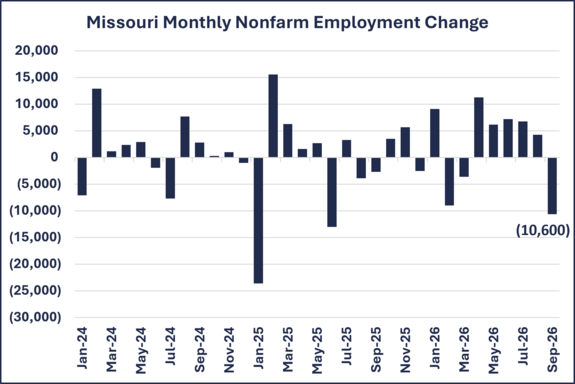
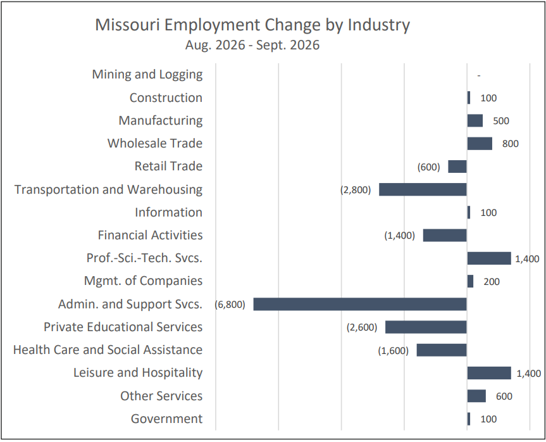
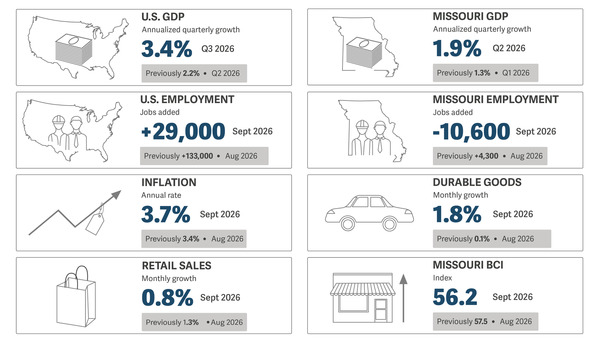
On the challenges side, we will start with employment. Non-farm employment cooled both nationally and in Missouri. Nation-wide businesses expanded their payrolls by just 29,000 jobs in September, down from 133,000 in August. So far in 2026, the U.S. is averaging 68,000 new jobs a month, which is modest figure over the long-term, but an improvement from 2025, when the economy averaged just 10,000 new jobs a month. In Missouri, job growth had been strong relative to the U.S., averaging over 4,000 jobs a month through August, but September’s data showed a 10,600-job decline. Most of Missouri’s job losses were seen in the Administration-Support Services industry.
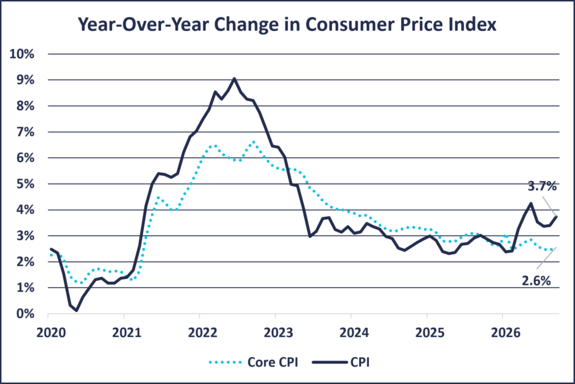
The inflation situation continued in the wrong direction. September’s inflation rate came in at 3.7%, up from 3.4% in August. Higher fuel costs were the driving factor.
Slower employment and higher inflation put the Fed in a tough situation. Their remedies to address both of these issues (raise interest rates to curb inflation and lower interest rates to boost hiring) were in conflict.They opted to hold interest rates steady this month, but most Fed watchers expect to see an increase when they meet in December.
So, where do we see evidence of this “solid foundation”? We see it pretty directly in last week’s U.S. GDP number for the third quarter. The US economy grew at a healthy 3.4% growth rate over the summer. Looking at the details, we see continued growth in non-residential investment, which is undoubtedly spurred by the data center surge. But we also see good growth in consumer spending, indicating that overall, the consumer has taken the forementioned challenges in stride and has continued participate in the economy.
Again, despite challenges, the economy is on solid ground. But just being on solid ground doesn’t mean we want to just stay here. A solid economic foundation with slowing jobs growth, higher prices and declining (inflation-adjusted) wages will likely not be solid for long. For now, we can be thankful for this foundation, but the economy seems to waiting for some sign that numerous challenges will soon subside before it can begin expanding in earnest.
Sincerely,
Jeff Pinkerton
Director of Economic Research
 Sources: Bureau of Economic Analysis, Bureau of Labor Statistics, U.S. Census Bureau, Creighton University
|
|
Inflation
Headline inflation rose to 3.7% in September from 3.4% in August. Prices increased 0.6% over the month, a sizable jump compared to the average monthly increase of approximately 0.2% last year and 0.4% so far this year. Energy was the main driver, with gasoline prices jumping 9.1% and accounting for more than half of the monthly increase in consumer prices. Gasoline prices were up approximately 34% from a year earlier, while fuel-oil prices were up 74%. Core inflation, which excludes food and energy, increased to 2.6% from 2.4% in August. September marked the sixth consecutive month that annual inflation outpaced average hourly wage growth, putting additional pressure on consumer purchasing power. Overall, higher energy prices remain the main driver of rising headline inflation, impacting household budgets while potentially adding to businesses’ transportation and production costs.
Source: Bureau of Labor Statistics
Retail Sales
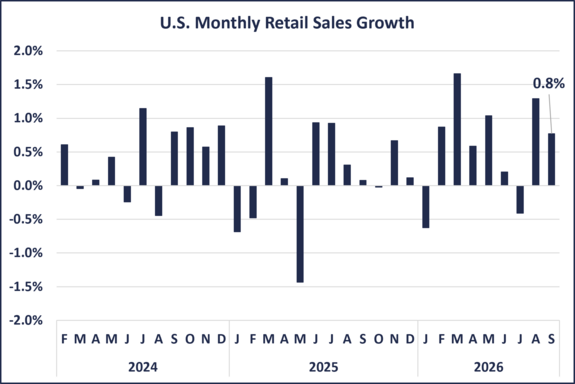
Retail sales rose 0.8% in September following an upwardly revised 1.3% increase in August. However, sales excluding gas stations increased just 0.2%, suggesting higher fuel prices drove much of the headline gain. Sales excluding automobiles, gasoline, building materials and food services edged up 0.1%, slowing from August’s 1.2% increase. While consumers have remained resilient this year, September’s data points to slower spending growth outside gasoline. Holiday spending could bring a rebound in the coming months, especially if gas prices stabilize and leave households with more room for other purchases.
Source: U.S. Census Bureau
Business Conditions Index
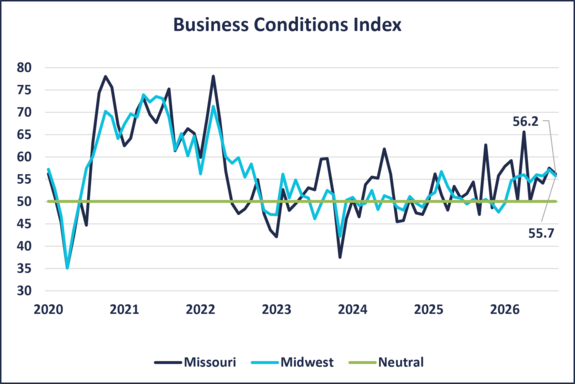
Missouri manufacturing continued its growth streak heading into fall, with the state’s Business Conditions Index coming in at 56.2 in September. Although down 1.3 points from August, the reading marked Missouri’s 10th consecutive month above the growth-neutral threshold of 50. Missouri had the third-highest reading in the nine-state region, trailing only Kansas and Minnesota. The regional index also declined to 55.7 but remained above growth neutral for the 7th consecutive month. Supply managers continued to report cost pressures tied to transportation and tariffs. Overall, the report points to continued manufacturing expansion in Missouri and the region, though rising costs concerns are worth keeping an eye on as we head into the last part of the year.
Source: Creighton University
Employment
After a 5-month stretch of solid employment gains, Missouri lost 10,600 jobs in September. This is a sizable drop but there are few things to keep in mind. First, September’s number was weak nationally (up just 29,000 jobs), so we expected to see slow growth (at best) or a decline.
Secondly, August’s number was revised upward from 2,100 to 4,300, taking some of the sting out of the decline.
Sources: Missouri Economic Research and Information Center (MERIC), Bureau of Labor Statistics
|
|
|
The industry detail shows us the declines were greatest in administrative support services (down 6,800). This sector has been declining in recent years both nationally and in Missouri. Other sectors like professional-scientific-technical services, leisure-hospitality and manufacturing posted employment gains.
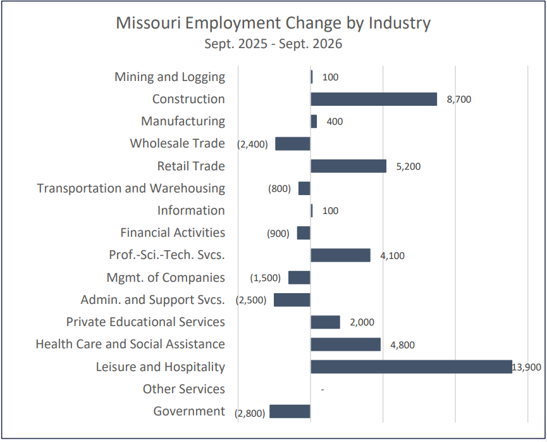
For the year, leisure-hospitality and construction remain Missouri’s leading job creating industries.
Sources: Missouri Economic Research and Information Center (MERIC), Bureau of Labor Statistics
|
|
|
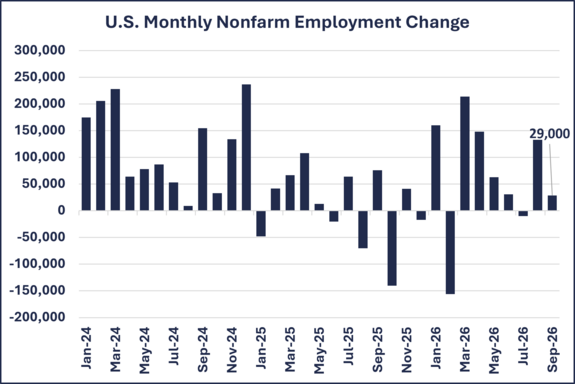
US businesses added just 29,000 jobs in September, down from August’s 133,000 total. This is more in line with the employment trend we have seen so far in 2026: growth, but modest growth.
Through September, the US has averaged 68,000 new jobs a month. Historically we would consider this slower growth, but it is an improvement over 2025 when the economy added just 10,000 jobs a month.
The national employment story is indicative of the economy right now. We continue to see growth, but it is slow. With the many challenges facing the economy right now, this slower pace might be all we can expect for a while.
Source: Bureau of Labor Statistics
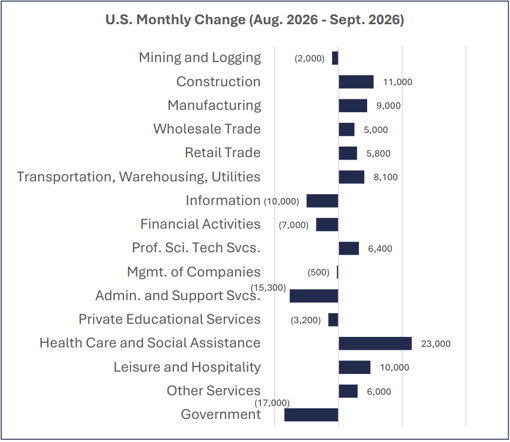
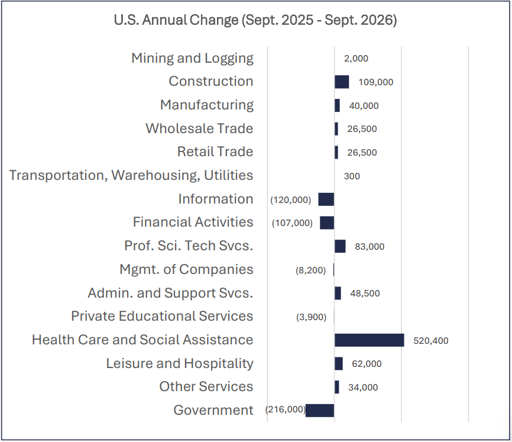
As expected, health care continues to be the leading job creating industry, adding 23,000 new jobs. Construction, leisure-hospitality and manufacturing also posted solid gains which offset losses in government (mostly federal), admin-support services and information. For the past 12-months, health care remains the dominant job creator, adding 520,400 jobs. Government, information and finance are showing sizable declines.
Source: Bureau of Labor Statistics
Interest Rates
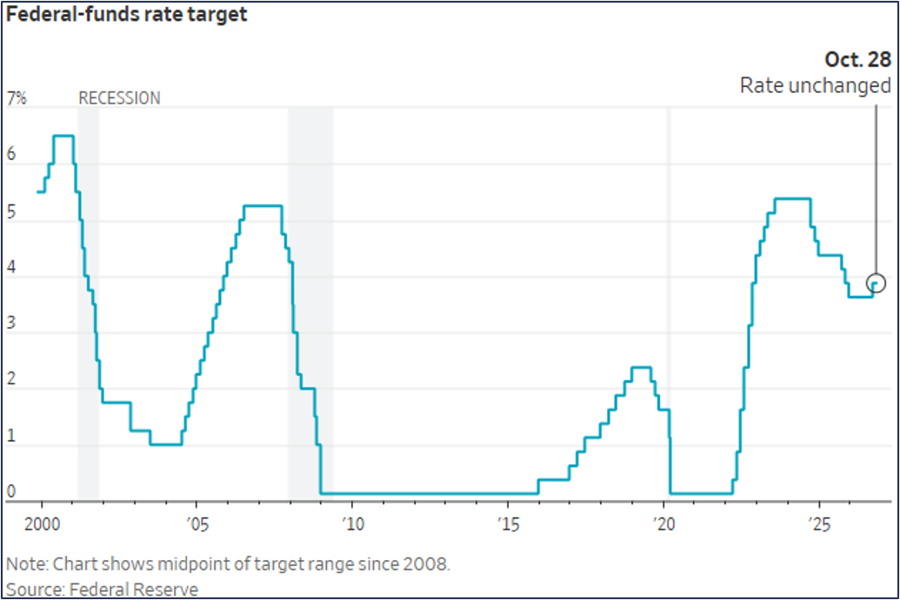 The Federal Reserve left interest rates unchanged at 3.75%–4% at their October meeting, following a quarter-point increase in September. Officials opted to wait for more information before deciding their next move, with inflation still above its 2% target and the labor market showing some signs of softening. Two officials favored another quarter-point increase, resulting in a 10–2 vote. The Fed’s assessment of the economy remained positive, describing growth as strong and pointing to resilient spending, robust business investment, and a relatively stable labor market. The AI investment boom has added to the debate, with some officials concerned that increased spending is contributing to inflationary pressures. However, Fed Chair Kevin Warsh said most officials do not view the economy as running too hot. September’s “dot plot,” which shows where individual officials believe interest rates should be in the coming years, pointed to one more quarter-point increase this year. Attention now turns to the Fed’s last meeting of 2026 on December 8–9.
Source: Federal Reserve
U.S. GDP Growth
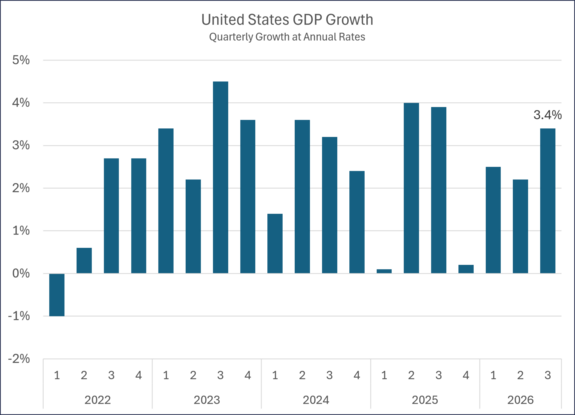 U.S. Economy Grew at the Fastest Rate in a Year in Q3.
U.S. GDP rose by a strong 3.4% rate over the summer. This is up from 2.2% in Q2. This increase shows us again that, despite challenges with inflation and slower employment, the economy remains fundamentally sound. The economy is in an interesting period right now. From a strict data perspective, the current GDP number paints a positive economic picture (3.4% is a good GDP growth rate), but other data points (slower employment and higher prices) are often more directly impactful for most Americans. So, while the overall economy might seem to be performing well, it is understandable why many people may be skeptical.
Source: Bureau of Economic Analysis
|
|
|
|
|