|
|
DED Stakeholders,
While "uncertainty" was the economic buzzword in 2025, 2026 (at least for one month) showed some stability. We’ll start with the national picture.
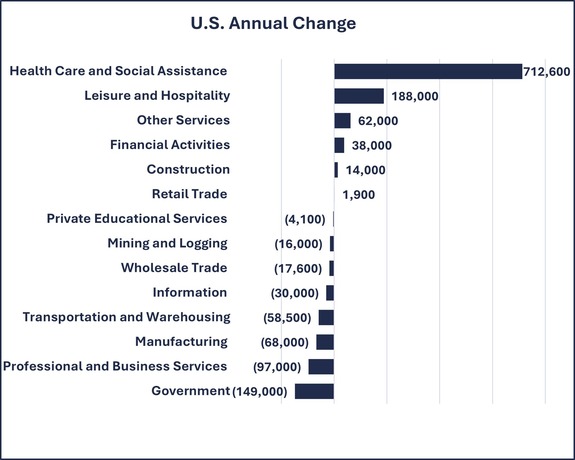
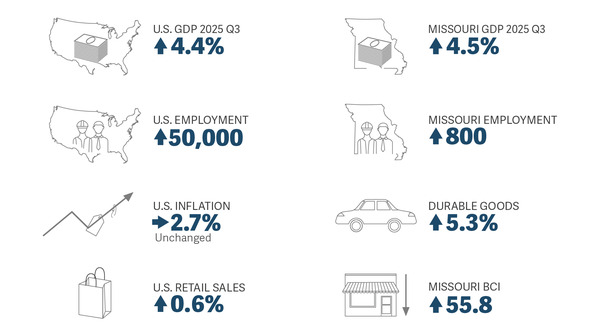
US employment continued its slower pace, adding just 50,000 jobs in December. The year ended with 584,000 new jobs, which was the lowest yearly figure since 2020. Most of that growth occurred by April with only 93,000 net new jobs created during the rest of the year. The growth was also heavily concentrated in the health care industry, which added 712,600 jobs. There were sizable declines in government, professional-business services, and manufacturing.
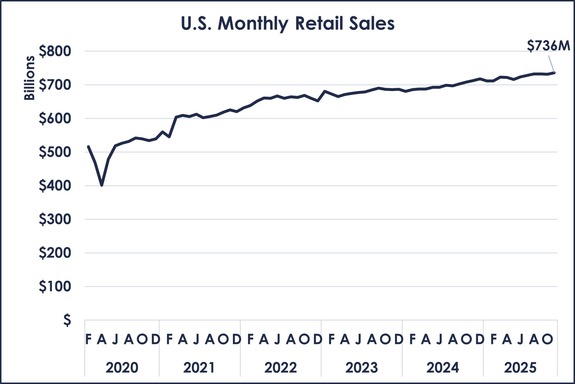
Another major story of 2025 was that, even in the face of uncertainty, the U.S. consumer kept spending. The most current data is from November, but retail sales were up 0.6% on the month.
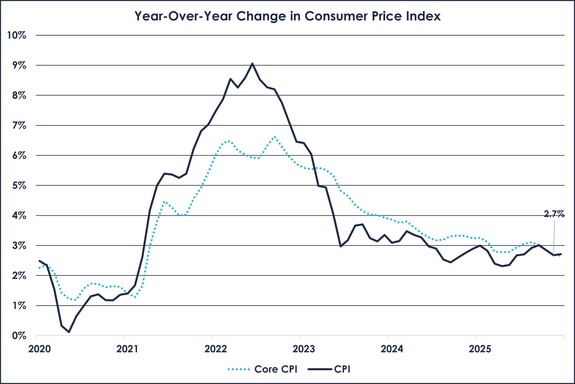
Inflation is another metric that seems to have stabilized (albeit at a slightly higher level than the Fed would like). December’s headline annualized inflation rate remained at 2.7%. Despite higher-than-normal inflation, the Fed decided to hold interest rates steady, citing a more stable economic picture.
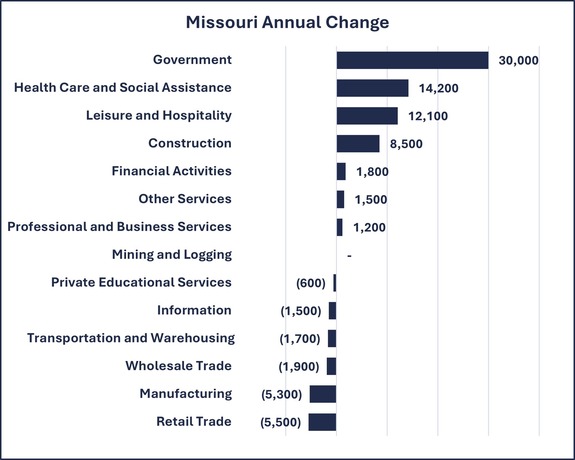
Turning to Missouri, after outpacing the U.S. in job growth for most of 2025, employment growth slowed in the Show-Me State in November and December. As we saw nationally, health care was a major component in Missouri’s job growth in 2025, but the data is showing that government (particularly local government) was the leading jobs creator, adding 30,000 jobs on the year. We will see if this surprising result holds when the data is revised and re-benchmarked in a few months.
We also take a closer look at the recent swings in the Business Conditions Index (BCI) to better understand what drove the month-to-month swings in confidence in 2025.
We’ll close with perhaps the most general of economic indicators: population. The Census Bureau released 2025 state-level population estimates and a very positive trend for Missouri has continued. Missouri’s population grew by nearly 27,000 in 2025. International migration was down from recent levels (as was the case nationally) but growth via net domestic migration (people moving into Missouri minus people moving away) was up by 14,000. In the 2010s, net domestic migration in Missouri was typically negative, but that changed in 2021 and has remained positive since. In March we will be able to take a more detailed look at population change within Missouri when the county-level data is released.
Sincerely,
Jeff Pinkerton
Director of Economic Research
 Sources: Bureau of Economic Analysis, Bureau of Labor Statistics, Census Bureau, Creighton University
|
|
Inflation
Headline CPI held at 2.7% in December, matching November, while core inflation stayed at 2.6%. Consumer prices rose 0.3% over the month and core prices rose 0.2%. The biggest drivers of price increases were still the familiar duo of shelter and food, up 0.4% and 0.7%, with energy also up 0.3%.
Over the past 12 months, the food index is up 3.1% and the energy index is up 2.3%, which is a good reminder that even when the overall inflation rate looks steady, the categories people feel most can still be running hotter. Inflation is still above the Fed’s 2% target, but policymakers opted to hold rates steady in January.
Source: Bureau of Labor Statistics
Retail Sales
After stalling in September and October, the U.S. consumer came back strong in November with a 0.6% increase. Year-over-year sales were up 3.3%. This data is not inflation-adjusted, so some of the increase in sales was due to higher prices. On the month, consumers pulled back a bit on motor vehicles, furniture, and building material purchases, but increased spending on health care, clothing, hobbies, and dining out.
As we have said before, the consumer is the backbone of the U.S. economy (consumer sales account for two-thirds of U.S. GDP). Despite a slowing labor market, consumers are still spending. And as long as they continue to, the economy will have a foundation to grow on.
Source: Census Bureau
Business Conditions Index
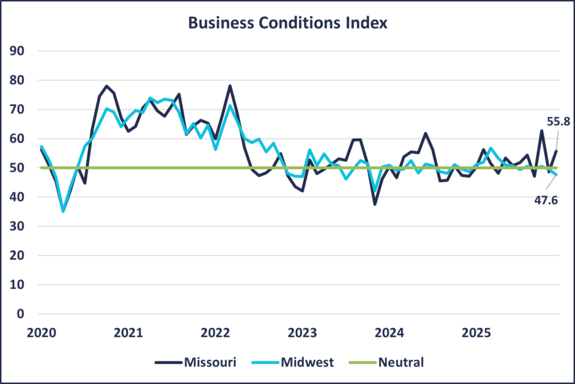
The Mid-America Business Conditions Index kept its back-and-forth pattern to close out the year, with Missouri rebounding from a regional low to the highest regional confidence reading in December (55.8). That is up from 48.6 in November, when Missouri saw its largest monthly drop in the past five years. The biggest driver of the December rebound was a sharp increase in inventories confidence (+22.5), with additional gains in employment (+8.8) and production (+5.6).
Meanwhile, Midwest confidence fell to its lowest level of 2025, dropping to 47.6 from 49.5 in November. Interpreting the last few readings has been tricky. Missouri has posted two regional highs and two readings at or near the regional low in consecutive months (see this month’s ‘Data Deep Dive’ for a closer look).
The broader region has been steadier but has generally trended downward over the past four months. For the year, Missouri averaged above growth neutral (52.6) and above the Midwest average (51.0).
Source: Creighton University
Employment
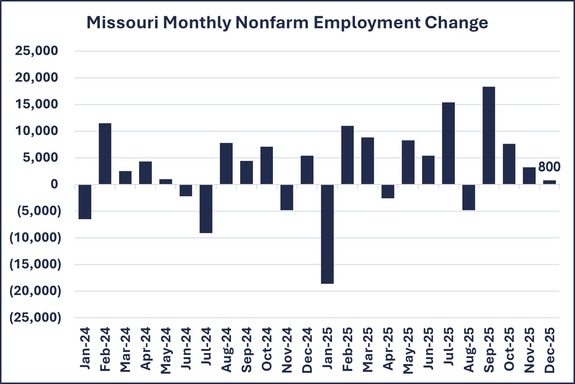
Missouri employment grew by just 800 in December, bringing the total to 3,052,800. For the year ending in December, Missouri employment grew by 52,800 jobs. This is a strong annual number, but, as we saw last year, it is subject to change when the Bureau of Labor Statistics re-benchmarks the data. We should have the re-benchmarked data in March.
Sources: Missouri Economic Research and Information Center, Bureau of Labor Statistics
|
|
|
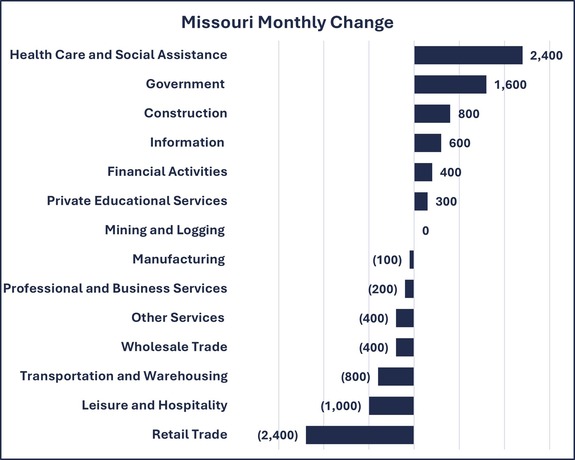
On the month, Missouri saw increases in health care (+2,400) and government (+1,600). Losses were seen in retail (-2,400) and leisure-hospitality (-1,000). A decline in retail during the holiday season seems odd at first but recall that this is seasonally adjusted data. There was an actual increase in retail jobs but less than we typically see in December, thus, the seasonal adjustment shows as a decline. Missouri’s unemployment rate fell to 3.9% (down from 4%).
Sources: Missouri Economic Research and Information Center, Bureau of Labor Statistics
|
|
|
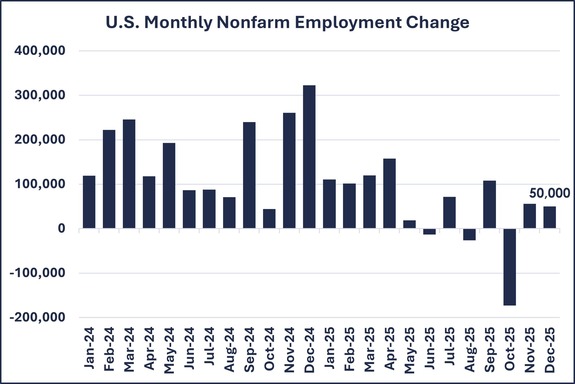
U.S. employment grew by 50,000 in December, continuing a run of slower employment growth nationally. In addition to December’s slower number, October's and November’s numbers were revised downwards by a combined 76,000. On a year-over-year basis, the economy added 584,000 jobs. This is the slowest level of growth since 2020 and well below longer-term trend.
Source: Bureau of Labor Statistics
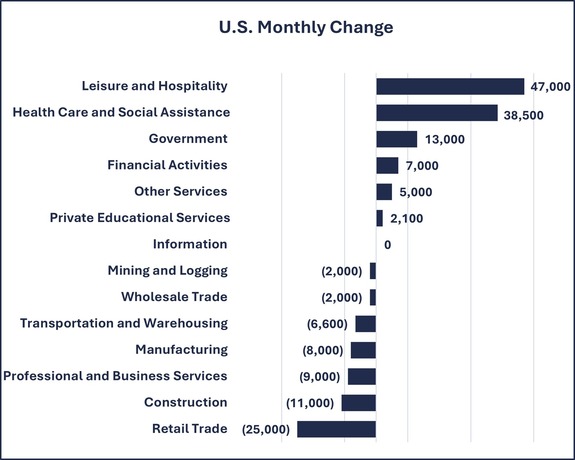
Looking at industry change, we see that health care and leisure-hospitality were the primary job creators for the month. For the year, health care accounted for virtually all the growth, adding over 712,000 jobs. Leisure-hospitality added 188,000. Significant losses were seen in government (-149,000), professional-business services (-97,000), and manufacturing (-68,000). The national unemployment rate fell to 4.4%.
It is worth keeping in mind that this stretch of slow employment growth coincides (seemingly counterintuitively) with a period of strong U.S. GDP growth (around 4% in Q2 and Q3). We will get U.S. GDP data for Q4 at the end of next month. If we get another strong reading (even after factoring in the impact of the shutdown) economists will need to start considering how increases in productivity (GDP per employee) are changing the economy.
Source: Bureau of Labor Statistics
Missouri Business Conditions Index (BCI)
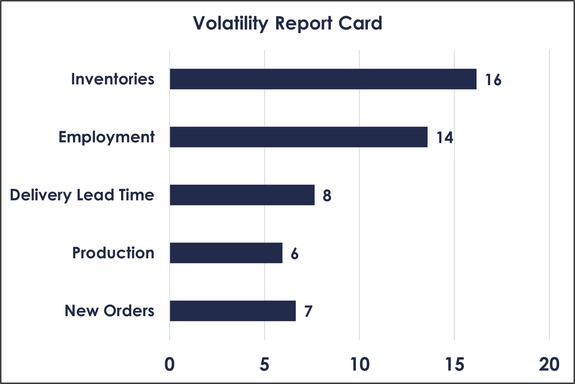
 Missouri’s Business Conditions Index (BCI) has shown unusually sharp month-to-month swings, so we built a quick “volatility report card” that looks at standard deviation across each component to flag which measures are moving around the most. It shows that inventories and employment are where the biggest shifts tend to show up month to month. That helps explain part of the shift, but not all of it.
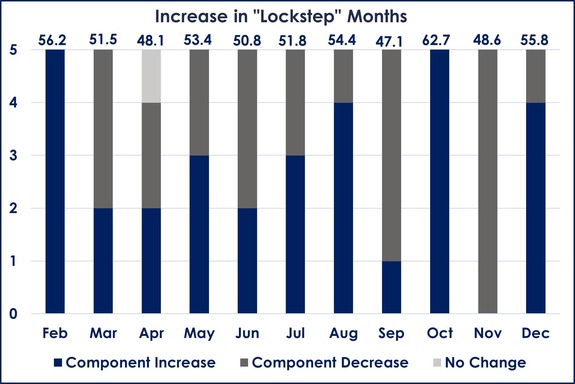
To understand the bigger late-year jumps, we reviewed each BCI component month by month and tagged whether respondents reported an increase, decrease, or no change in conditions for each component.
Earlier in the year, the components often moved in mixed directions, with some rising while others fell, which is generally normal for a survey and tends to mute big moves in the headline index. Starting around August, the pattern shifts toward more “lockstep” months where most components move in the same direction at the same time (all blue or all gray), and those are the months where Missouri’s BCI swings the most.
Since the broader region is comparatively steadier over the same stretch, Missouri’s bigger moves likely reflect sentiment or survey dynamics (like who is responding and how conditions are being interpreted) more than a sudden, across-the-board shift in underlying activity.
Source: Creighton University
Missouri Population Change
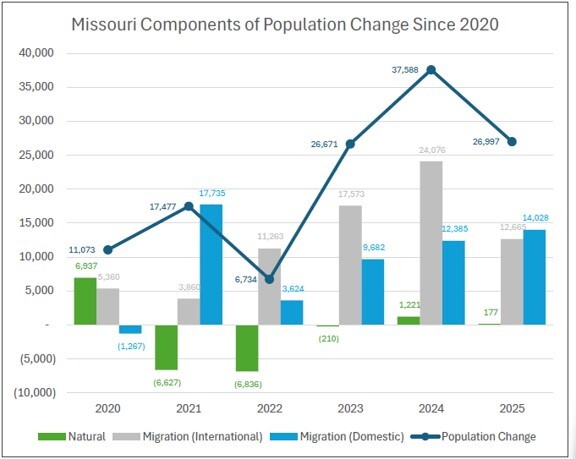 Missouri’s population grew by 26,997 between 2024 and 2025, bringing the total to 6,270,541. This increase ranks 19th nationally. The components of this population growth offer some interesting (and positive) insights. A state’s population can grow naturally (that is, births minus deaths) and/or via positive net migration (more people moving in than moving out). Missouri has seen a shift in how its population has grown over the past few years.
Historically, Missouri’s population grew because of natural growth (more births than deaths), but as the national population ages, more and more states, including Missouri, are seeing little or even negative natural growth. Migration includes international and net domestic migration (people moving into a state from another state minus those moving out to another state). In Missouri, while natural growth has declined, growth via migration (both international and net domestic) has grown. The international migration numbers were down from last year across the country. Missouri followed that trend but still added over 12,000 people via international migration.
The real positive news comes from the growth in net domestic migration. In the 2010s, Missouri’s net domestic migration was steadily negative (more people moved out of Missouri to another state than moved in), but that has changed. Over the past 5 years, Missouri has had positive net domestic migration (in 2025, 14,000 more people moved into Missouri from another state than moved away).
Economists look at net domestic migration as a good indicator of a strong economy. People can move for a variety of reasons, but more economic opportunities is a common one. Seeing this measure being consistently positive over the past 5 years is a good sign.
Source: U.S. Census Bureau
|
|
|
|
|