|
|
DED Stakeholders,
The economy moves forward cautiously as it seeks some clarity.
Resilience has been the buzzword for the economy so far in 2025. If you were limited to just looking at the data and not the news, you might describe the current economy as performing at just about normal. When you factor in the news of the past few months, you might give the recent economic performance a bit more credit.
Let’s look at the key numbers that were released in July. We’ll start with GDP.
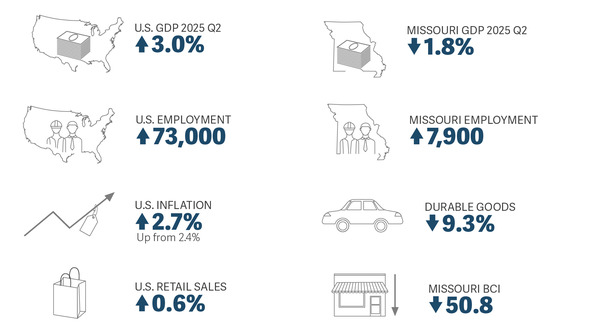
The U.S. economy posted a very strong 3% annualized growth rate in the second quarter. This was a rebound from the first quarter’s 0.5% contraction. This down and up pattern is mostly due to businesses importing more goods than usual in the first quarter to get ahead of tariffs (you can read more about this week’s GDP release below).
Looking past international trade, we see a couple of telling signs in the data. First, the U.S. consumer is still active as personal consumption grew at a 1.4% rate in Q2. However, investment from businesses (which grew at a 0.1% rate) was mostly flat. Business investments are typically large and require some sense of confidence in the direction of the economy and preferably, lower interest rates. These two items are in short supply right now as new international trade deals are being worked out and the Fed continues its wait and see approach.
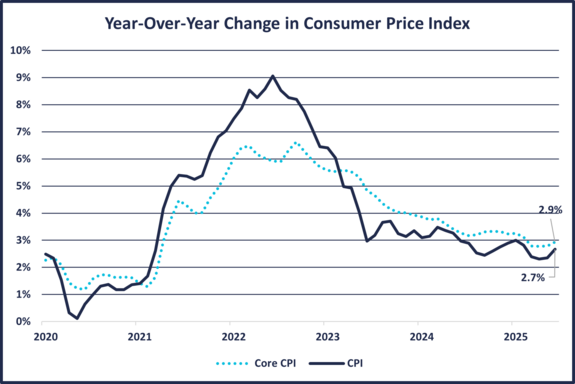
Part of the Fed’s reasoning for not cutting rates is inflation. Lowering rates would boost the economy but it would also add inflationary pressure. The latest inflation figure showed a 2.7% increase in overall prices for the year ending in June. This is up from a 2.4% reading in May. This could be the early signs of tariff-driven inflation many economists had been worried about.
Elsewhere, today’s U.S. employment data release shows that businesses may be starting to pull back on hiring. In July, businesses added just 73,000 new jobs. More importantly, the employment data for May and June was revised significantly downward by a combined 258,000 jobs. Missouri’s employment data had shown good overall growth through June, adding nearly 15,000 new jobs, but this data will likely also be revised when the July data comes out.
All told, the economy seems to be moving ahead at a pace that's as fast as the current level of uncertainty will allow.
Sincerely,
Jeff Pinkerton
Director of Economic Research
 Sources: Bureau of Economic Analysis, Bureau of Labor Statistics, Census Bureau, Creighton University
|
|
Inflation
Inflation rose for the second straight month in June, with the annual rate increasing from 2.4% to 2.7%. Core inflation, which excludes food and energy, edged up to 2.9%. On a monthly basis, headline prices rose 0.3%, the largest gain since January, while core prices increased 0.2%. Shelter costs were the biggest driver of the monthly increase, rising 0.2% in June and 3.8% over the year. Prices for furniture, toys, and clothing also saw larger-than-usual gains. Meanwhile, prices for used and new vehicles fell and hotel and motel rates dropped 3.6%. Airline fares also edged down 0.1%, suggesting a potential softening in consumer demand for travel-related services. Together, the data present a mixed picture. Some price increases may be tied to categories more exposed to trade policy shifts (furniture, toys, etc.), while others hint at consumer pullback in discretionary spending.
Source: Bureau of Labor Statistics
Retail Sales
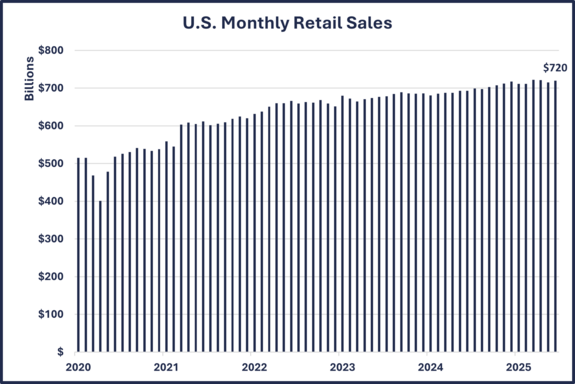
After a decline of 0.9% in May, U.S. retail sales were up 0.6% in June. Automobile sales drove June’s increase (up 1.2% on the month). Building materials and clothing stores also posted strong sales. So did dining out (up 0.6%). Dining out is seen as an indicator of consumers' level of concern as they tend to cut such discretionary spending if they are less confident in their economic future. Keep in mind that this measure is not inflation adjusted, so roughly half of June’s increase in retail is due to the 0.3% increase in prices. Still, the U.S. consumer remains resilient even in the face of uncertainty.
Source: Census Bureau
Business Conditions Index
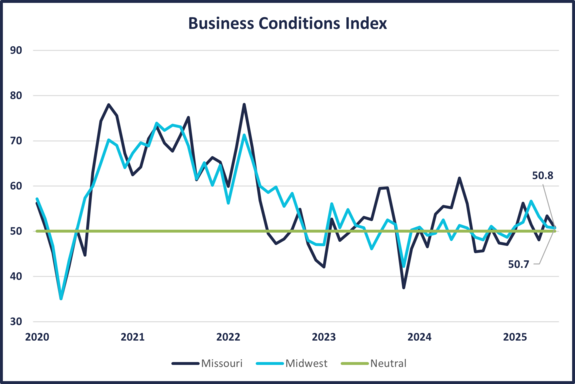
Missouri’s Business Conditions Index (BCI) fell to 50.8 in June, down from 53.4 in May. Most of the drop came from a sharp decline in inventory confidence (-10.5) and a moderate decline in employment confidence (-5.7). The Midwest was mostly unchanged, slipping just 0.3 points to 50.7, marking the sixth month in a row that the region has stayed above the growth-neutral mark of 50.0. On average, supply managers expect input prices to rise by 7.5 percent in 2025, according to Ernie Goss, director of Creighton University’s Economic Forecasting Group.
Missouri and the Midwest are still outperforming the national confidence level, which came in at 49.0. Confidence is cooling a bit and there’s growing caution around trade policies and rising costs, but Missouri businesses are still feeling more optimistic than many of their peers.
Source: Creighton University
Employment
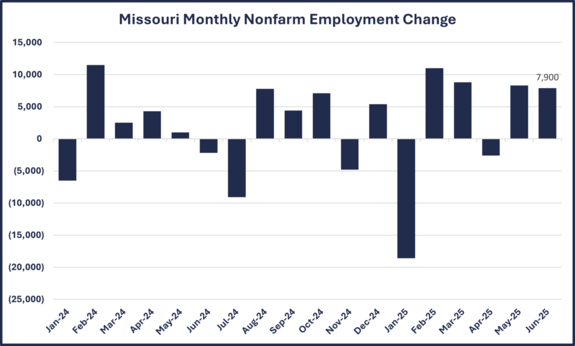
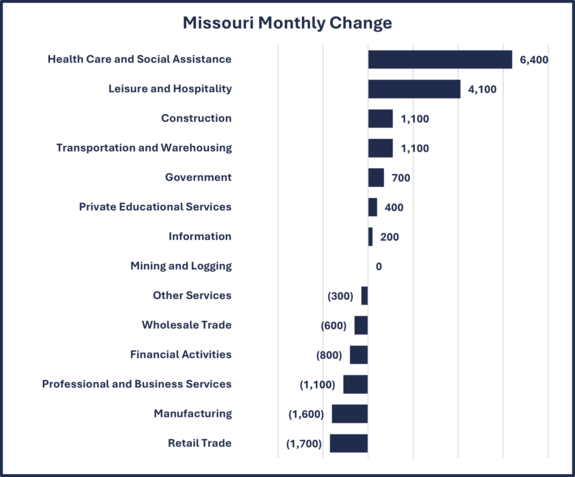
Missouri employment was up 7,900 in June. Additionally, May’s figure was revised upwards by 4,600 (to 8,300). For the 12 months ending in June, Missouri has added 25,600 jobs, which ranks us 18th nationally.
Sources: Missouri Economic Research and Information Center, Bureau of Labor Statistics
|
|
|
Health care continues to be leading job creating industry in Missouri, adding 6,400 jobs in June. Leisure and hospitality also posted a strong number, adding 4,100 jobs. We did see some declines in retail (-1,700) and manufacturing (-1,600).
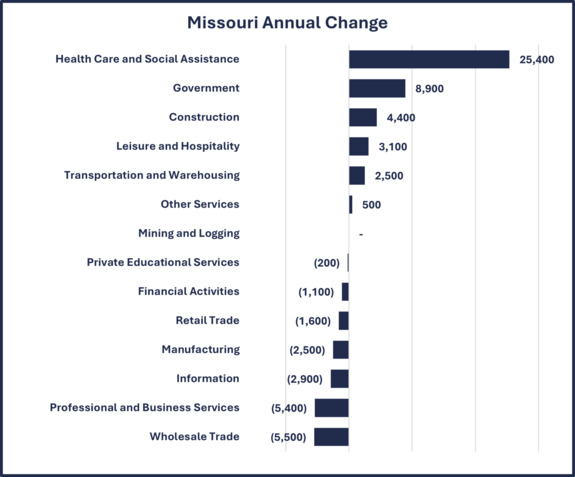
For the year, again health care has been the leading growth industry (up 25,400), well ahead of (second place) government, which was up by 8,900. (All of government’s growth was in state and local. Federal employment is down by 1,900 on the year).
Sources: Missouri Economic Research and Information Center, Bureau of Labor Statistics
|
|
|
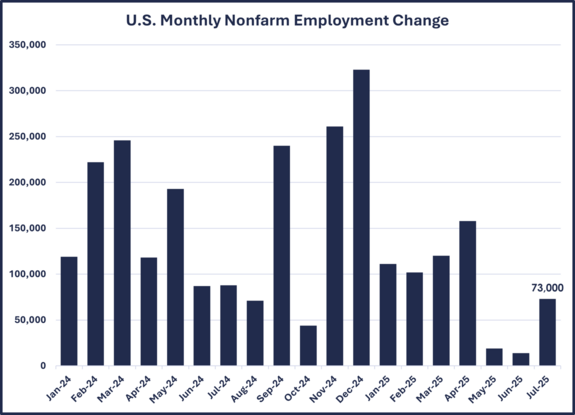
New and revised data shows that U.S. employment growth has slowed considerably in the last 3 months. July’s new number came in at 73,000 new jobs created, but more importantly, May and June’s numbers were heavily revised downward by a combined 258,000 jobs.
This new data suggests that businesses are becoming hesitant to expand their payrolls with multiple economic issues still at play (tariffs, immigration, federal cutbacks).
Source: Bureau of Labor Statistics
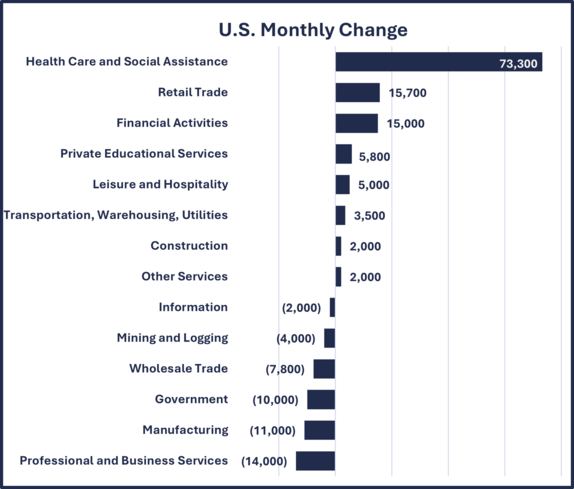
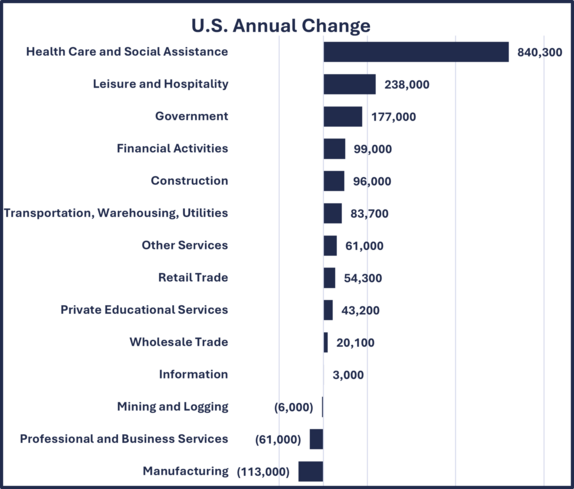
Health care continues to be the main driver in terms of U.S. employment growth. The industry added 73,300 jobs in July. It also leads for annual job growth (by a lot) with 840,300 jobs added. Leisure-hospitality is a distant second, with 238,000 jobs on the year.
Outside of health care, all other industries combined showed no growth (-300) in July. As expected, government employment was down 10,000 due to cutbacks at the federal level. But the U.S. lost more jobs in manufacturing (-11,000) and professional/business services (-14,000).
Source: Bureau of Labor Statistics
|
|
U.S. GDP Growth
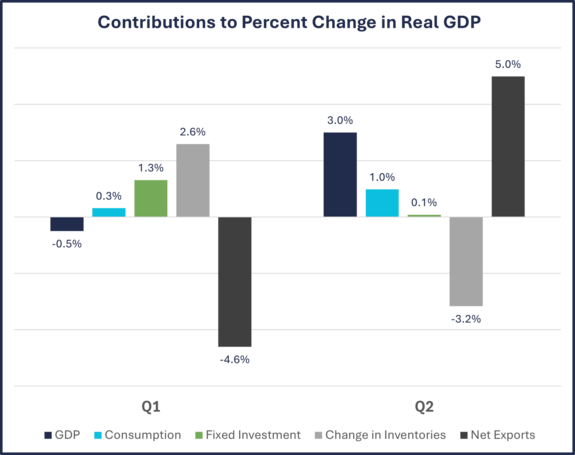
The U.S. economy grew at an annualized rate of 3% in the second quarter. This was a largely expected rebound from Q1, when the economy contracted by 0.5%. The cause for this quarter’s sharp rise is the same cause for the previous quarter’s decline: international trade. In the first quarter, businesses actively stocked up on imports to get ahead of tariffs.
Imports, since they are produced in another country, are counted as a negative in the GDP calculation. With their warehouses full and some tariffs in effect, businesses imported fewer goods in Q2, which resulted in a strong increase in "net exports." Other details within the data are telling. One, consumption grew at a decent 1% rate, telling us that the U.S. consumer is still active. More concerning is that fixed investment fell to just 0.1%.
This likely reflects the uncertain environment right now as businesses are currently hesitant to take on major projects. Overall, this quarter’s number was good, but not a surprise.
Source: Bureau of Economic Analysis
|
|
|
|
|