|
|
DED Stakeholders,
The U.S. economy remains resilient despite growing uncertainty.
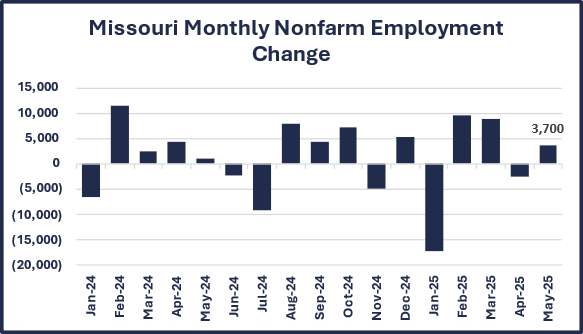
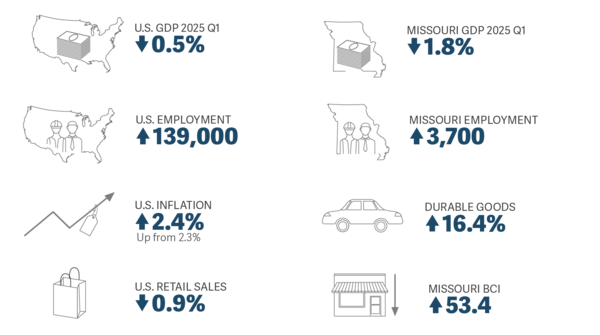
U.S. employers added 139,000 jobs in May, a slight dip from April’s 147,000, but still stronger than expected. In Missouri, employment rebounded with 3,700 jobs, and April’s decline was revised upward from -6,600 to -2,600. Over the past year, Missouri has added 10,900 jobs, and our unemployment rate stands at 4%, below the national rate of 4.2%.
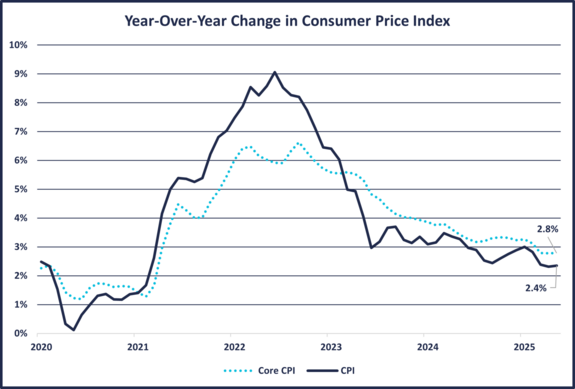
Inflation also remained stable as overall prices were up 2.4%, a slight uptick from April’s 2.3%, but still low relative to recent years
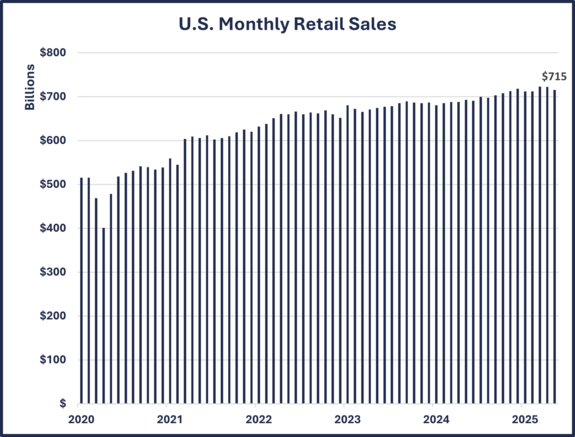
One area that did see a sharper shift was retail sales, which fell 0.9% in May. A 3.9% drop in motor vehicle sales was a key driver, likely due to buyers pulling back after purchasing early in the spring to avoid potential tariffs.
As mentioned before, all of this is happening in an increasingly uncertain economy and the area of the greatest uncertainty right now is inflation. While price growth has moderated over the past year, suspended tariffs announced in April are currently set to be reinstated on July 9. If fully implemented, these tariffs could lead to higher consumer prices.
This situation puts the Fed in a tricky position. If inflation stays near the 2% target, rate cuts could be on the table to support growth. However, those cuts, combined with rising prices from tariffs, risk reigniting inflation. We explore the Fed’s challenge more closely below.
In short, both national and Missouri indicators remain relatively stable, but several factors on the horizon could shift the landscape quickly.
Sincerely,
Jeff Pinkerton
Director of Economic Research
 Sources: Bureau of Economic Analysis, Bureau of Labor Statistics, Census Bureau, Creighton University
|
|
Inflation
Inflation edged up 0.1% in May but remains relatively tame at 2.4% year-over-year. Core inflation (excludes food and energy) held steady at its four year low of 2.8%. Used and new vehicles, airfares, clothing, furniture, and hotel rooms saw price decreases. Gas prices also declined by 2.6%, helping to offset a 0.3% increase in grocery prices. Food inflation over the past year stands at 2.2%, with fruits, cereals, and frozen items seeing the most notable gains.
Overall, the data provides reassurance that recent trade-related policy changes have not yet triggered broader inflationary effects.
Source: Bureau of Labor Statistics
Retail Sales
U.S. consumers pulled back a bit in May. Retail sales were down 0.9% in May. A 3.9% drop in motor vehicle sales was the leading cause of the overall decrease. Motor vehicle sales were elevated in March and April as consumers made purchases in advance of tariffs, so May’s decline was not unexpected, but it was larger than economists expected. Motor vehicles aside, retail sales were down 0.3%.
The consumer’s response to an uncertain economy will play a huge role in how the economy performs in the coming months.
Source: Census Bureau
Business Conditions Index
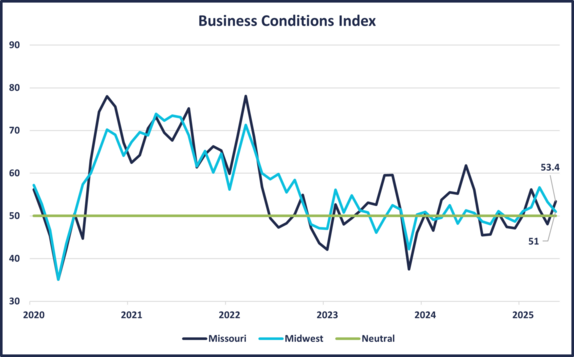
Missouri’s Business Conditions Index rose to a regional high of 53.4 in June. The increase was largely driven by a strong 21.1-point jump in employment confidence, along with an 8.8-point boost in inventory sentiment.
The Midwest confidence slipped to 51.0 and the U.S. index stayed below the growth-neutral threshold at 48.5.
Businesses in Missouri seem confident in their current outlook, but falling confidence in new orders and production could point to some uncertainty around supply chains.
According to Ernie Goss, Director of Creighton University’s Economic Forecasting Group, “Approximately 34.8% of supply [managers] reported switching suppliers due to tariffs, proposed and implemented.”
Even with that uncertainty, Missouri is outpacing much of the region. Half of the other eight Midwestern states reported confidence levels below the growth-neutral mark of 50.0.
Source: Creighton University
Employment
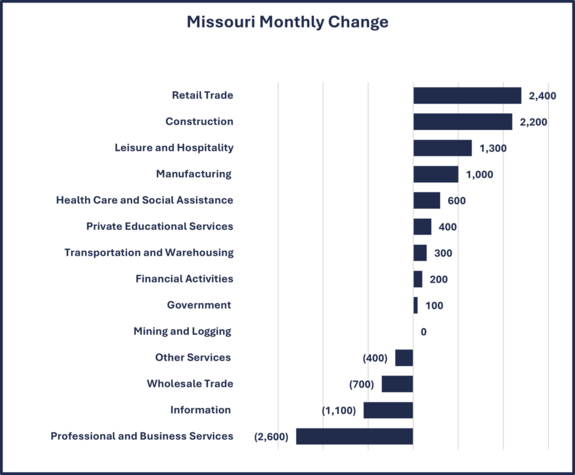
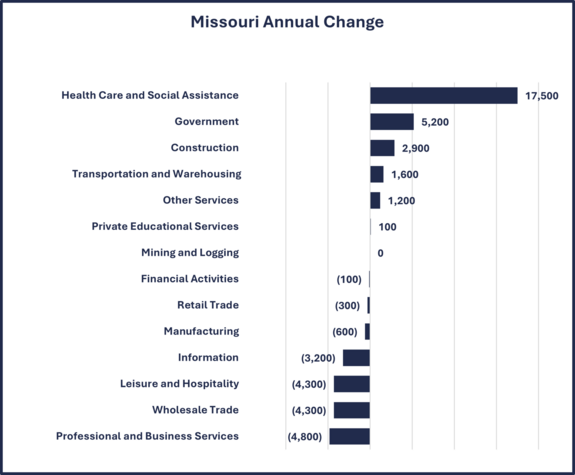
Missouri employment grew by 3,700 in May. This a rebound from the 2,600 loss we saw in April (and that April figure includes a 4,000 upward revision). 2025’s employment numbers have been up and down so far with a net increase of 2,300 jobs. For the year ending May, Missouri is up 10,900 jobs. This further represents a continued cooling in employment relative to recent years in Missouri and at the national level.
Sources: Missouri Economic Research and Information Center, Bureau of Labor Statistics
|
|
|
May’s employment growth was led by the retail trade (+2,400) and construction (+2,200) sectors. The professional and business services sector saw a drop of 2,600 in May, but all of that was in the administrative and support services subsector.
If Missouri is following national trends, this is likely a drop in temporary employment services. Temporary employment services is often a sector that will see declines when businesses are facing economic uncertainty. Missouri’s unemployment rate rose to 4% - still below the national rate of 4.2%.
Sources: Missouri Economic Research and Information Center, Bureau of Labor Statistics
|
|
|
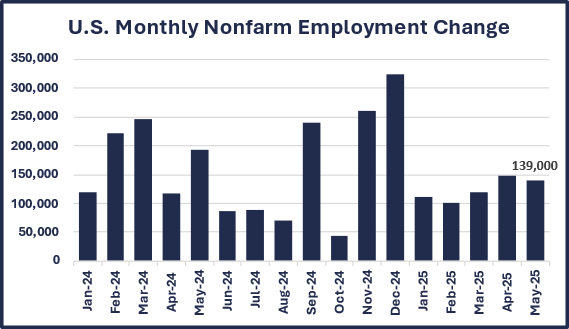
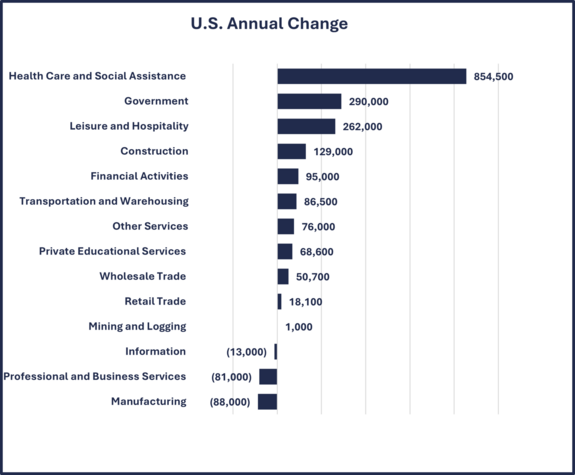
U.S. employers added 139,000 workers to their payrolls in May. While slightly lower than April, it's still a solid number that beat expectations.
Source: Bureau of Labor Statistics
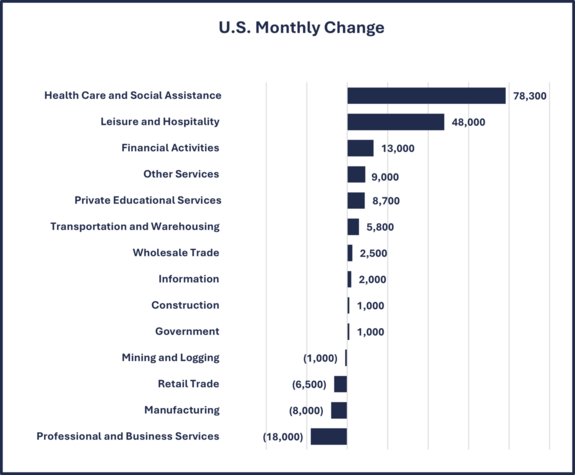
Employment growth continues to be led by the health care industry, which added 78,300 jobs in May and more than 850,000 jobs over the past year. Leisure-hospitality had a good month, adding 48,000 jobs.
Professional-business services was down 18,000 jobs in May, but most of this was due to declines in temporary help services. Also of note is government employment, which was down just 1,000 jobs with sizable gains in local government that roughly match declines at the federal level.
At this point, the large federal cuts are not showing up in the data.
Source: Bureau of Labor Statistics
|
|
Missouri GDP
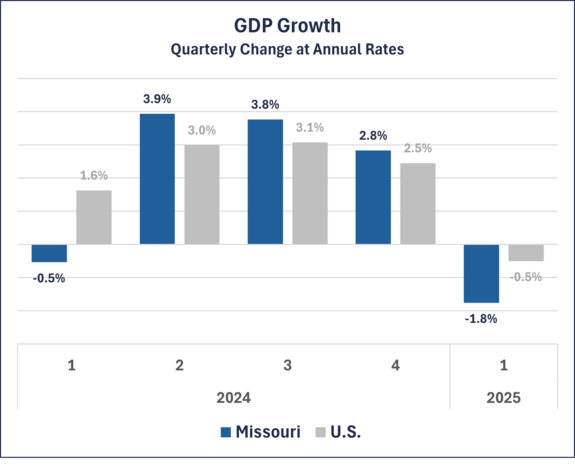
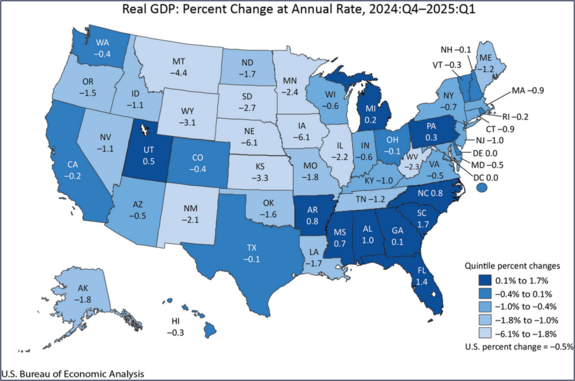 Missouri’s economy shrank by 1.8% in the first quarter of 2025. The U.S. economy also shrank (by a revised 0.5%) in Q1.
Forty other states also saw their economies contract in the quarter. Those that saw growth were mostly concentrated in the Southeast. South Carolina (+1.7%) Florida (+1.4%) and Alabama (+1%) were the top three performing states.
This quarter’s numbers mark the end to a three-quarter run where Missouri had outpaced the U.S. in GDP growth. The decline was not a surprise given the slowing economy and the negative U.S. growth rate for the quarter that was released earlier. This data does reinforce the fact that the economy is entering an uncertain period, and businesses and consumers are seemingly taking a cautious approach.
Source: Bureau of Economic Analysis
Federal Reserve Holds Interest Rates
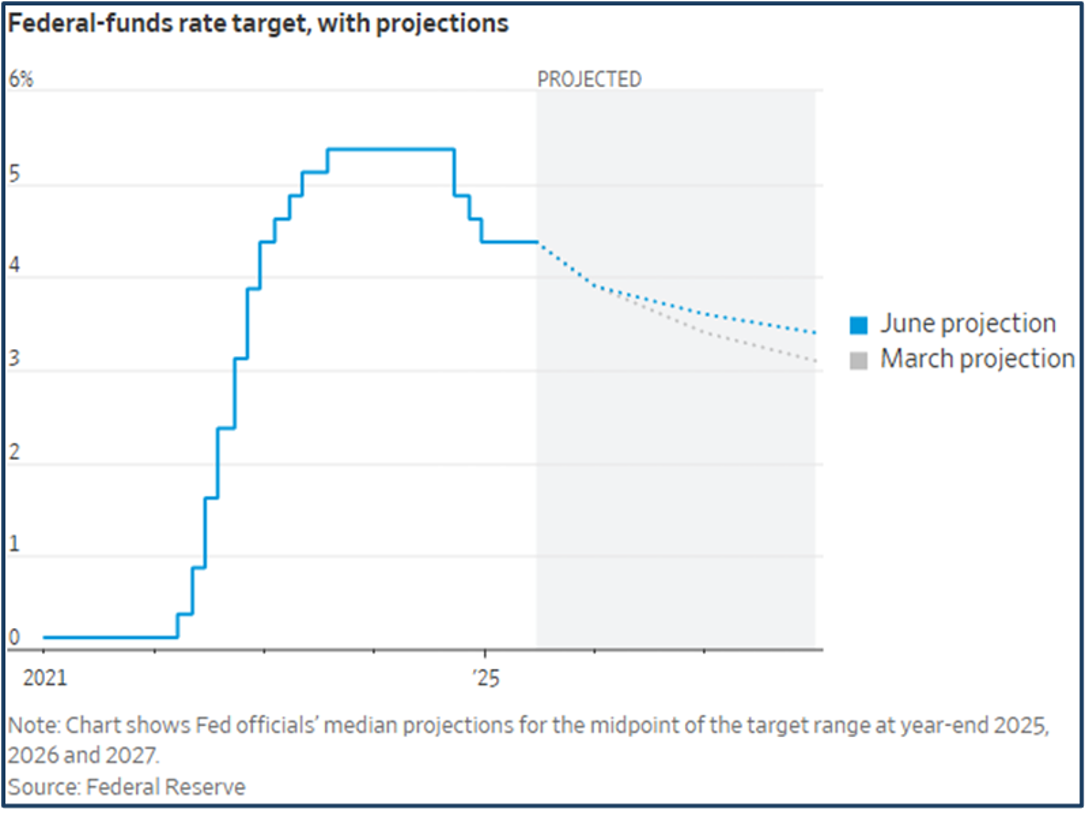 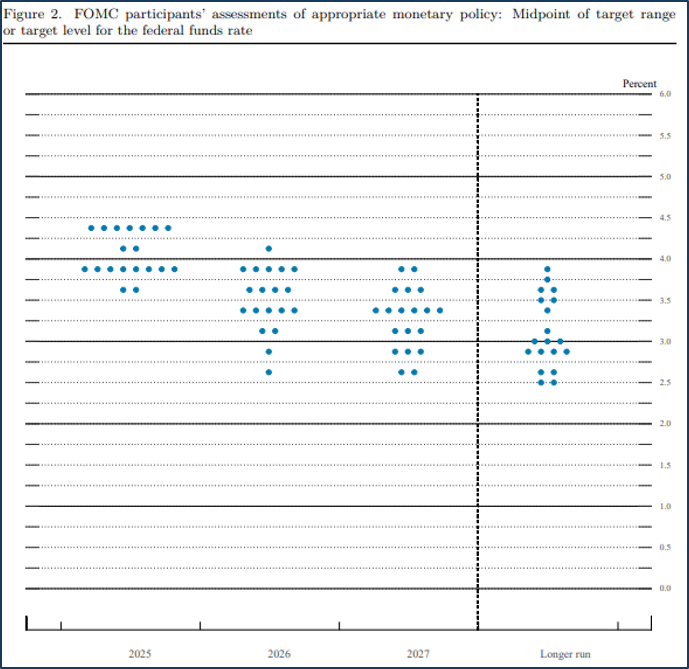 The Federal Reserve held interest rates steady for the fourth consecutive meeting, keeping the federal funds rate (FFR) at 4.25-4.50% as expected. The Fed has four more meeting scheduled this year. As part of its quarterly economic projections, the Fed released its updated “dot plot,” which shows each official’s forecast for the federal funds rate.
The median projection now shows at least two quarter-point cuts by the end of this year, unchanged from the March projections. However, there is growing divergence among the 19 officials. Ten still expect at least two rate cuts this year (down from 11 in March), while two project just one cut, and seven expect no cuts at all (up from four in March).
The Fed also updated its broader economic outlook, now projecting slightly higher inflation and unemployment than it did in March. That shift highlights the tricky balance the Fed is trying to strike: cooling inflation while also keeping employment high.
However, Fed Chair Jerome Powell acknowledged the economy remains solid and the Fed has time to wait and see despite any projections; “We haven’t been through a situation like this and think we have to be humble about our ability to forecast it... There are many, many different scenarios... where inflation does or doesn’t prove out to be at the levels we think, where the labor market does or doesn’t soften."
Overall, the Fed seems content on keeping their options open as the economy continues to remain relatively solid.
Source: Federal Reserve Bank
|
|
|
|
|