|
|
DED Stakeholders,
Last month we discussed the impact of tariffs on the economy and noted four data releases where we might begin seeing this impact (hiring, consumer spending, inflation and interest rates). So, did we see the impact of tariffs reflected in May’s data releases (which reflect April’s data)?
In a word... no.
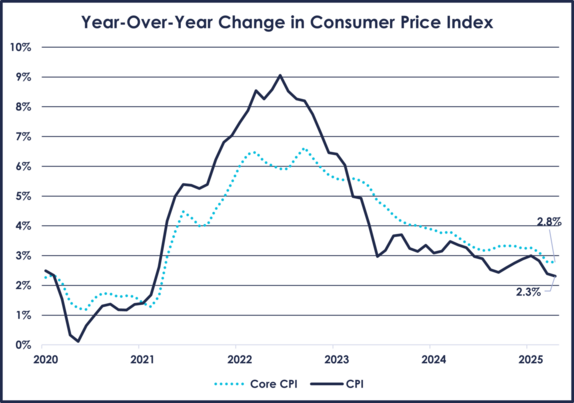
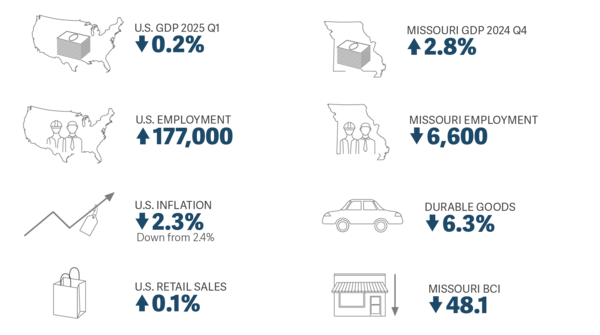
The U.S. economy had a solid showing in April, adding 177,000 jobs. Retail sales remained strong. Inflation continued to moderate, falling to 2.3%, and the Fed left interest rates unchanged. These are all signs of a solid economy, but as the tariffs were enacted in April, it may be too soon to see their impact. May’s number (released in June) will be more telling.
Earlier this week, we saw a twist in the tariff story as the U.S. Court of International Trade (a three-member panel of federal judges) ruled that the administration’s recent tariff increases were illegal. The judges gave the administration 10 days to end them. An appeals court put the ruling on hold to allow more time for an appeal. Even with the ruling, trade experts believe there are other avenues the administration could go down to enact tariffs.
This latest twist adds another layer of uncertainty to an economy that has been performing well.
Things are never certain in the economy, but the elevated level of uncertainty we are seeing now could act as a drag. Increased uncertainty makes it difficult to see where the economy might be headed. If the uncertainty persists, businesses and consumers are more likely to pull back on their activities (like consuming or investing) until they gain more economic clarity.
Sincerely,
Jeff Pinkerton
Director of Economic Research
 Sources: Bureau of Economic Analysis, Bureau of Labor Statistics, Census Bureau, Creighton University
|
|
Inflation
Inflation continued to ease in April after declining in March as well. Headline inflation fell to 2.3% year-over-year, the lowest rate in over four years. On a monthly basis, both headline and core inflation rose 0.2%. Core inflation, which excludes food and energy, held steady at 2.8% year-over-year, also a four-year low.
Overall, the latest inflation and retail sales data suggest a gradually cooling economic environment. Price increases have been more moderate than many expected, especially given recent policy shifts and international trade developments that were anticipated to put upward pressure on goods. So far, those effects have not shown up meaningfully in the data. For now, stable prices and steady consumer activity could give the Federal Reserve more room to remain patient, with markets still expecting potential rate cuts later this year if inflation continues to cool.
Source: Bureau of Labor Statistics
Retail Sales
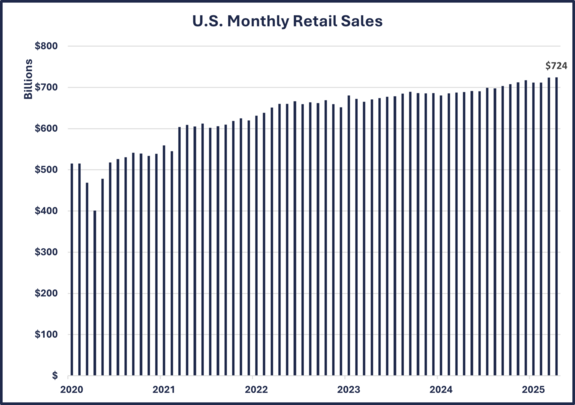
Retail sales in the U.S. rose by 0.1% in April, following a sharply revised 1.7% gain in March. On a year-over-year basis, retail sales increased 5.2%. However, core retail sales, which excludes autos, gas, building materials, and food services, fell 0.2% after rising 0.5% the previous month.
Auto dealership sales edged down 0.1%, while sales at food services and drinking places increased a strong 1.2%, signaling continued discretionary spending.
Although a slowdown was expected after March’s surge, the data shows consumers are still spending, particularly in service-based areas, a positive sign for overall consumer confidence. Still, the dip in core retail categories could suggest a softening in consumer demand. After adjusting for inflation, real retail sales declined 0.1% from March but remained 2.7% higher than a year ago.
Source: Census Bureau
Business Conditions Index
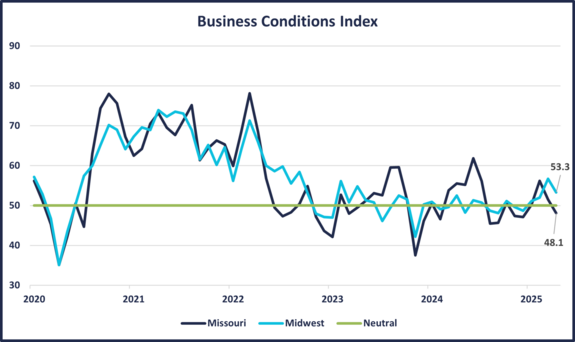
The Missouri Business Conditions Index dipped in April to 48.1. The index is based on a 1 to 100 scale where a value over 50 indicates a belief that the economy will grow in the near future. A value under 50 indicates a slowing economy. The broader Midwest index also fell slightly but remained in growth territory at 53.3. Respondents indicated that the uncertainty regarding tariffs has dampened economic prospects for the near term.
It should be noted, given the large impact tariffs could have on the economy, that businesses seem to be taking the news in stride so far. Even Missouri’s drop to 48.1 is still above the index score we had as recently as December. The modest drop in the index could indicate that businesses are cautious due to uncertainty, but they do not appear to be overly pessimistic about the future.
Source: Creighton University
Employment
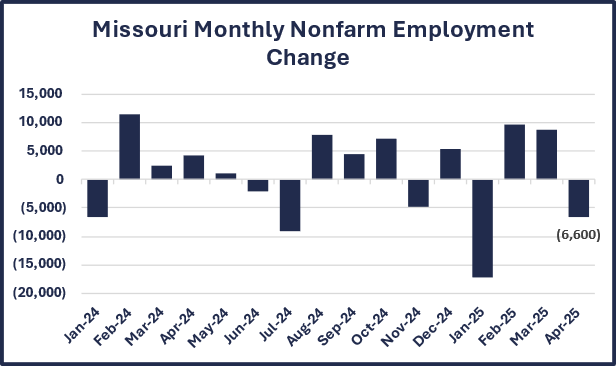
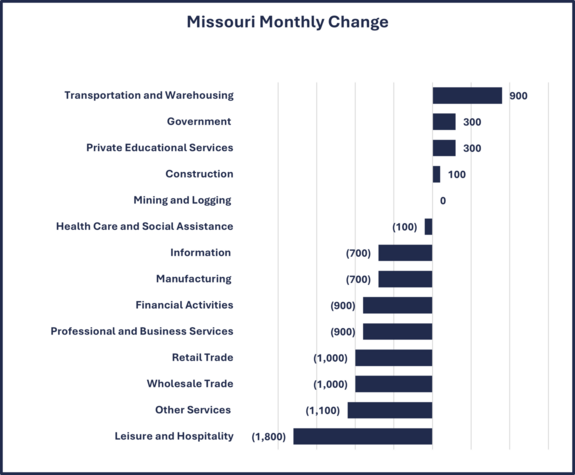
Nonfarm employment fell by 6,600 in April, continuing an up-and-down pattern we have seen over the past several months. Missouri’s unemployment rate ticked up to 3.9%, still below the national rate of 4.2%. The up and down nature of Missouri’s employment data is somewhat surprising given that employment growth has been steady nationally so far this year.
Unemployment claims have been below trend in recent months, so we cannot point to anything specific at this point. Additionally, this data can fluctuate considerably on a monthly basis. The longer-term story is consistent with an economy that is returning to historic norms, and an economy that is facing a higher level of uncertainty.
Sources: Missouri Economic Research and Information Center, Bureau of Labor Statistics
|
|
|
The transportation-warehousing industry added 900 jobs while government, private education and construction saw smaller gains.
The remaining industries saw a drop in employment, but the declines were widespread with no one industry losing more than 1,800 jobs.
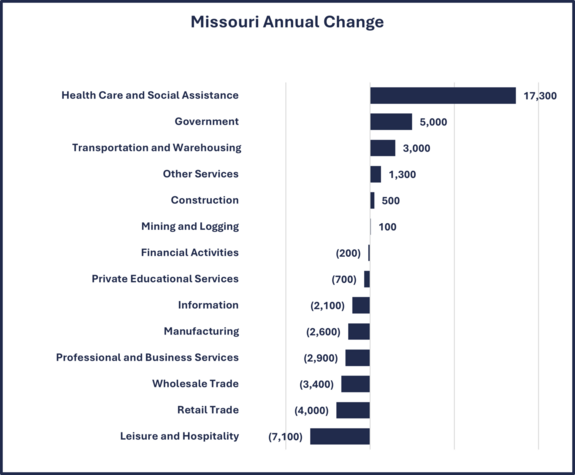
For the year ending in April, health care has been Missouri’s largest job creator, adding over 17,000 jobs, followed by government and transportation/warehousing. The data shows declines of over 3,000 for the year in leisure/hospitality, retail and wholesale trade.
Sources: Missouri Economic Research and Information Center, Bureau of Labor Statistics
|
|
|
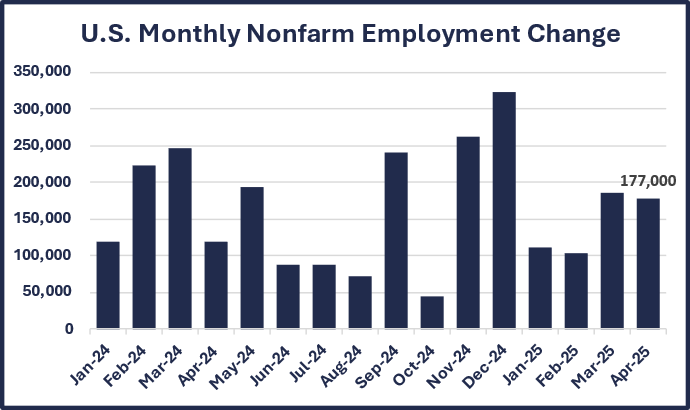
The U.S. economy added 177,000 jobs in April. This is down from March’s 185,000 figure, but well above expectations. Many thought employment growth would slow considerably given recent job cuts at the federal government level and concerns that tariff increases would slow the economy.
Those concerns are still out there, but they have not yet had much impact on overall employment. This is another sign that the U.S. economy remains fundamentally strong.
Source: Bureau of Labor Statistics
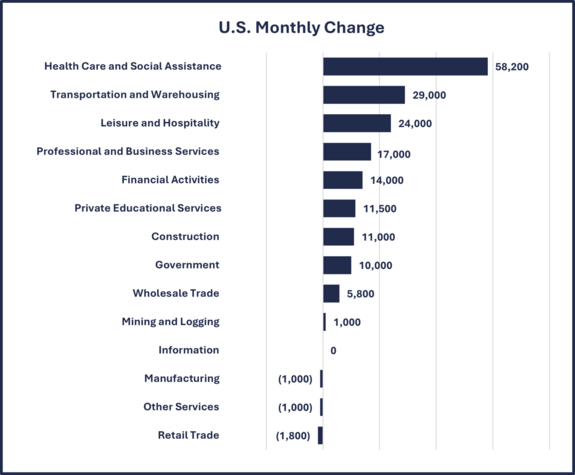
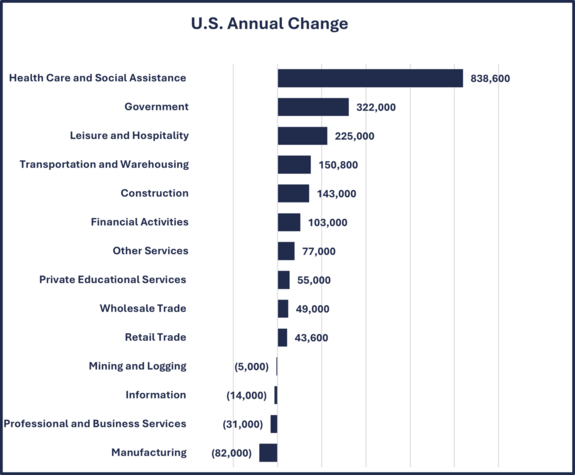
Health care is, by far, the leading growth industry, adding 58,200 jobs in April. Transportation-warehousing and leisure-hospitality also saw significant growth, with each adding over 20,000 jobs. Government employment grew by 10,000, but that is all state and local government, as federal employment fell by 9,000.
For the year, health care was again the leading job creator, adding over 800,000 jobs, followed by government and leisure-hospitality. Manufacturing, professional-business services, information and mining saw year-over-year decline.
Source: Bureau of Labor Statistics
|
|
Consumer Confidence
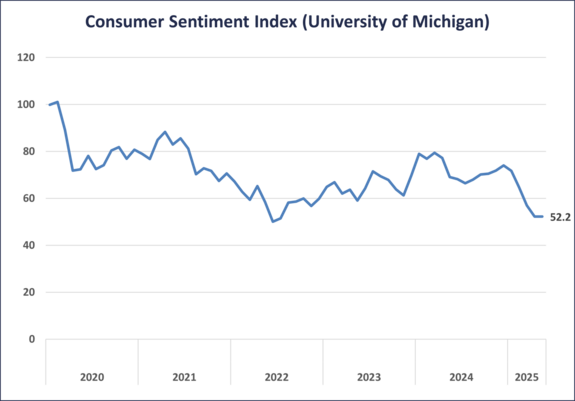
U.S. consumers remain concerned about their economic future according to the University of Michigan’s latest consumer sentiment survey data.
May’s index figure came in at 52.2, which was unchanged from April’s number, but down from the start of the year.
The leveling off in May’s data could reflect that consumers are taking a “wait and see” approach to a rapidly changing international trade story.
Consumer sentiment will be a particularly important metric to monitor in the near term. Consumption accounts for over two-thirds of the U.S. economy. Consumer confidence (or the lack thereof) can either drive the economy forward or slow it down.
Source: University of Michigan, Consumer Sentiment
U.S. New Home Sales Rise in April
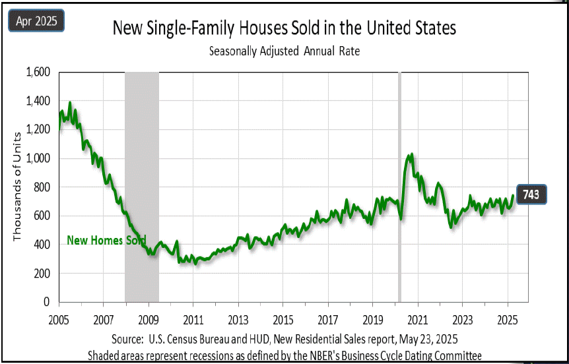 Sales of new U.S. single-family homes rose 10.9% in April to a seasonally adjusted annual rate of 743,000 units, the strongest monthly gain since August 2022 and the fastest pace since February 2022. However, March’s previously reported sales figure was revised downward from 724,000 to 670,000. The median new home price in April was $407,200, slightly above March, but still down 2.0% from one year ago. Inventory remained elevated at 504,000 units, translating to 8.1 months of supply, down from March but up from last year.
Despite the monthly surge, year-to-date numbers show continued softness in the housing market. Through April, national new home sales are down 1.2% compared to the same period last year, with declines in the Northeast, Midwest, and West. Only the South has seen growth, up 5.7% year-to-date. While April’s data suggests signs of potential momentum, broader conditions such as high interest rates, construction costs, and market uncertainty continue to weigh on housing demand.
Source: U.S. Census Bureau and HUD, New Residential Sales report (May 23, 2025)
|
|
|
|
|