|
Missouri's natural areas represent some of the best — and last — examples of our state's original landscape. These are places where you can still see the rare plants, animals, and geological features that pre-settlement native Americans knew well or that explorers such as Lewis and Clark observed and recorded. They include remnant prairies, old-growth forests and woodlands, rare wetlands, caves, and many other kinds of native habitat like glades. Here locally, Wildcat Glade Natural Area was designated in 1984, a 27-acre chert glade.
Chert glades are formed on nearly solid beds of chert rock. Chert, silicon dioxide, is composed of mainly interlocking crystals of quartz. Flint is a type of chert. Chert is relatively insoluble and has weathered out of the more soluble limestone and dolomite rocks. Grand Falls is made up of massive chert beds over six feet thick. The largest percentage of the chert glades in world are found along Shoal Creek and its tributaries in about a two square mile area around Joplin.
These globally unique chert glades are a tough place for life. Soils are shallow to non-existent. The sun bakes down in the summer. In the winter they are exposed and the shallow soils that do exist are prone to frost-heaving. Plants found here such as fame flower, widow’s cross sedum and Nuttall’s sedum have small, greatly thickened leaves covered with a waxy coating called cuticle. The waxy coating seals the fleshy leaves and permits storage of water during the spring for blooming and seed development in the summer. The prickly pear cactus produces disk-like pads of succulent stem material that store water. Another way in which plants survive is by being an annual plant, sprouting from seed in the early spring and growing, maturing and flowering then when the moisture is available. Venus’ looking glass plant is an example of this. Lichens, a symbiosis between algae and fungi, cover many of the chert outcrops. Capitalizing on the extensive lichen growth are the lichen grasshoppers which blend right in with them.
Whether your interest is nature study, birding, hiking, or photography, you'll find Wildcat Glades Natural Area a wonderful place to enjoy your favorite low-impact outdoor recreational activity. This natural area is owned both by the Missouri Department of Conservation and the City of Joplin. For directions from Joplin, head south on Highway 86, crossing Shoal Creek. Immediately after crossing Shoal Creek turn right (north) on to Castle Drive. Follow Castle Drive as it winds around for about 1.25 miles to the parking area on the left (west). The natural area begins on the western side of the parking lot. If you are visiting this natural area you may also be interested in visiting the nearby Shoal Creek Conservation Education Center located at 201 W. Riviera Drive in Joplin (call 417-629-3434). The center includes exhibits on local natural history and has developed hiking trails. It is well worth a visit for naturalists of all ages.
Tips to Remember
- Dress appropriately for the weather and the bugs.
- Make sure to bring enough water, regardless of the season.
- Wildcat Glade Natural Area is open from sunrise to sunset every day of the year.
- Do not collect plants, animals, minerals or artifacts.
- Vehicles, including off-highway vehicles and all-terrain vehicles, are prohibited.
- Please keep pets on leashes.
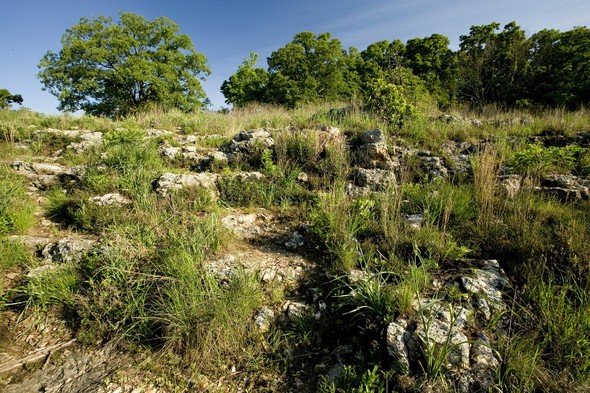 Wildcat Glade Natural Area
|