|
Many children learn about this orange-flowered native plant by playing with the green seedpods, which, when ripe, "explode" upon the slightest touch; this mechanism for seed dispersal is the reason for the name "touch-me-not." These plants occur in dense stands along banks of streams or other damp, moist, undisturbed areas. You may find poison ivy and stinging nettle in this same area as well. There are two species of jewelweed which are often found growing together. The spotted touch-me-nots (orange-flowered) are usually visited by hummingbirds, while the pale touch-me-nots (yellow-flowered) are pollinated by bees.
Jewelweed has a long history of use in North America by Native Americans and herbalists as a natural preventative and treatment for poison ivy, stinging nettle, and chigger bites. The sap has been shown to have anti-fungal properties and can treat athlete’s foot. Compresses and salves from jewelweed are folk remedies for bruises, burns, cuts, eczema, hives, insect bites, sores, sprains, warts, and ringworm. Jewelweed contains a compound called “lawsone” in its leaves that has proven to have anti-histamine and anti-inflammatory properties.
Parts Used and Uses:
• Juice from the inside of the stem can be rubbed on areas exposed to poison ivy or stinging nettle, or rubbed directly on poison ivy rash.
• Crushed leaves in compress form are a traditional and well-known remedy for poison ivy.
• Ice cubes made from tea are also rubbed topically on rashes.
• Leaf tea is a folk remedy in preventing poison ivy.
For more information on our touch-me-nots check out https://nature.mdc.mo.gov/discover-nature/field-guide/spotted-touch-me-not-jewelweed and https://nature.mdc.mo.gov/discover-nature/field-guide/pale-touch-me-not-jewelweed.
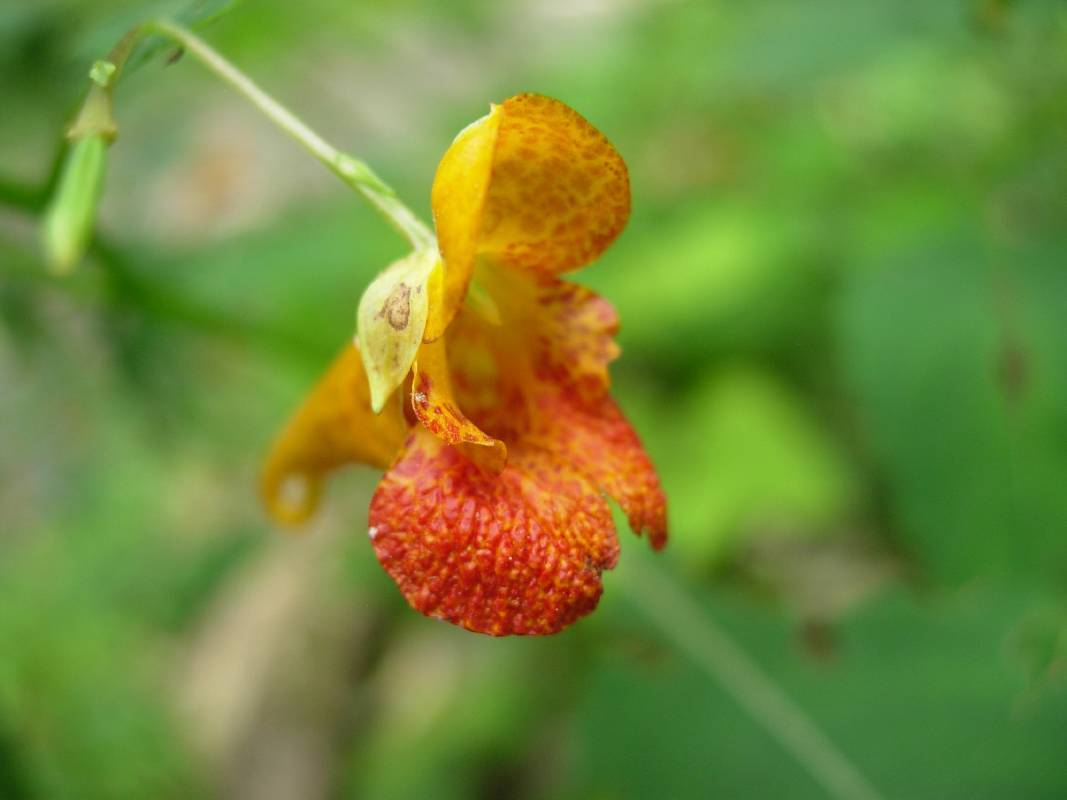 Jewelweed or Spotted Touch-me-not
|