|
Visit research.mdc.mo.gov/ for indepth info on various MDC research projects.
JEFFERSON
CITY, Mo. – Want more information on
the science behind how the Missouri Department of Conservation (MDC) manages
wildlife such as deer, eagles, elk, black bears, and other species? Want to
know more about the scientific research involved in MDC
setting hunting, fishing, and trapping regulations? Want more information on
how MDC determines its forestry practices and the many benefits of trees? Want
to know more about how MDC is working with landowners to help increase public
hunting, fishing, and wildlife watching opportunities on private land?
MDC
has recently launched a new website dedicated to the extensive scientific
research staff do on these and other topics. Visit the new MDC website to learn
more at research.mdc.mo.gov/ or go through
the MDC main website at mdc.mo.gov/ and use the
search box by typing “research.”
“Missouri Department of Conservation staff
from various divisions all around the state conduct a wide variety of
scientific research projects to help us protect and manage the fish, forests,
and wildlife of the state,” explained MDC Resource Science Division Chief Jason
Sumners. “These science-based research efforts also help us provide many opportunities
for all Missourians to use, enjoy, and learn about these resources. Our new
research website provides indepth information on many of these efforts for
those who want to know more.”
BLACK
BEAR RESEARCH
One topic of interest to many people is
black bears in Missouri. Common questions include: Where are they and where do they
move around? How many bears are there in the state and is the population growing?
And will they be allowed to be hunted one day?
MDC has been conducting black bear research
since 2010 to help answer these and other questions about these large and
mostly secretive native animals.
“One new and very exciting feature of
the new MDC research website is our Missouri Black Bear
Project Story Map,” said MDC Furbearer Biologist and Black Bear Researcher
Laura Conlee. “Our hope with this Story Map is to provide interesting and
interactive content related to the black bear project in Missouri where people
can explore maps, photos, and videos about Missouri black bears and the
research we are conducting.”
Explore
the Missouri Black Bear Project Story Map at mdc.mo.gov/BlackBearProjectStoryMap. The site
includes maps of where black bears have been spotted, information on research
efforts and results, and plenty of photos and videos of black bears – including
peeks inside bear dens, and much more.
BE
BEAR AWARE
Conlee also reminds people to never feed
bears and to “Be Bear Aware.”
“Never feed bears and remember that bird
feeders, trash, barbeque grills, and food waste left out at home or camp can
all serve as huge attractions for bears,” she said. “When a bear associates
food with people, it can become a problem and may have to be killed to keep
people safe.”
MDC offers these tips for avoiding
attracting black bears to possible food sources:
- Don't leave pet
food sitting outside. Feed pets a portion they'll eat at each meal and remove
the empty containers.
- Store garbage,
recyclables, and compost inside a secure building or in a bear-proof container
until the day of trash pick-up.
- Keep grills and
smokers clean and store them inside.
- Don't use
birdfeeders in bear country when bears are active from April through November.
- Use electric
fencing to keep bears away from beehives, chicken coops, vegetable gardens,
orchards, and other potential food sources.
- Keep campsites
clean and store all food, toiletries and trash in a secure vehicle or strung
high between two trees. Do not burn or bury garbage or food waste.
While close encounters are uncommon, MDC
offers this advice when outdoors in black-bear country:
- Make noise while
walking or hiking to prevent surprising a bear. Clap, sing, or talk loudly.
- Travel in a group
if possible.
- Pay attention to
the surroundings and watch for bear sign, such as tracks or claw or bite marks
on trees.
- Keep dogs
leashed.
- Leave a bear
alone! Do not approach it. Make sure it has an escape route.
- If encountering a
bear up close, back away slowly with arms raised to look larger. Speak in a
calm, loud voice. Do not turn away from the bear. Back away slowly. Do not run.
For more information on black bears in
Missouri and how to Be Bear Aware, visit the MDC website at mdc.mo.gov/bearaware.
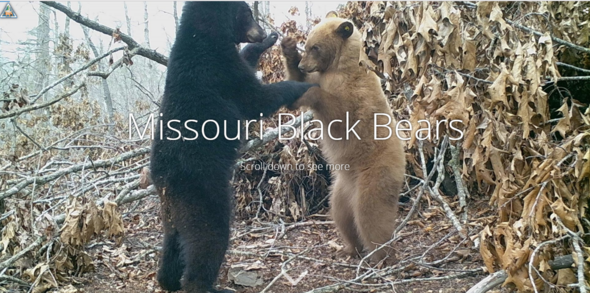 Explore
MDC’s new Black Bear Project Story Map at mdc.mo.gov/BlackBearProjectStoryMap for maps of
where black bears have been spotted, information on MDC research efforts and
results, and plenty of photos and videos of black bears.
|