|
Volunteers needed to help with 2018
North American Breeding Bird Survey May 27 – July 7.
JEFFERSON
CITY, Mo. — Calling all birders in
Missouri! The Missouri Department of Conservation (MDC) needs volunteers to
help with its 2018 North American Breeding Bird Survey (BBS) efforts May 27 – July
7.
Volunteers need access to suitable
transportation, good hearing and eyesight, and must be able to identify all
birds in the area. All new BBS volunteers must successfully complete an online
training program. Knowing bird songs is also extremely important because most
birds counted on these surveys are singing males.
There
are five route areas in Missouri that need volunteers: Kahoka, Lincoln,
Milford, Mincy, and Williamsville. Volunteers need only conduct their survey
route once during the May 27 – July 7 survey period.
For
more information or to volunteer, contact MDC Resource Scientist Janet Haslerig
by email at Janet.Haslerig@mdc.mo.gov or call
573-522-4115, ext. 3198.
"Bird populations are subjected to
numerous, widespread threats including habitat loss, habitat fragmentation,
land-use changes, and other chemical contaminants," said Haslerig.
"If significant declines are detected through BBS data, their causes can
then be identified and appropriate actions taken to reverse them before
populations reach critically low levels."
The BBS is a long-term, large-scale, international
bird monitoring program that started in 1966 to track the status and trends of
North American bird populations. Each year during mostly June -- the height of
the bird-breeding season for most of the U.S. – BBS volunteers collect bird-population
data along roadside survey routes. Each survey route is 24.5 miles long with
stops at half-mile intervals. At each stop, volunteers conduct three-minute
point counts where they record data on the bird species and numbers they see or
hear within a quarter-mile radius. Surveys must start one-half hour before
sunrise and take about five hours to complete.
Haslerig hopes surveyors will commit to
multiple years of collecting data on the same route. "It helps with the
consistency in data collection," she said. "And volunteers also get
familiar with the routes and have better ideas what birds they will encounter.
And it’s fun!”
For
more information on birds of Missouri, visit the MDC online Field Guide
at nature.mdc.mo.gov/discover-nature/field-guide/search.
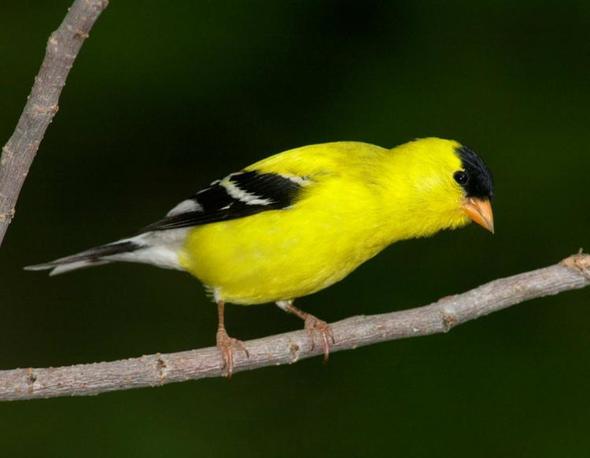 In
breeding plumage, the male American goldfinch is bright yellow with black wings,
tail, and forehead, along with two white wing bars and tail spots. It is one
species volunteers may see and hear during the annual North American Breeding
Bird Survey.
|