|
Tree-killing pest has spread to 42
Missouri counties, suspected in more locations.
COLUMBIA,
Mo. – Forest
health professionals with the Missouri Department of Conservation (MDC) advise
Missourians to watch for damage from an invasive tree pest in winter months. The
Emerald Ash Borer (EAB) is a small, metallic green beetle native to Asia that
attacks and kills ash trees.
EAB attacks
all species of ash trees, and kills nearly every tree it infests. At
approximately a half-inch long, the green adult beetle feeds on leaves and does
very little damage to trees. However, in its larval stage, the insect kills ash
trees by feeding on the water- and nutrient-conducting tissues just under the
bark.
The
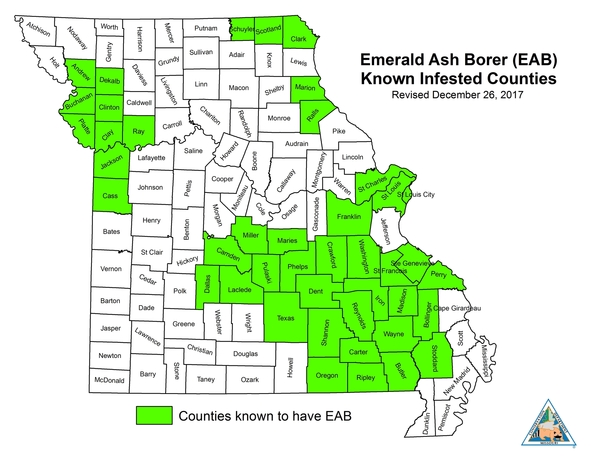
destructive insect has been confirmed in 42 Missouri counties, as well as the
City of St. Louis, and is suspected to be present in several more locations.
MDC
encourages Missourians to watch for signs of this invasive pest during winter
months. While birding, watching
wildlife, hiking, or enjoying other outdoor pursuits this winter, keep an eye
out for bark blonding on ash trees. Bark blonding is caused by woodpeckers
removing a tree’s outer bark while searching for insect larvae. On ash trees, this feeding activity reveals a
white inner bark that is highly noticeable.
Ash trees with bark blonding may not have EAB, but it is certainly worth
reporting these trees for a closer look by trained foresters.
“EAB is
estimated to cost Missourians more than $180-million in tree treatments,
removals, and replacements over the next 20 years,” said MDC Forest
Entomologist Robbie Doerhoff. “If you
have a healthy, high-value ash tree in your yard, it can be treated with
insecticides that will protect it from EAB. However, these treatments can be
expensive and must be applied every year or two to guarantee protection. For
some ash trees, the best option is removal and replanting with a different species
such as an oak native to Missouri.”
MDC encourages
Missourians to help prevent the spread of this destructive pest by learning to
identify signs of EAB and reporting possible infestations in counties where EAB
has not yet been confirmed. For more information on insecticide treatments for
ash trees, consult the Emerald Ash Borer
Management Guide for Missouri Homeowners at short.mdc.mo.gov/ZSq.
For a map of
EAB’s spread across Missouri, detailed information on identification, and a
guide on insecticide treatments, visit eab.missouri.edu.
Report suspected EAB damage in new counties to a local MDC forester, call MDC’s
Forest Pest Hotline at 866-716-9974, or email forest.health@mdc.mo.gov.
MDC works with you and for you to sustain healthy forests,
fish, and wildlife.
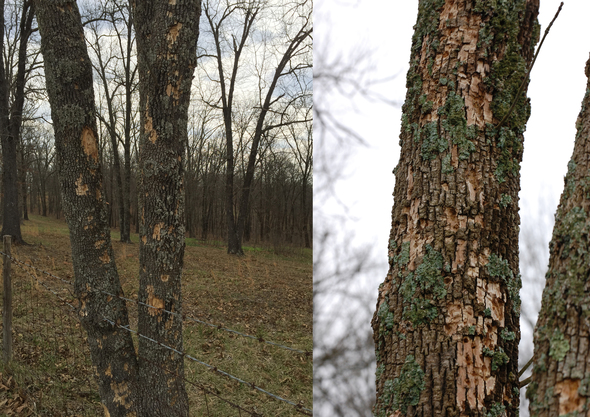
Bark
blonding on ash trees caused by foraging woodpeckers can be an indicator of Emerald
Ash Borers (EAB).
|