|
Southeast
Missouri hosts two thirds of the state’s known invasive population.
 |
|
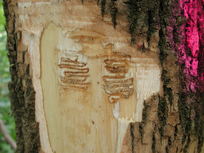
Look for the “galleries” or long, squiggly tunnels EAB leave under the bark of ash trees. (MDC photo by Rob Lawrence) |
CAPE GIRARDEAU, Mo. – Foresters with the Missouri Department
of Conservation (MDC) urge people not to move firewood and ash logs to avoid
the further spread of invasive Emerald Ash Borer (EAB) insects. Native to Asia,
these bugs are destroying ash trees wherever they are, ruining millions of
dollars in forest products and blemishing Missouri’s forests as they leave
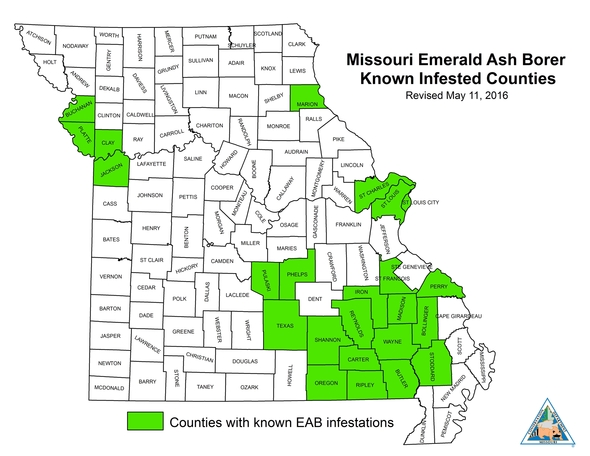
behind skeletons of dead ash trees. An MDC EAB distribution map was updated
this week marking all the known Missouri counties with EAB infestations. Examination of ash trees on public land by a U.S.
Department of Agriculture officer this spring has revealed additional EAB
populations. The updated count of
infestations in Missouri is 23 EAB positive counties with 16 of those in the
southeast portion of the state.
According to Jennifer Behnken, MDC’s urban forester for
Missouri’s southeast region, EAB is especially threatening to Missouri’s ash
population because of a simple reason -- it doesn’t belong here.
“Our native borer insects kill only the severely weakened
trees, the trees that need to be taken out anyway,” Behnken explained. “The EAB
isn’t native to our area and it isn’t so picky. It kills healthy ash trees, so
it’s devastating to our ash tree population.”
Behnken said there are few ways to control EAB in forests beyond trying to
slow its spread. Many infestations start when people move infested ash wood
into new areas. Missourians are encouraged to not move firewood, but rather
obtain it near where it will be burned. A
statewide EAB quarantine put in place by the U.S. and Missouri Departments of
Agriculture in 2013 restricts the movement of ash nursery stock, any part of an
ash tree, or firewood cut from any hardwood species into other states not known
to have EAB.
“If people will stop moving ash trees, firewood or logs, that will help,”
she said. “On their own, EAB can only move up to five miles a year, so that’s
why moving firewood accelerates their movement tremendously.”
Also, Behnken said MDC encourages cities, counties and neighborhoods to
work with a local forester to help manage ash tree populations.
Ash trees are popular in urban areas, like neighborhoods, because they have
a hearty reputation and tolerate a variety of environments. They’re easily
recognized and typically line urban streets to provide shade and improve the
appearance and value of communities. However, they’re also a native tree to
Missouri forests and the effects of EAB are becoming noticeable on the
landscape.
“There are several reasons you might notice a dead tree in the middle of an
otherwise healthy forest, but it’s becoming more often that you notice it’s an
ash tree that’s fallen prey to EAB,” Behnken said.
With EAB, it’s the larvae that do the real damage. Adult beetles simply
nibble on foliage, but the larvae feed on the inner bark of ash trees, which
stops the tree’s ability to move water and nutrients and eventually kills it.
All of Missouri’s native ash trees such as green, white, pumpkin and blue ash
are vulnerable to EAB. Behnken said cultivars aren’t immune and EAB affects the
trees at all stages, from saplings to fully mature.
“We ask that people watch for and report suspected EAB infestations in
counties that aren’t yet known to have them,” Behnken said. “We’re working to
understand how EAB spreads and we certainly appreciate help from people who
notice damage to their ash trees.”
Symptoms of an EAB infestation include leaf die-off from the top of the
tree, moving downward, excessive new branch growth (epicormic sprouting), bark
splitting and woodpecker damage. To check an ash tree for EAB, look for a
thin-bodied, emerald colored beetle that is less than a half inch long. Look
for the “galleries” or long, squiggly tunnels EAB leave under the bark of ash
trees and look for D-shaped exit holes about 1/8 inch in diameter left from
adult EAB beetles emerging from an infested tree.
If you
suspect you have seen EAB damage, check the map of counties with known
infestations at www.eab.missouri.edu. Reports
of EAB damage in new counties should be made to the EAB toll-free report line,
1-866-716-9974, or online at that website. More information about EAB, including
EAB management guides and photos of symptoms, can be found at www.eab.missouri.edu.
|