In this issue:
-
Monitoring Begins: Forms, Tips and
Suggestions
-
Compliance Updates
-
One Year Later: Lessons Learned For
Permittees
- Goodbye from the Stormwater Manager
Improved website offers
expanded information access
In response to requests for more
compliance information available electronically, increased accessibility and data transparency, the MPCA is expanding its online information
services. This tool provides permittees, trade associations, consultants,
and others easier access to the industrial stormwater program’s
required permit documents and monitoring report forms.
-
View a list of applicants who applied for permit
coverage or certified for the No Exposure Exclusion (sortable by county,
sector, city, facility name and other search options)
-
View and confirm industrial stormwater application
information, and if necessary, download the forms to modify/change
application data, or terminate permit coverage altogether
-
View facility-specific monitoring calendars, allowing
the permittee to understand exactly when stormwater samples must be
collected and submitted
-
Download a copy of the permit coverage card and/or
cover letter
-
View monitoring data results, once submitted
Here are a couple of tips and
suggestions when using this new online tool:
-
Select “active” as a status type to see a list of all
active facilities
-
Not sure of the facility name? Enter just a few letters
of the facility name to populate a list
-
Leave all fields blank to get a list of all
facilities
MONITORING REPORT FORMS AVAILABLE
ONLINE ONLY!
Permittees who
want a paper copy of the monitoring report forms mailed out to them or have questions about this new tool can call
(651) 757-2119 or (800) 657-3804
(non-metro only) or email: iswprogram.pca@state.mn.us.
Monitoring Tips and
Suggestions
The Industrial Stormwater
Multi-Sector General Permit was issued a year ago, and for many facilities, benchmark monitoring begins this year. If you have not already started
monitoring at your facility, now is the time to prepare. The better prepared
you are, the more successful your chances of collecting samples
correctly.
Before collecting samples:
-
Contact your preferred lab to make sure they can accept
and process your samples
-
Consider conducting a mock collection opportunity
(without actually collecting a sample). This simple step can greatly
improve your actual sample collection process.
When collecting samples:
-
Safety is the highest priority. Do not endanger
yourself to collect stormwater samples.
-
Take notes of site conditions, such as weather, soil,
discoloration in the stormwater discharges, etc., right before or during
sample collection.
-
Make sure samples are collected when stormwater is
flowing; stagnant water will not give a representative sample.
-
Keep the sample jar lid in a place where it won’t be
accidentally contaminated. Do not place it on the ground or in your pocket
as it could contaminate your sample.
No Exposure Flyovers
Recently, MPCA staff conducted
industrial stormwater compliance inspections from an unusual perspective: an
airplane. Offering multi-site visits in a short period of time, the recent
fly-over inspections targeted No Exposure certifiers. The results? Many of the
facilities observed DO have exposure and DO NOT meet the No Exposure
certification requirements. Facing potential enforcement action, these
facilities will have to either make facility modifications to meet and maintain
the No Exposure exclusion status, or apply for permit coverage. More fly-over
inspections are being planned. If your facility has certified for No Exposure,
review the No Exposure: Qualifying For, and Maintaining, the Exclusion fact
sheet to ensure you’re meeting all requirements.
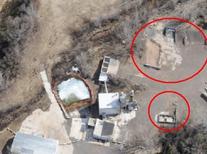 |
|
This
facility claimed to be eligible for the No Exposure certification which excludes
the facility from the requirements of the industrial stormwater Multi-Sector
General Permit. The activities and materials being conducted outdoors in the
photo above that are circled in red are examples of exposure that require
permit coverage. |
Terminating “old”
permits
Nearly 90 percent of facilities that
previously had industrial stormwater permit coverage before April 2010 have
applied for the “new” Multi-Sector General Permit or terminated coverage
because they no longer have met the applicability requirements.
To help the remaining 10 percent
stay in compliance, the Agency sent them reminder letters in January 2011, to
apply for or terminate permit coverage. In May 2011, the agency terminated
permit coverage for those that still hadn’t re-applied.
The Agency made one more effort and
sent an e-mail to the remaining facilities notifying them that they may be out
of compliance. The effort was effective: many facilities, including those which
had not applied for coverage and were required to, or failed to terminate
coverage after activities ceased, re-established contact with the industrial
stormwater program.
Since the Industrial Stormwater
Multi-Sector General Permit was issued in April 2010, the Industrial Stormwater
Program would like to offer a few compliance tips for permittees based on the
lessons staff have learned during the past year:
Annual report:
-
Monthly inspections: monthly inspections are required
for all facilities, and the results must be summarized within the annual
report. Be sure to conduct them monthly and use
the MPCA’s Site Inspection Form. Read parts III.F of
the Multi-Sector General Permit for more
information.
-
Most facilities have sector-specific inspection requirements
and permittees need to review Part VII of the permit to comply with these
requirements. Visit Step 7: Sector-specific requirements,
guidance of the Steps to Compliance for more information.
-
Newly listed impaired waters: Every facility must
conduct an annual review to determine if they are discharging to a newly listed
impaired water. Type in
your facility address on the “Maps of Impaired Waters” page to locate
nearby impaired waters.
-
Monitoring: the annual report does not require any
monitoring information to be provided; those details are provided either
on the Stormwater Monitoring Report Form for Benchmark Monitoring, or
Discharge Monitoring Report Form for Effluent Monitoring.
Monitoring:
-
About two percent of all permittees have effluent
monitoring requirements. Are you one of them? If so, effluent monitoring
is a once-per-year requirement for every calendar year of the permit’s
term. In 2010, a number of facilities did not send in Discharge
Monitoring Report forms, or sampled the wrong parameters. Visit Step 7: Sector-specific requirements,
guidance of the Steps to Compliance for more information, or, to determine whether your facility is
required to conduct effluent monitoring.
Sector-specific requirements:
- Facility
owner/operators may be unaware that their industrial sector has permit
requirements pertaining to that sector. Visit Step 7: Sector-specific requirements,
guidance of the Steps to compliance section of the Web
site for more information.
As the MPCA Stormwater program manager for the past 4 ½ years,
and a water veteran of 35 years, I was asked to share a few parting thoughts
before my June 30 retirement.
Stormwater management and regulation in Minnesota have changed
considerably since my first small involvements with stormwater in 1998. Before
federal and state regulation of stormwater, cities, watershed districts, and
others had already been making changes to factor water quality protection into stormwater
management.
Much more progress has been made since, Yet many
challenges lie ahead.Minnesota’s abundant water resources are under increased pressure.
The last century saw profound improvements in the quality of many water bodies
as the result of modern wastewater treatment. But as the focus has shifted to
more widespread pollution sources that affect far more of our waters, we’ve
seen mixed results—water quality improvements in some cases, further degradation
in others. Ultimately that puts big parts of Minnesota’s economy and quality of
life at risk.
In the face of these challenges, how will we respond? Let’s
begin with continued reliance on all parties--the private sector, local
governments and others--to keep innovating, partnering, self-policing and
tightening up stormwater management practices. Let’s continue to improve our
regulatory, compliance, technical and administrative systems in a world where
cumbersome tools and practices have an ever-diminishing place. Above all we
should focus on preventing and eliminating pollution at the source, vs.
over-reliance on transporting it to treatment. This translates into a long list
of practices such as green stormwater infrastructure, sustainable development,
retaining precipitation where it lands, volume control, securing future
maintenance and eliminating discharges altogether through no-exposure and the
like, along with continuous improvement, research and knowledge sharing.
Beyond that, we’ll have to improve our ability to manage
pollutant sources that number in the thousands or more and to effectively reach
larger numbers of people who control those sources.
Finally, we must focus our efforts where they make the biggest
difference. One key way to accomplish these aims will be watershed-based
management—focusing our efforts on those sources and priority areas within an
individual watershed that matter most to the water quality of that watershed.
The good news is that we have key assets to build on. Not least
of these are the many leaders and innovators in local government, the private
sector and a world-class stormwater research and training capacity at the
University of Minnesota that didn’t exist 10 years ago. Moreover, much of the
public highly values Minnesota’s waters. We in the stormwater management
community need never apologize about our work to protect those waters.
We’ve done a great deal already to pull together our many areas
of strength, work collaboratively and build ever better systems, practices,
tools, regulation, enforcement and voluntary measures. That continues to be the
path forward. It’s how we will maximize our stormwater management contribution
to preserving and cleaning up our waters.
Thanks for the opportunity to work with you, best wishes, and
much success. ~Don Jakes
| 



