|
July 2026
 |
|
Municipal stormwater success story: Woodbury |
Minnesota Pollution Control Agency (MPCA) staff recently conducted an audit of the City of Woodbury's Municipal Separate Storm Sewer System (MS4) program. The city demonstrated full compliance with the six Minimum Control Measures and TMDL requirements outlined in the MS4 Permit.
The city utilizes a database system to document construction site and stormwater pond, BMP, outfall, and maintenance inspections. Woodbury met and documented all training requirements. Education and outreach efforts are robust and well-documented.
Woodbury has achieved success with their MS4 program through consistent, organized, and documented efforts to engage with citizens and manage their stormwater system. Thank you to the city for keeping stormwater (and our lakes and rivers) clean!
If you have questions or would like to discuss Woodbury's MS4 program, contact the city's Environmental Resources Specialist Ben Guell at 651-414-3497 or benjamin.guell@woodburymn.gov.
Contact your MPCA MS4 staff person with any questions you have about your Municipal Separate Storm Sewer System (MS4) permit.
You can also download the MS4 Implementation Guide for sample educational materials, ordinances, checklists, and other MS4 templates. For more stormwater resources, visit the MN Stormwater Manual.
|
 |
|
Construction stormwater FAQs |
Do I need a Construction Stormwater (CSW) permit?
You need CSW permit coverage if you are the owner or the operator/contractor for any construction activity disturbing:
- one acre or more of soil
- less than one acre of soil, if that activity is part of a larger "common plan of development or sale" that covers more than one acre
I do not have an operator/contractor named yet. Can I still fill out my application?
Yes. For now, use the owner information in both owner and contractor fields of the application. The owner signs both parts of the application. After the contractor has been identified, use the transfer form to add the contractor.
A common plan of development or sale — such as a subdivision, phased project, or combination of construction activities — is an area where multiple, contiguous, separate land-disturbing activities may happen on different schedules, but under one proposed plan.
Check if you need construction stormwater subdivision registration from the MPCA before construction begins. If a portion of a permitted project is sold, such as a single lot in a residential development, use the subdivision registration form to transfer permit coverage to the new owner/contractor. This process allows a single permit covering an entire site to be broken up or “subdivided” to cover many different builders and sites.
Hosts needed for MPCA Smart Salting trainings! |
|
 |
Smart Salting is a suite of techniques minimizing the environmental and economic impacts of chloride while still meeting public needs. The MPCA offers Smart Salting certification trainings, refreshers, and a workshop to educate a range of audiences about chlorides’ impacts to our environment and infrastructure, chloride reduction strategies and tools to reduce chloride pollution for deicing and water softening without compromising safety or public needs. All MPCA Smart Salting trainings are provided in partnership with hosts to offer trainings to educate winter maintenance staff, their supervisors, property managers, water softening professionals, and plumbers on ways to reduce chloride at the source.
Review our MPCA Smart Salting training page for all trainings we offer including our newest certification trainings for Rural Roads and Water Softening.
Hosting allows choice of:
- Date and time, within instructor’s availability
- Public or private
- Location (online or in-person)
Host responsibilities:
- Cover the training fee cost (fee is per training)
- Help recruit attendees
- Provide a venue (if in-person)
Consider hosting if you wish to train a majority of your staff, or groups of 12+. Collaborating with other organizations to cover the training fee is encouraged. If costs are prohibitive, contact the chloride reduction program for options.
To get more information and schedule trainings email the Chloride reduction program at smartsalting.pca@state.mn.us.
 |
|
2026 Salt Symposium October 27 – 28, 2026 |
The 2026 Salt Symposium marks an exciting new chapter in one of the nation’s leading forums on chloride reduction, winter maintenance, and freshwater protection. Now hosted by the University of Minnesota Cold Climate Stormwater Center of Excellence (CCSCoE), the Symposium continues its long-standing mission of bringing together researchers, public agencies, industry leaders, educators, and practitioners to advance innovative, science-based solutions for managing salt use in cold climates. Building on more than two decades of collaboration and leadership established by Fortin Consulting, the Freshwater Society, and Bolton & Menk, the 2026 Salt Symposium will expand opportunities for research, training, and cross-sector collaboration focused on protecting infrastructure, water resources, and community safety while designing a lower salt future.
Workshop: Vegetation Identification and Maintenance Techniques for Stormwater Treatment Practices
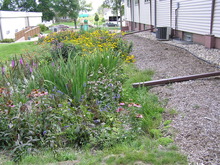
The Water Resources Center is hosting a one-day, hands-on vegetation maintenance workshop for stormwater maintenance professionals. Participants learn to use plant identification apps to accurately identify species and determine which should be removed from vegetated stormwater practices. This course introduces maintenance of vegetated systems, particularly for professionals who have traditionally focused on mechanical practices. If registration links become unavailable, please email Jessy Carlson to be added to a waitlist.
6.5 professional development hours (PDHs) are available for this course. Those wishing a PDH certificate should send Jessy an email.
|
 |
|
Erosion control inspection requirements |
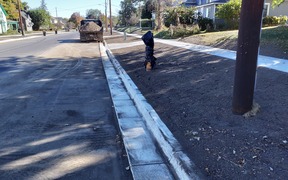
Sediment and erosion control inspections are required to be conducted regularly on construction sites until the NPDES/SDS General Construction Stormwater Permit (Permit) is terminated. Throughout most of the project, you will be required to conduct inspections weekly as well as within 24 hours of all rain events of ½” or more. Per item 11.11 in the Permit, there are several cases in which this inspection schedule may be adjusted:
- inspections of areas with permanent cover can be reduced to once per month, even if construction activity continues on other portions of the site; or
- where sites have permanent cover on all exposed soil and no construction activity is occurring anywhere on the site, inspections can be reduced to once per month and, after 12 months, may be suspended completely until construction activity resumes. The MPCA may require inspections to resume if conditions warrant; or
- where construction activity has been suspended due to frozen ground conditions, inspections may be suspended. Inspections must resume within 24 hours of runoff occurring, or upon resuming construction, whichever comes first.
- for projects where a pollinator habitat or native prairie type vegetated cover is being established, inspections may be reduced to once per month if the site has temporary vegetation with a density of 70% temporary uniform cover. If after 24 months no significant erosion problems are observed, inspections may be suspended completely until the termination requirements in section 13 have been met.
Soil stabilization BMPs such as wood fiber blanket, mulch, and rolled erosion control products are NOT considered permanent cover. Per item 25.22 of the Permit, "Permanent Cover" means surface types that will prevent soil failure under erosive conditions. Examples include: gravel, concrete, perennial cover, or other landscaped material that will permanently arrest soil erosion. Permittees must establish a uniform perennial vegetative cover (i.e., evenly distributed, without large bare areas) with a density of 70 percent of the vegetative cover native to local undisturbed areas on all areas not covered by permanent structures, or equivalent permanent stabilization measures. Inspections your site must continue until permanent cover is established and the Permit is terminated.
Adopt-a-Drain nears a million pounds of debris removed in Minnesota |
|
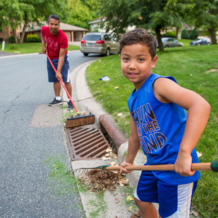 |
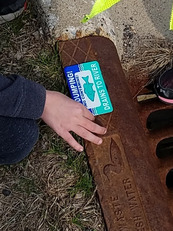
The Adopt-a-Drain program will soon reach a big milestone: volunteers across the state will have removed 1 million pounds of debris from storm drains, logged via cleaning reports at mn.adopt-a-drain.org.
Adopt-a-Drain began as a pilot project in 2014 in St. Paul and has since grown to over 16,000 volunteer participants statewide. The program partners directly with cities, counties, and watershed districts to help them meet MS4 public education and outreach requirements, connect residents with their local watersheds, and build community understanding of the impacts of runoff pollution. Over the last decade, participants have logged nearly 100,000 cleaning reports, documenting the types of debris they clear from storm drains. Half a million pounds of leaves and grass alone have been removed, preventing large amounts of phosphorus from entering local waterways.
In recent years, Adopt-a-Drain has expanded beyond Minnesota, and now has over 170 municipal partners around the country. The program is expected to become available in all 50 states later this year.
Adopt-a-Drain thanks its 70+ partners across Minnesota for working together to reach this milestone! If your jurisdiction is not yet an Adopt-a-Drain partner, you can request more information by visiting ms4.adopt-a-drain.org/contact.
 |
|
Looking for Stormwater Success Stories |
The Minnesota Pollution Control Agency (MPCA) is looking for roadway stormwater temporary construction and post-construction success stories. The MPCA is assisting a research team at the University of Minnesota, St. Anthony Falls Laboratory (https://stormwater.safl.umn.edu/) to identify examples of completed linear (roadway) projects that demonstrate successful management of stormwater runoff. Examples of success might include the use of unique collaborative partnerships, creative design solutions, employing innovative construction methods, and new means to operate or maintain the stormwater management system.
Please consider completing a brief survey (https://forms.gle/k3yGjtV5RWZdfcUi6) by July 31, 2026, to help us identify these projects. Direct any questions about the survey and research to Andy Erickson at eric0706@umn.edu.
The MPCA municipal stormwater program continues to revise the draft permit (initial draft was posted during the winter) and currently anticipates that the MS4 General Permit will go to public notice before the end of the summer. Additional information about the permit reissuance process is available on the MS4 General Permit webpage.
|
|