|
Keeping stormwater (and our rivers and lakes) clean |
|
|
July, 2024
EPA's Stormwater Smart tools now available in Spanish
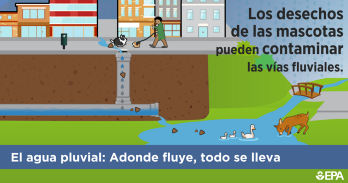
EPA’s “Stormwater Smart” tools are now available in Spanish! You will find the Spanish versions with their corresponding English version on the webpage, each ready for downloading and customizing. The Stormwater Smart collection includes brochures, infographics, one-pagers, and social media posts to educate the public.
Explaining why it’s important to invest in stormwater management to reduce stormwater pollution can be complicated. Many people don’t know what the term means, or how their actions can pollute stormwater and affect local waterways. Education is key to helping people understand how they can avoid polluting and protect stormwater as a resource. The Spanish versions will help to reach even larger groups of community residents.
Developed with coordinated content and artwork, these tools can help in three ways:
• Show what stormwater is and how it can pollute local waterways.
• Promote good stormwater management practices.
• Explain how everyone can value stormwater as a community resource as well as manage it with green infrastructure.
Stormwater Smart tools, in English and Spanish, can be printed or posted on social media, web pages and as hardcopy handouts or posters customized with local contact information. EPA’s How-to Manual offers practical suggestions for how and when to use the materials.
The full collection of products can be found HERE.
|
MPCA's Smart Salting Tool - The ultimate chloride reduction resource
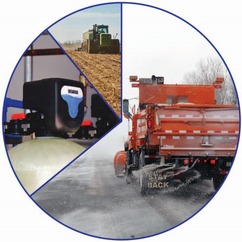
The Minnesota Pollution Control Agency has recently updated and redesigned the Smart Salting Tool (SST) to help communities across the state evaluate chloride sources impacting them, along with information and resources to address those sources. The update also assists with annual chloride reporting requirements for NPDES permittees.
This redesigned SST still allows winter maintenance organizations to evaluate their operations for improved efficiency and reduced salt use to obtain their Level 2 Smart Salting certification. But now the SST can also support communities with all sources of chloride making it the first and only comprehensive chloride reduction tool. The Chloride Source Assessment includes:
- Mapping feature to select geographic areas for customized evaluation of chloride sources
- Detailed information for each source of chloride
- Guidance for collecting additional source data
- Option to modify estimated chloride contributions with local data
- Develop a chloride reduction Action Plan
- Assist with MPCA permit reporting requirements related to chloride
Create a free account today: https://smartsaltingtool.com
Those interested in the SST’s Winter Maintenance evaluation for Level 2 certification, can register for the online training on July 17th. A short overview of the Chloride Source Assessment will also be covered.
|
|
|
Are you sure you don’t need a NPDES permit?
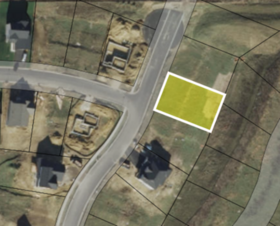
Construction site owners and operators must apply for an NPDES/SDS construction stormwater permit from the MPCA for any construction activity disturbing:
- One acre or more of soil, or
- Less than one acre of soil but the activity is part of a larger common plan of development or sale that is greater than one acre.
A common plan of development or sale is a contiguous area where multiple separate land-disturbing activities may happen at different times, on different schedules, but under one proposed plan. Examples include:
- Residential subdivisions
- Phased projects
- Industrial parks
If you are building on one lot within a larger subdivision over an acre, you still need an NPDES/SDS permit.
REMINDER
MS4 Permittees (cities, counties, townships) must provide written notification to owners and operators proposing construction activity, including projects less than one acre that are part of a larger common plan of development or sale, of the need to apply for and obtain coverage under Minnesota’s Construction Stormwater (CSW) Permit (MS4 Permit Item 19.6).
In addition, MS4 Permittees must implement and enforce a Construction Site Stormwater Runoff Control and Post-Construction Stormwater Management program to address construction activity with land disturbance of greater than or equal to one acre, including projects less than one acre that are part of a larger common plan of development or sale, within the permittee's jurisdiction and that discharge to the permittee's stormwater system (MS4 Permit Items 19.2, 19.3, 20.2, and 20.3).
For more information, visit www.pca.state.mn.us/water/construction-stormwater or call the MPCA at 651-296-6300 or 800-657-3864.
|
Update your MCM 4 regulatory mechanism by July 31st
Last summer, the MPCA reissued the Construction Stormwater (CSW) permit. According to item 19.4 of the 2020 MS4 general permit, MS4 permittees have until July 31, 2024, to update/revise, if necessary, their existing MCM 4 regulatory mechanism. The permittee’s MCM 4 regulatory mechanism must be at least as stringent as the requirements for erosion, sediment, and waste controls as written in the August 1, 2023, CSW permit. To assist in this process, the MPCA has updated the MCM 4 and MCM 5 model ordinance guidance document to reflect the August 1, 2023, CSW permit requirements.
The guidance document discusses the different ways that a MS4 can update their regulatory mechanism. The model ordinance covers options such as incorporating the most current version of the CSW permit by reference, incorporating only the erosion, sediment, and waste control requirements by reference, or incorporating the requirements directly into your regulatory mechanism. The model ordinance can be found under the MCM 4 and MCM 5 sections.
Questions? Reach out to any of the technical assistance and compliance enforcement staff.
|
MS4 permittees annual report update
Annual Reporting for 2023 deferred for all MS4 permittees covered by the 2020 MS4 General Permit
The MPCA is still in the process of developing a new e-service for the MS4 annual report. This means MS4 permittees that have coverage under the 2020 MS4 General Permit did not need to submit an annual report for calendar year 2023 by June 30, 2024. Instead, reporting is deferred until the e-service is available. At that time, MS4 permittees will be expected to begin reporting MS4 activities for each previous reporting year (i.e., each calendar year after 2021).
MS4 permittees must continue to conduct internal Annual Assessments for MCMs 1-6 each year (Permit Items 16.9, 17.8, 18.18, 19.16, 20.23, and 21.15).
For more information about the MS4 annual report, visit the MS4 annual report webpage.
Minnesota Stormwater Research Council Annual Meeting
Date: July 18
Time: 9:00 a.m. - 2:30 p.m.
Location: St. Anthony Falls Lab with optional virtual participation.
Register by July 12
|
Featuring
- updates on the ten ongoing research projects
- networking with the advisory board and current researchers
- highlights of the past year including the release of the annual report
- summary of the 2024-2025 research priorities and path forward
- showcase the new and upcoming enhancements to stormwater technology transfer, including
- the new Clean Sweep Lunch & Learn monthly events
- continuation of the ever-popular Minnesota Stormwater Seminar Series
|
|
Questions about stormwater?
MPCA stormwater staff are available to answer questions about stormwater and your MS4 permit requirements. Click the button below to find staff contact information.
|
|
Contact
If you have questions about or suggestions for this newsletter, contact:
Kevin Strauss
MPCA-Rochester
kevin.strauss@state.mn.us
507-206-2624
|
|
The Minnesota Pollution Control Agency is a state agency committed to ensuring that every Minnesotan has healthy air, sustainable lands, clean water, and a better climate. |
|
|
|
|