From General Manager Wes Kooistra
Several months ago, we launched the Great Workplace Project. The purpose of this project is to strengthen how we work together to serve our region.
The first step is assessing our workplace culture. We are seeking to understand how we work together, how we treat each other, and what steps employees feel we should take to ensure Metro Transit is a great place to work.
In recent weeks, many of you have provided feedback about our work culture through the Employee Engagement and Satisfaction survey. Thank you for taking the time to help us begin to see where improvements are needed.
To build on this survey, the results of which will be shared soon, we are inviting staff to participate in a series of March focus groups where ideas can be shared freely among peers. A consultant leading these groups will bring information back to leadership.
Survey results, interviews and focus group feedback will all inform our Great Workplace Project, an effort to make changes that ensure all employees feel more valued and supported.
Please review the information below and get involved in the shared effort to make Metro Transit an even better place to work.
Rebuilding ridership
As reported this week at the Transportation Committee meeting, we provided about 33 million rides last year.
A newspaper article erroneously reported, or at least implied, that our ridership was continuing to decline when ridership is actually increasing.
While total 2021 ridership is down from 2020 ridership, 2020 had nearly three months of pre-COVID ridership. If you compare only the COVID months of both years, ridership in 2021 has increased over 2020.
I recall that in the early COVID months of 2020 systemwide ridership was down nearly 70% when compared to the same months in 2019. Today, systemwide ridership is down 50-55% from our pre-COVID experience. All this to say that our ridership is increasing despite delayed return-to-office plans and service reductions due to our operator shortage.
We won’t be able to expand service until more operators are hired. But the decline in COVID-19 cases, steady demand on our core routes, and signs that employees will soon return to offices in greater numbers are all hopeful signs that ridership will continue moving in the right direction this year.
And, continued good news – January’s ridership was up about 11% compared to the same month last year.
|

All employees are invited to participate in guided conversations that will help inform efforts to improve work culture.
- A total of 12 focus groups will be scheduled throughout March. Groups will meet both virtually and in-person, with COVID-19 protocols in place.
- Employees who participate will be paid their standard hourly wage for participating. Each session will last 90 minutes.
- Sessions will include six to ten people from different departments and be led by a consultant.
- Feedback will be summarized for leadership; employees will not be identified.
- Space is limited. If focus groups fill up, employees who cannot participate will be invited to complete an online survey.
- For more information, contact Sarah Berres.
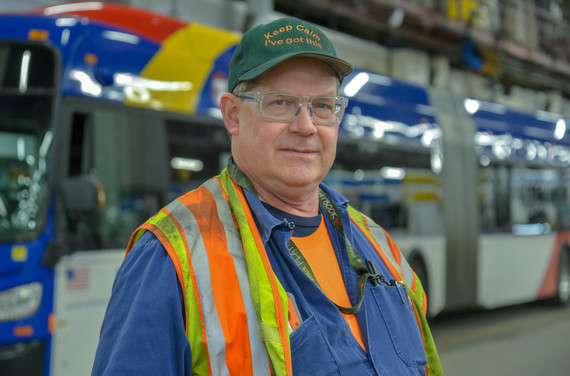
Robin Betland was a “fuzzy-faced” 18-year-old when he started working as a vault puller at the old Nicollet Garage. This week, he retired with 42 years of service.
Less than a year after he started, Robin transferred to Bus Maintenance, where he worked as a cleaner and fueler before becoming a technician. He worked at every garage except for East Metro and spent the last 25 years of his career at Heywood. At Heywood, Robin spent a decade in bay service, quickly troubleshooting issues raised by operators so they could pull out on time.
“I didn’t have mechanical experience – everything I learned I learned on the job,” he said. “A lot of people gave me a lot of help along the way.”
In retirement, Robin plans to spend more time traveling. His first planned destination? Hawaii.
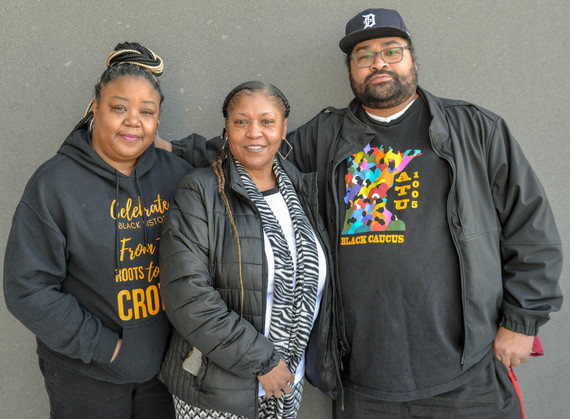
The Black History Month Committee, above, will host their first of two live events today, Friday, Feb. 18, to celebrate Black history and host a friendly talent competition.
Several music videos submitted by staff will be shared as part of the event, and top vote-getters will advance to next week's event. The festivities also include a singing of the Black National Anthem, Soul Train Scrabble and an introduction to a forming BIPOC Employee Resource Group.
Add these events to your calendar using the links below.
Employees are also invited to order a "soulful dinner" to enjoy during the Friday, Feb. 25, event. Pre-order online here.
For more information, contact Black History Month Committee members Traci Williamson, Devona Love or Demetre Muhammad.
Learn more about the history of the Black History Month Committee
Join the BIPOC ERG for a conversation about Black history
All employees are invited to join BIPOC ERG for conversations about Black history on Thursday, Feb. 24. Add these virtual events to your calendar using the links below. For more information, contact Victoria Dan.
Other ways to celebrate Black History Month
- Download Black History Month backgrounds for Teams here and here.
- This week, Advancing Women in Transit hosted an event about Black contributions to transit. View the slides and learn more here.
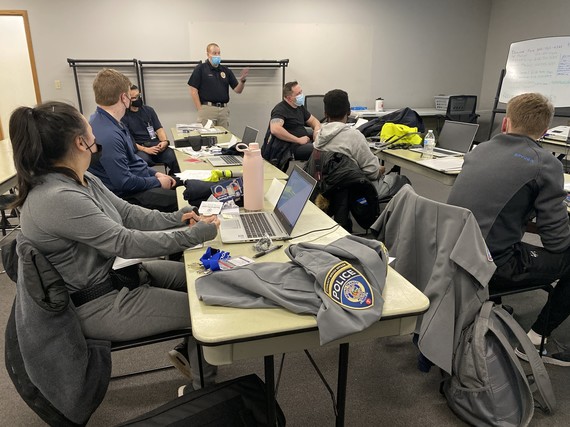
Two initiatives aimed at improving perceptions of safety and emergency response are moving forward with the addition of new staff.
The Metro Transit Police Department's Real Time Information Center (RTIC) is now staffed by a team of seven people who watch live feeds from cameras on light rail trains and stations. Video is monitored from 6 a.m. to 10:30 p.m., Monday through Friday, and noon to 10 p.m. on weekends.
The newest hires are Teresa Eisfelder, who previously served as a detective and court security officer, and Keith Hendrickson, who has served as a police dispatcher, military police officer and embassy guard.
The department also recently added another video technician, Luis Paniagua, who will serve in the department’s Business Technology Unit, responding to requests for video.
The department’s team of Community Service Officers, or CSOs, has also expanded. Six new CSOs began training this month.
CSOs are students who are pursuing degrees in law enforcement. They serve primarily on light rail lines, conducting fare inspections, assisting customers, and contacting police in the event of an emergency.
Newly hired Juvenile Outreach Coordinator Chaunté Ford will manage the CSO program and help build relationships with community organizations. Ford has spent the last 10 years with the St. Louis Park Police Department, where she served as a police officer and CSO.
We're hiring!
Efforts to hire more police officers and Community Service Officers are ongoing. If you know someone who would be a good candidate, please encourage them to apply.
Review the police officer job posting
Review the Community Service Officer job posting

Nicollet Operator Wiley Trueblood has made an impression on a Route 21 customer who recently submitted the following commendation.
Wiley has been my driver several times on my way home from work. He is always on time, friendly and kind and brings a smile to your face. One night, I had a very rough day at work. When I got on the bus, he started singing and made me laugh. Tonight, Wiley saw an older man sitting on the bench near a stop and asked if there was anything he could do to help. I moved forward to chat with him, thank him for his kindness and said I appreciated his good sense of humor. I believe people like Wiley are hard to find in this fast-paced angry world of today. I want to sincerely thank him for brightening my night several times and look forward to having him as my driver in the future. Thank you, Wiley and keep singing!
Susan, St. Paul
|
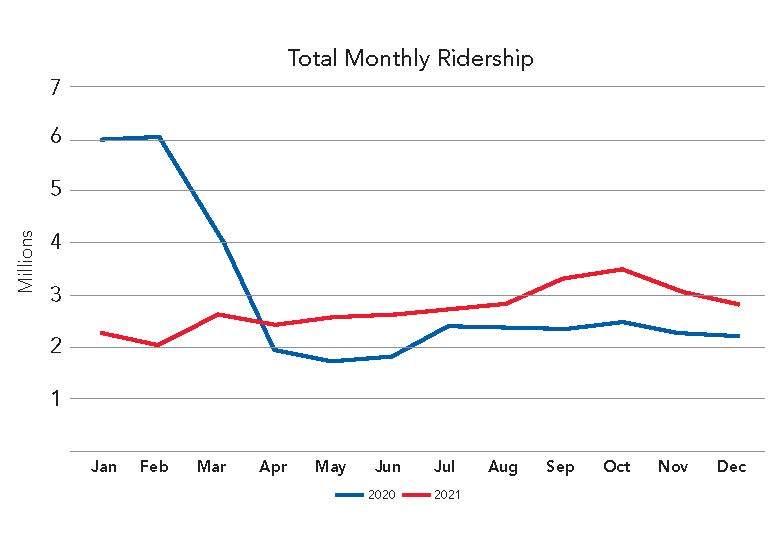
Steady demand for all-day, all-purpose trips and a return to in-person learning led to a rise in pandemic-era ridership last year.
In all, 32.9 million rides were provided in 2021 and average weekday ridership topped 99,000. Ridership from April to December was up about one-third compared to the same period the year before, when the pandemic reduced travel demand.
Ridership steadily grew in 2021 as the pandemic showed signs of subsiding. A rise in COVID-19 cases and a seasonal ebb slowed momentum late last year. January's ridership was up compared to the same month last year, though, and a continued decline in cases could help ridership recover in the coming months.
When people travel and who's riding has also evolved since the start of the pandemic.
Morning and afternoon peak periods have lessened while demand throughout the day has been sustained. That all-day demand is served by frequent service on core bus routes, light rail and Bus Rapid Transit lines.
Initial results from on-board surveys completed on the busiest routes last fall show:
- 83% of trips are taken for something other than a peak commute
- 64% of riders make less than $35,000 a year
- 55% of riders identify as Black, Indigenous or People of Color (BIPOC)
- 52% of riders are under 35 years of age
|