From Nick Thompson, Deputy General Manager-Capital Projects
The METRO Green Line Extension is the largest construction project in our state’s history. So, it stands to reason that we’d encounter some unforeseen challenges on the path to its completion.
One of the biggest challenges we’re facing is in Minneapolis, where the construction of a light rail tunnel is proving far more complicated than we’d anticipated.
The project has also expanded to include a barrier protection wall between light rail and freight rail tracks and a station in Eden Prairie that had been deferred during the design process.
This week, the Council accounted for these and other developments by authorizing staff to settle with a civil construction contractor working on the project. The $210 million agreement will extend our construction timeline by up to 34 months.
The Green Line Extension is now expected to open in 2027, about four years later than planned. We also estimate that at least $450 million in additional funding will need to be secured to complete the project.
This is difficult, disappointing news to deliver to you, to our partners and to all those who are eager to enjoy the benefits of this new service. The setbacks we’ve faced are especially felt by project office staff who are working tirelessly to keep this project moving forward.
As hard as this is, though, this is an important milestone in the life of this project. This settlement will set construction benchmarks and a dispute resolution process that together provide the clarity and assurance we need to move forward.
At Metro Transit, this adjusted timeline also means we’ll have more opportunity to build the workforce we’ll need to operate this service and other future additions to our transit network. Thank you in advance for everything you’re doing to prepare for what lies ahead.
It is also worth remembering that we didn’t get where we are today without ambition and perseverance. Anyone who helped design, build, and open our first two light rail lines knows these projects are full of uncertainties, risks, and challenges.
But our region will face even bigger issues if we let today’s difficulties disrupt our vision for creating a stronger network of light rail and Bus Rapid Transit lines that will benefit our region for generations.
When it opens, the Green Line Extension will give people more freedom to choose where they live, work and play, and create a healthier, more vibrant region for everyone to enjoy. Its positive effects, including new housing and trail improvements, are already being felt throughout the corridor.
So, thank you for keeping the faith that we are on the right path. And thank you for continuing to do the hard but necessary work that will get us and our region where we need to go.
Continue reading: Agreement and Met Council action establish foundation for projected opening day and total budget
Watch a presentation about the settlement, approved by the Council on Wednesday
Gov. Walz Identifies $200 million for METRO Blue Line Extension
|

After 32 years of service, Dispatcher Bob Patkoff retired this week out of South Garage.
Patkoff began his career in transit in 1973, as a baggage handler for an interstate bus company out of Dallas, Texas. Working in interstate busing kept him away from home more than he wanted, though, and he eventually arrived in Minnesota where, in 1990, he started as a part-time operator. Patkoff has been a full-time dispatcher in bus and rail since 2002.
In retirement, he and his wife plan to be “snowbirds,” splitting their time between Minnesota and Oklahoma, the state he was raised and has family and friends.
Read more about retirees with 30+ years of service
|
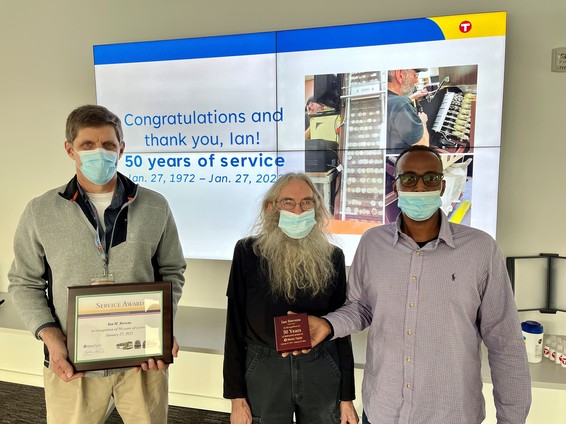
You don’t stay at the same job for a half century without really liking your colleagues.
“It’s the happy people,” said Revenue Processing Specialist Ian Stevens, who celebrated his 50th anniversary at Metro Transit this week.
Stevens is just the second Metro Transit employee to reach that milestone. The longest-serving Metro Transit employee is Sy Sharp, who retired in 2016 with 52 years of service – a record the 71-year-old Stevens may or may not break.
“When people ask, I say, ‘What I like about it is if I don’t want to do it anymore, I don’t have to,’” Stevens said.
It was Stevens’ wife Micki who encouraged him to apply shortly after leaving the Army all those years ago. “I thought it was going to be party time, until 11 days later my wife said, `No, you’re going to go get a job,’” Stevens said.
But sorting cash and coins, it turned out, was a natural fit for Stevens, who excelled at math in school. A good work-life balance, friendly co-workers to picnic and go bowling with and good benefits have also kept him coming back.
Over the years, he’s trained just about everyone, including his supervisors, and has learned all the nuances of the job. For a while, he could pinpoint the unique sound of silver half-dollars running through sorting machines so they could be retrieved and sold to collectors. The practice has since been discontinued.
“When silver spiked, he would say, `Dennis, it’s time to sell the silver,’” recalled Dennis Dworshak, who served as Stevens’ manager 20 years ago.
Today, Stevens’ supervisor is Abdul Ahmed, who summed it up this way: “He is extremely reliable to a point where we almost take it for granted.”
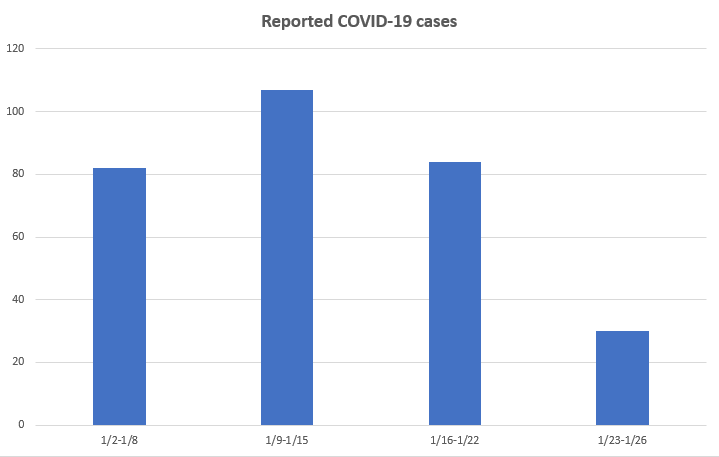
There are hopeful signs the latest COVID-19 wave is subsiding, including a drop in newly reported cases at Metro Transit (view the latest case data by worksite here).
Public health officials say prevention measures like wearing a mask and getting tested if you feel ill remain important, however. Of note since last week:
The decline in cases has also had a positive impact on service reliability. There were 10 lost pull-outs recorded between Sunday, Jan. 23, and Wednesday, Jan. 26, compared to 90 lost pull-outs the previous week and 237 lost pull-outs the week before that.
Thank you to everyone in operations who has helped us manage this latest wave in cases, and stay safe!
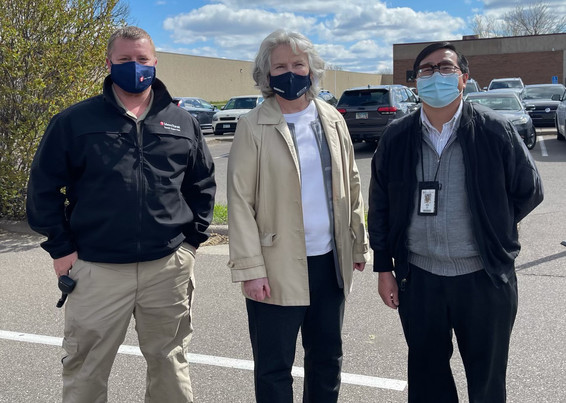 Above: Transit Supervisor Lance Wallace, left, with Minnesota Department of Health Commissioner Jan Malcolm and East Metro Operator Xia Yang.
Transit Supervisor Lance Wallace wasn’t quite sure what he was getting into when he volunteered to take the lead on an effort to bring specially equipped vaccination buses everywhere from St. Paul’s Hallie Q. Brown Community Center to International Falls.
But as he’s done several times during his five years in Street Operations, he stepped up and took charge.
This week, he was recognized for doing so as part of the Awarding Accomplishment program. The program recognizes supervisors and frontline staff whose actions reflect a strong commitment to Metro Transit’s Guiding Principles.
For several months last year, Wallace helped transport nurses and vaccines, worked with clinic hosts and MnDOT to park and store buses and partnered with garage and Transit Control Center staff to schedule operators. Wallace said it was gratifying to see the buses meeting the demand for vaccines.
“The earliest ones where we served more than 100 people a day were probably the most rewarding because it really felt like we were getting a lot done,” he said.
Wallace was nominated by Street Operations Manager Antoinette Brasson. In her nomination, Brasson said Wallace is always willing to take on special projects and to help his teammates. While traveling, he helped get other supervisors up to speed; and he recently developed the department’s Standard Operating Procedure.
Wallace began his career 17 years ago as a bus operator. Today, he works overnight shifts, supporting operations across the region.
Awarding Accomplishment
Supervisors and frontline employees who have shown a strong commitment to Metro Transit's Guiding Principles are eligible for recognition through the Awarding Accomplishment program. Nominations are reviewed by division directors. Individuals who are selected for recognition will:
- Be introduced to the Metropolitan Council's Transportation Committee
- Receive an Awarding Accomplishment certificate
- Receive 8 hours paid leave

The Black History Month Committee is still seeking employees to participate in an online talent contest to help celebrate Black History Month in February. To participate, employees should record and submit videos of their talents as soon as possible. Videos should be sent to Traci Williamson and Drew Kerr.
Collected videos will be shared during virtual Black History Month events that will be held in February.
Employees are also invited to order a "soulful dinner" to enjoy at home as part of the Friday, Feb. 25, event. Pre-order online here.
Health equity and radical healing session on January 31
Employees are invited to join an online session about the economic and health costs of racism, and how to respond to and heal from racial trauma, on Monday, Jan. 31. The session begins at 11 a.m. and will be led by Jamil Stamschror-Lott of Creative Kuponya. If you did not receive a calendar invite, please email fitforlife@metc.state.mn.us for more information.
February 4 is Transit Equity Day
Next Friday, Feb. 4, is Transit Equity Day, celebrated on Rosa Parks' birthday. To commemorate, signs celebrating Parks and other women who were arrested for refusing to give up their seats will be placed on several buses.
Help finalize a BIPOC Employee Resource Group
All employees are invited to help finalize a new Employee Resource Group (ERG) that will serve as a resource for those interested in supporting and networking with staff who identify as Black, Indigenous and People of Color (BIPOC). The group is now finishing its charter, a step toward becoming a Council-recognized ERG that employees can devote paid time to participating in. For more information, contact Victoria Dan.
Help discover and share our Black history
Throughout the year, the Equity & Inclusion Team will be drawing connections between our past and present by sharing information about the history of transit in our region. The team is currently gathering information, photos and artifacts for a Transit Equity through History exhibit that will be displayed later this year. The exhibit will highlight transit’s Black history, and the role of women in transit. For more information, contact Rachel Cagle.
Explore Minnesota’s Black History
Black History, Black Voices – Minnesota Historical Society

Bus operator Hassan Johnson recently received a commendation for his onboard demeanor.
I don’t ride often due to the pandemic, but I will when I need to see my doctor. This bus driver is the best driver I’ve ever had, and I’ve ridden with him many times. He makes sure people are wearing their masks properly and ensures elderly people take their time to safely sit down. He also keeps his calm when dealing with unruly customers. Thank you so much!
|

Growing up on St. Paul’s East Side, James Partlow-Hernandez was no stranger to Metro Transit. His father and two uncles spent several decades working out of the East Metro Garage.
“My family kept nudging me to apply for a job at transit,” he said.
While working as a kitchen manager at a local Italian restaurant, he applied. But he soon discovered that he needed his GED to qualify.
In 2018, with GED in hand, he applied and became a full-time bus operator. Today, he continues in his family’s footsteps working as a bus operator out of East Metro.
“It was a weight lifted off my shoulders,” he said. “It felt good.”
As fate would have it, Partlow-Hernandez recently inspired someone else to finish their education.
Onboard Route 63, a simple, “How’s your day going?” led to a deeper discussion with a customer who was unemployed and who told him how hard it was to get a job without a GED.
Partlow-Hernandez shared his story, encouraged him not to give up and even explained which routes he could use to get to places where he could work toward his GED. The customer recently submitted a commendation about this interaction, thanking Partlow-Hernandez for inspiring him.
“It feels good to help others,” Partlow-Hernandez said. “I hope he pursues his GED and gets the job he wants.”
Know an operator we should feature? Please email insights@metrotransit.org.
|
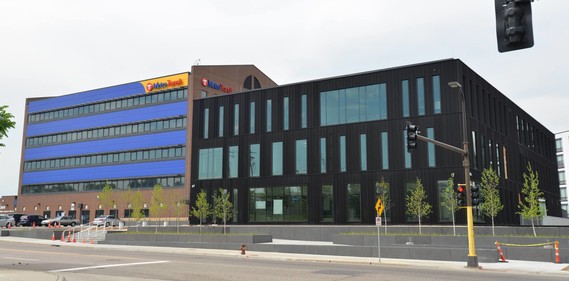
Beginning Monday, employees coming to the Metro Transit Campus may use the Orange Lot at any time. To access the parking area, off North Fifth Street, employees will need to use their employee badge.
The Green Lot, by the Transit Control Center, will continue to be reserved for Metro Transit staff whose positions are on the priority parking list. The Blue Lot off Sixth Avenue is primarily for visitor, accessible and Well@Work clinic parking.
The Orange Lot will return to priority access when more employees begin reporting to on-site work. Employees with priority access include operators, technicians, and others whose work hours and positions make it more difficult to use alternatives to driving.
-
The former operator breakroom at the Heywood Garage is currently being renovated into a flexible working space with booths, cubicles, and other furniture staff can use as workspace and to meet with one another. The space is expected to open this spring.
-
Employees who do not have an assigned workspace at the Heywood Office will soon be able to reserve desks using Outlook.
-
Plans to renovate the Heywood Office are moving forward. Construction is scheduled to begin in 2023. The project will address accessibility issues, create more shared space on each floor and improve lighting. New furniture will also be installed throughout the building. During construction, some employees will need to temporarily relocate.
-
Progress on the new Minneapolis Bus Garage continues. The garage is expected to open in early-2023.
-
Please continue to keep clean workspaces and begin discarding any files or items that are no longer needed (review the document retention policy).
-
Submit workorders for any items that need to be repaired by facilities maintenance staff by emailing transit-facmaint-workorders@metc.state.mn.us.
Questions about facility improvements should be directed to Molly Ellis.
As a reminder, all employees performing on-site work for more than 10 minutes must be in compliance with the Council’s weekly COVID testing requirements or have approved vaccine card information on file with HR.
MentoringWorks applications due February 4: Applications to serve as a mentor through the Council's MentoringWorks program are being accepted through February 4. The six-month program will begin on March 1. To learn more, visit the MentoringWorks MetNet site and watch a recording of a recent information session.
Learn more about 2020 Census results: Community Development is hosting two webinars in February for staff interested in learning more about the 2020 Census results. The Research department will also share resources and offer more detailed consultation on census information and how it applies to your work. To attend:
To learn more, visit the 2020 Census page or email Research@metc.state.mn.us.
Internship applications will be accepted in February: Position descriptions for more than 80 Council internships will go live next week, and applications will be accepted the entire month of February. If you know someone who might be interested in applying for a Met Council internship please direct them to the Met Council's internship webpage and let them know about upcoming online info sessions that will be held on February 15 at 9 a.m., February 16 at 3 p.m., and February 17 at 6 p.m.
|