|
In this Issue
Comment now on our 2022 Metropolitan Council draft budget
We are accepting public comment on our 2022 draft budget through Dec. 8. The budget totals about $1.2 billion, including the cost of operations, pass-through funding programs, and debt service (loan repayments). It reflects our legislative charge, overall mission, goals, and priorities for the current period.
Met Council revenue comes from four primary areas: customer payments, state funds, federal revenues, and local property tax, which is proposed at $91 million for 2022.
These revenues go to support planning and services, including:
-
Metro Transit, which provides bus, light rail, and commuter rail services. We also operate Metro Mobility, for certified riders with disabilities, and contracted transit services. Overall, Met Council provided 94% of total regional transit ridership in 2020.
-
We collect and treat wastewater for 111 communities, representing 90% of the region’s population.
-
We partner with 10 regional park implementing agencies to plan, acquire land, and develop facilities for regional parks and trails.
-
Our Metro HRA provides safe, stable, and affordable housing opportunities for about 7,200 households with low incomes.
-
We support local community vitality through grant programs, local planning assistance, robust regional data collection and analysis, and other tools.
Offer public comments at Metro Transit Police Work Group in December
We’re encouraging members of the public and advocates to join the Metro Transit Police Work Group at its meeting Dec. 17 to provide comments about safety and policing on our transit system.
The work group has been meeting twice a month since September to prioritize and discuss safety issues related to our transit system and the role the Metro Transit Police Department plays. The group discussions are building upon the public engagement and internal analysis regarding safety on our transit system.
There are a number of ways you can make sure your feedback is included in the Dec. 17 meeting, which will be held virtually from 9 to 10:30 a.m.
At the most recent meeting of the group, attendees discussed a survey of Metro Transit Police Department personnel, which revealed concerns about safety on the system and other long-term concerns about working conditions. Council members will also be discussion this survey information at the Nov. 17 Committee of the Whole meeting. We encourage you to follow the meeting on our website.
Recently, Metro Transit has been adding more officers, patrols and real time video monitoring to light rail vehicles to better address safety and quality of life issues on our transit system. We are working hard to provide the customer experience that our riders deserve, while working to ensure all feel welcome. We invite you to help us in this work.
Serving on the Met Council’s Climate Work Group
Earlier this month, we held our inaugural meeting of the Met Council’s new Climate Work Group. We are tasked with developing and helping to implement the Council’s Climate Action Plan. The six of us (five Council Members and one community member) will work with staff to:
-
Guide Council Member, partner agency, and public engagement.
-
Identify areas in the plan where more investigation or discussion is needed.
-
Point out barriers to implementing impactful strategies and identify potential solutions to those barriers.
-
Guide and monitor progress of Climate Action Plan development and implementation.
-
Identify emerging climate change issues and strategies to bring back for the full Met Council’s consideration.
I’m excited to begin this incredibly important work. Please get in touch with me and the committee if you have input you would like to share.
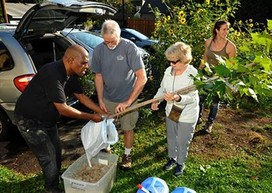
In Frogtown, Midway, and the historic Rondo neighborhood, residents are particularly lacking in tree cover. On a scorching summer day, that means temperatures can be as much as 15 degrees hotter than more shaded parts of the city. Unity Unitarian Church and Frogtown Green are two organizations that are working to plant trees in their communities to battle climate change. Last month they planted 70 new trees on private property, free of charge, in the Saint Paul neighborhoods.
Higher heat is spreading as the emerald ash borer infestation continues to devastate Minnesota’s tree canopy. It’s a problem the Metropolitan Council has been working on in partnership with the Nature Conservancy and the Tree Trust. The partners are developing an online application to help communities track where tree canopies are thin, and then prioritize where cities and communities can get the most impact from new planting.
The Growing Shade application takes data from multiple sources. Demographic information about neighborhoods, locations of businesses, schools, bus stops, parks, and other data are combined to create a complete picture of a city down to the neighborhood level. Nonprofits, cities, and communities can then take that data to target the best places to plant trees. The online tool is currently in beta testing and expected to be launched in early 2022.
Hot neighborhoods can be a legacy of past racial injustices. Neighborhoods that have been historically subject to redlining and other discriminatory practices are clearly visible today if you look at the land surface temperatures on a regional heat map.
|
Across the globe, researchers are looking for ways to reduce the spread of COVID-19, as well as variants that may spread more easily. They’ve found that wastewater, or sewage, can help public officials better understand the extent of infections in communities and complement existing surveillance where clinical testing is underutilized or unavailable. Scientists in the Met Council’s Environmental Services division extract viral genetic material from wastewater samples and send it to research partners at the University of Minnesota Genomics Center. There, scientists measure concentrations of the SARS-CoV-2 viral material in the wastewater to assess COVID-19 prevalence among the population who live in the sewershed, or the part of the region that has sewer service. This could become one more tool to help public health officials make informed policy decisions to reduce and prevent future spread.
Current research suggests that people may start shedding the virus in their feces up to five days before symptoms appear. Researchers at Met Council and the genomics center have found is that the concentrations of the virus in wastewater, to date, closely mirror the changing infection rates in the metro area, where the Metropolitan Wastewater Treatment Plant (in Saint Paul) treats the wastewater of about 70% of the region’s population.
In addition to these efforts, Met Council is also involved in state and national initiatives to evaluate wastewater surveillance as a tool for tracking the spread of the virus. The Met Council was selected to participate in the first phase of a national Wastewater Surveillance System. The Centers for Disease Control and Prevention (CDC) and U.S. Department of Health and Human Services (HHS) are collaborating with municipalities across the nation to examine how wastewater-based epidemiology can assist our response to the COVID-19 pandemic.
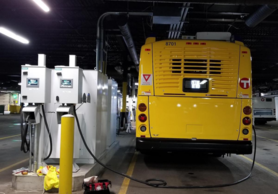
Metro Transit is committed to reducing vehicle emissions by bringing more electric buses into its fleet. The Met Council is responsible for developing a Zero-Emission Bus Transition Plan and revising the plan once every five years. The plan will identify short-term (2022-2025), medium-term (2026-2030), and long-term (beyond 2030) opportunities, risks, and implementation strategies to transition Metro Transit's bus fleet to zero-emission technology. Metro Transit is engaging interested stakeholders and communities in our region and hosted facilitated workshops in November that can be viewed here. Get involved and take a survey on the Zero-Emission Bus Transition Plan.
We are currently planning for the purchase of eight 40-foot electric buses that will be used on local routes beginning in 2023, electric bus charging equipment in the new Minneapolis Bus Garage, and the purchase of up to 70 electric buses in 2025, some of which will be used on the planned METRO Gold Line and METRO Purple Line.
|
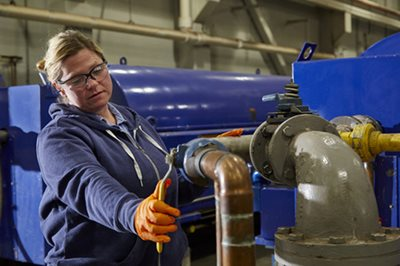
This fall, the U.S. Environmental Protection Agency (EPA) honored Met Council Environmental Services with a 2021 WaterSense Excellence Award. The award recognizes our agency’s dedication to helping consumers and businesses save water, despite the challenges and disruptions of the COVID-19 pandemic. WaterSense is a voluntary partnership program the EPA sponsors and is both a label for water-efficient products and homes, and a resource for helping consumers learn ways to save water. The program honored Met Council Environmental Services as a 2021 Excellence Award winner for strategic collaboration.
Earlier this year, all nine plants were recognized during the National Association of Clean Water Agencies (NACWA) Peak Performance Awards program. Based on their performance through 2020, six plants earned Platinum Awards for achieving five or more consecutive years of full compliance with their clean water discharge permits. Our plants combined now have 117 years of consecutive compliance.
|
The Twin Cities region gained 314,000 residents over the last decade, bringing the total population to 3.16 million in 2020, according to decennial U.S. census counts released August 12. Significant growth occurred in both urban center cities and suburban edge cities. Not only has the seven-county area grown since 2010, it continues to transform: the share of residents who identify as Black, Indigenous or people of color (BIPOC) now stands at 31%, up from 24% in 2010. Learn more about the changing demographics of our region.

Like many transit agencies, Metro Transit is facing a significant driver shortage, which means we don’t have enough staff to meet our schedules. We apologize to anyone who has experienced times when a bus or train was not there when it was scheduled to be there. Since March, we’ve been working hard to hire more drivers with monthly one-day hiring events. These events streamline the hiring process and are providing on-site CDL training. We also offer hiring and referral bonuses. Drivers start at more than $21 per hour – even during training – and receive outstanding benefits, including paid training, health care, annual salary increases, a pension plan, an unlimited-ride bus pass, and a $1,000 hiring bonus. Combined with upcoming service adjustments, we hope to deliver the quality service we strive to provide to our riders.
|
|