
From General Manager Wes Kooistra
We are now 18 months into the pandemic, and I want to again express my wholehearted appreciation to all Metro Transit employees for the critical work of providing transit services to our region under nearly impossible circumstances.
We have worked together through the continuing challenges of the pandemic and its far-reaching impact on our services. Our services and schedules have significantly and frequently changed. Our security, customer support, and maintenance needs have grown with underserved social needs and unaddressed crime in our communities.
We are constantly adapting public and customer messaging to changes in public health interests and the transit service environment. And now we are managing through an operator shortage. These are just some examples. The work of every transit employee has been changed and challenged in some way.
Your remarkable work is not taken for granted. I am proud of your heroic efforts. I admire the daily commitment of every worker that is essential to our success. You have earned the admiration of the Metropolitan Council members and leaders, community leaders, and others who have asked me to pass along their thanks.
But it is also important to acknowledge that sustaining this effort over this long period of challenge, with no certain end, often requires us to work through frustration and fatigue.
It is a difficult time! This has lasted too long. There is so much we can’t control. We feel helpless to end the pandemic and all its unwelcome influences on our work and personal lives. It can cause us to become anxious and tired.
Burnout can happen to any of us, and impatience and intolerance can easily become the product of our response. It is human nature, and in this difficult and constantly changing work environment, these feelings and responses can be contagious.
We cannot dismiss these feelings, but rather we must be self-aware so that we can manage our anxiety and fatigue in healthy ways.
We can all be part of the solution. We can be self-aware and seek help and support to take care of our own needs. We can also help each other with encouragement and support. Empathy expressed in positive, constructive ways can be exactly what our colleagues may need.
Know that your work is important, appreciated and admired. Your efforts are heroic because they provide a service that is essential to meeting the daily needs of so many people in our region. This is why it is important to take of yourself and to support your colleagues when you see a need and have an opportunity.
If you are one who is struggling and needing assistance, these resources are also available to you:
-
Sand Creek: Counseling services are available in-person, online or over the phone. For more information, call 888-243-5744 or visit sandcreekeap.com (use the code metcouncil to create a new account).
-
Well@Work: Virtual appointments, including those for mental health services, are available. For more information, call 952-967-5474 (downtown St. Paul clinic) or 952-967-7468 (Heywood clinic) or visit the Well@Work page on MetNet.
-
Fit For Life: Email fitforlife@metc.state.mn.us or contact the Wellness Champion at your worksite to learn more about the Council’s wellness program.
-
National Alliance on Mental Illness: Find resources at nami.org or call NAMI’s HelpLine at 1-800-950-6264.
Attend an August 28 virtual session on Navigating Transitions
All employees are invited to attend a session on navigating transitions with Sand Creek Counselor Brad McNaught, who has worked with frontline Metro Transit staff for more than 15 years. McNaught will talk about how to adapt during these ever-changing times, self-care and coping strategies, and take questions. The online session will run from 2 p.m. to 3 p.m. on Thursday, Aug. 26. If you did not receive an invite, please email fitforlife@metc.state.mn.us.
|
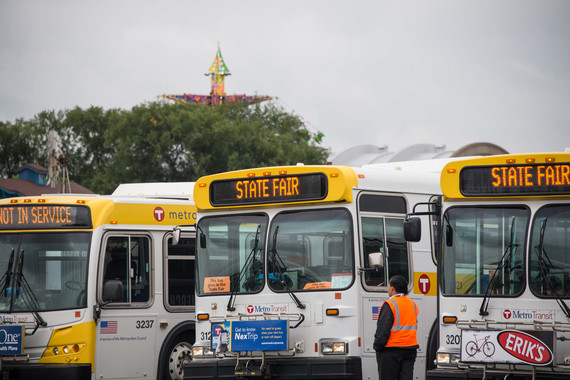
From Brian Funk, Acting Chief Operating Officer
After considerable discussion, we are moving ahead with plans to provide State Fair express bus service from three Park & Rides – I-394 & County Road 73, 28th Avenue in Bloomington and Cottage Grove. Buses will serve these sites every half hour, every day of the fair.
Those who are familiar with our traditional State Fair service know we have historically served many more sites than this. The decision to scale back is a reflection of the fact that we are still about 50 operators shy of our ideal staffing level.
Additionally, customer demand is uncertain as the state experiences a rise in COVID-19 cases. Like regular route service, masks will be required on State Fair express buses and will be made available to those who arrive without one.
This news is another reminder that we are actively recruiting bus operators, and that we need everyone’s help to find and hire talented candidates. If you know anyone who would make a great operator, please encourage them to apply.
Thank you for your patience, understanding and continued support.
Operator hiring events will be held August 17, 21
Two hiring events will be held later this month as efforts to bring on more bus operators continue. At each event, job seekers can submit their application and interview in one visit (applications may also be submitted online in advance). The events will run from 4 p.m. to 7 p.m. on Tuesday, Aug. 17, and from 9 a.m. to noon. Employees who refer successful candidates can earn a $600 bonus. Learn more at metrotransit.org/drive.
More than 70% of Minnesotans who are at least 16 years old have received at least one dose of the COVID-19 vaccine, Gov. Tim Walz announced on Thursday. The number of first doses administered per week is up 129% from one month ago.
Employees can access free COVID-19 vaccines through the Council's Well @ Work clinics. To make an appointment, call 952-967-7468 (Minneapolis) or 952-967-5474 (St. Paul).
At this time, the Council is reviewing a new state policy requiring some state workers to provide proof of vaccination or submit to at least weekly testing.
Remember:
- Masks are required inside all of Metro Transit's support facilities, even if you've been vaccinated. Under federal requirement, masks must be worn on transit at all times.
- Free COVID testing is available through HealthPartners, and mail-in test kits are available at all support facilities. Employees who are asymptomatic can schedule a test at the Well@Work clinic.
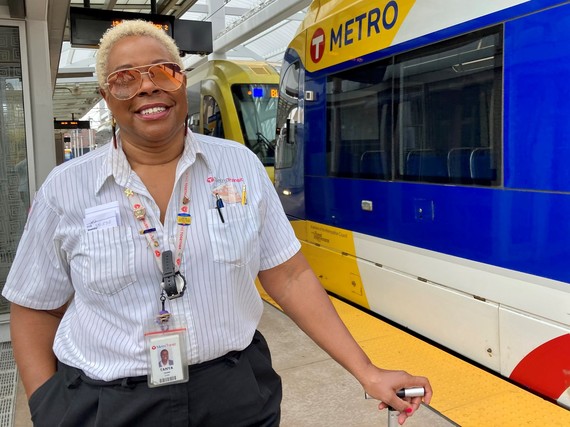
Tanya Young tells people she was raised to be a train operator on the METRO Blue Line.
As a child, she lived just east of Hiawatha Avenue, at the time a one-lane highway with apple trees. Her mom ran a business in downtown Minneapolis, and her grandfather lies in rest at Fort Snelling National Cemetery.
"So, there are these landmarks of my life along the way,’’ Young said.
Young’s career at Metro Transit didn’t begin in light rail, though.
In the late 1980s, she started as a part-time bus operator but left to pursue a career as a tailor for a department store. After running her own sewing and alterations business, she returned to Metro Transit in 2001. Young has been a full-time train operator since 2009.
“I like the freedom of operating a train,” she said. “Once you get in your vehicle, you are on your own."
Sewing remains a pursuit, but today she takes on work for friends and co-workers, including those who’ve lost weight and need their uniforms tailored. "Sewing is definitely my passion,” she said. “I could lose myself in sewing.”
Young has had many memorable moments in her 12 years as a train operator, the most-recent of which occurred this spring. Leaving the Franklin Avenue Station after finishing a shift, she saw a man fall off the platform and onto the tracks, get up and fall again.
“I was thinking, `Oh, my gosh. A train comes through there every 10 minutes or so,'’’ Young said.
Young called the Rail Control Center, which paused an approaching train and called for help. Paramedics soon arrived, carried the man off the tracks, and began to revive him.
“Operator Young’s quick actions likely saved a life,’’ Catrina Boucher, assistant manager of rail transportation, wrote after the incident.
Apply to become a train operator
Bus operators who are interested in transferring to light rail are invited to apply to become a train operator through Friday, Aug. 27. Operators who pass agility testing and an interview will go on an eligibility list according to seniority. Individuals on the eligibility list will be trained as positions open. To learn more an apply, visit metrocouncil.org/employment.
 This bus stop at 26th Street and Lyndale Avenue, in Minneapolis, is considered a favorite of Planner Sonja Burseth's because it has ample room for passengers to board and exit the bus.
Metro Transit planners often get asked how to accommodate bus stops when roads are rebuilt, or new buildings are constructed.
Guidance for designing high-quality bus stops are now summarized in a new design guide they hope will lead Metro Transit and partnering cities, counties, and developers to take a more proactive approach to creating ideal regular route bus stops.
While Metro Transit is responsible for installing and maintaining bus shelters, considerations like sidewalk width, pedestrian access, bike lanes and parking regulations are up to local government. Builders can influence where amenities like trees or planters are located, and keep them clear of areas customers use to board and exit buses.
“This guide is super-visual and easy to use, and we’re hoping it can answer a lot of questions before they’re even asked,” Planner Sonja Burseth said. “There is a lot of productive coordination and goodwill building happening with our partners. This will make those conversations even easier.”
The design guide isn’t intended to be overly prescriptive, but to give Metro Transit staff and partners a clearer sense of the advantages and disadvantages of design choices. Using bumpouts to make more room for shelters near intersections, for example, creates more space for pedestrians but can slow vehicle traffic.
“A lot of times people will say, ‘Why don’t you just tell us what the bus stop should look like?’ and it’s a little bit more complicated than that,” Burseth said.
“The design guide will also support Metro Transit’s commitment to improving accessibility at bus stops,” said Marilyn Porter, director of Engineering & Facilities. In practice, that means leaving enough clear space for riders using mobility or wheeled devices and thinking about things outside the bus stop zone, like curb cuts and crosswalks, that make bus stops more accessible.
Metro Transit relies on other agencies and partners to ensure construction projects maintain or create accessible transit stops.
There are around 12,000 bus stops systemwide, and more than 800 of these sites have shelters. Over the next five years, Metro Transit plans to install new or replacement shelters at 270 bus stops, and to construct accessible boarding areas at an additional 150 bus stops.

Train Operator Robert Molumby, above left, recently retired with 25 years of service. Safety Specialist Bobby Redd, center, right, was joined by co-workers from the Safety Department as he celebrated his retirement after 20 years of service.
Congratulations to these employees who retired in July
-
Vivian Larson, Operator, South, 6 years
-
Kelli Marroquin, Operator, South, 7 years
-
Alan Hinrichs, Operator, Heywood, 9 years
-
Douglas Grandy, Operator, Ruter, 11 years
-
Robert Poore, Welder, 13 years
-
James Mittelstedt, Operator, East Metro, 20 years
-
Daniel Langenfeld, Operator, East Metro, 23 years
-
Judith Bushey, Operator, South, 23 years
-
Steven Lee, Data Collector, 24 years
-
James Juettner, Mark Up Dispatcher, Ruter, 29 years
Congratulations to these employees who celebrated work anniversaries in July
-
Dennis Conley, Mechanic Technician, Ruter
-
Lue Xiong, Helper, Overhaul Base
-
Janice Brumlow, Electronic Revenue Equipment Administrator
-
Bonnie Ripple, Operator, Ruter
-
Bob Brevig, Assist. Transportation Manager, Nicollet
-
Stephen Karanja, Transit Supervisor
-
Trinity Jensen, Coordinator, Material Management
-
Henry Bridges, Operator, Heywood
- Robin Caufman, Director, Administration

Erin Mitchell rejoined the Service Development Department as program manager-transitway planning in June. Mitchell worked at Metro Transit from 1999 through 2014, when she left to focus on homeschooling and raising her children. In her new role, she will lead service planning efforts related to several projects, including MnDOT's study of I-94 between Minneapolis and St. Paul and Ramsey County's study of the West Seventh Street/Highway 5 corridor. Mitchell and her husband live in Minnetonka, where they are raising six children and a dog named Gilbert.
Josh Barnick is a new Mechanic Technician at the Heywood Garage. Barnick has 10 years of experience as an automotive technician. Outside of work his hobbies include ice fishing, boating any enjoying the outdoors.
Shawn Peters, joined the Metro Transit Police Department as a Senior Administrative Specialist in the Business Technology Unit. In this role, he will be handling requests for body worn camera video. Peters was previously part of the security team at M Health Fairview. He is a St. Mary’s graduate and a father of two.
To share information about new hires, promotions, retirements or other milestones, please email insights@metrotransit.org.

South Garage Operator John Decarlo recently received a commendation for his reliable and courteous service.
I ride the northbound Red Line bus from Apple Valley to the Mall of America every weekday. He is kind, courteous and one of the most reliable drivers I have had in my 30 plus years of riding the bus. He is on time and a very safe driver. Thank you for having him on this route - he is fabulous.
|
Bus maintenance exceeding reliability goals: Maintenance teams at each garage exceeded their reliability goals in July, collectively averaging 8,431 miles between road calls. All garages also exceeded their reliability goals in April and Maty. To date, buses have traveled an average of 7,606 miles between road calls. The annual goal is 7,500 miles.
Free on-site flu shots available: Employees can receive free flu shots at the Council’s Well@Work clinics or at two September clinics. The clinics will be held at Heywood Garage, in the second floor training room, from 2:45 p.m. to 4 p.m. on Wednesday, Sept. 15, and from 9:30 a.m. to 11:30 am. on Tuesday, Sept. 28.
Transit Police labeling doorways: Transit Police are labeling doors at all support facilities to make it easier for emergency responders and others to find their way in buildings. The labels are being placed on the frame and on each side of the doors. In the event of an emergency, first call 911. If possible, also contact the Transit Control Center at 612-349-7317. In addition to providing the street address, you may provide the number posted above the doorway.
|