From General Manager Wes Kooistra
Here and across the country, transit ridership is slowly starting to rise as COVID-19 restrictions are lifted and people have more reasons to ride again.
April’s ridership was up 24% compared to the same month last year, when statewide stay-at-home orders were in effect and we encouraged people to use transit only for essential trips.
We hope ridership will continue to grow through the end of the year as more people return to offices, classrooms and events. Following guidance from public health experts, we’re responding to this expected rise in demand by lifting capacity restrictions on our buses and trains beginning today, May 28.
While we’re excited for this next chapter, it could be several more years before ridership returns to the level it was at before the pandemic began. In this context, it is more important than ever that we measure and communicate our success in ways that aren’t centered entirely on ridership.
Among the principal ways we can evaluate our system’s performance moving forward is to measure how accessible and equitable our services are. We must also continue to look at the quality of the service we provide by evaluating things like on-time performance.
While there is work to do, there is also a strong foundation to work from.
Today, more than 20% of the region’s residents, and more than a third of Black residents, are within about a half-mile of high-frequency transit (trips every 10-15 minutes). On average, residents in our region can reach nearly 100,000 jobs within 45 minutes on transit; people of color can reach even more jobs within that trip time.
Our on-time performance, fleet reliability and collision rates all saw improvement in 2020.
Efforts to continue making progress in these and other areas are also in motion. To cite just a few examples:
- Planned investments in our network of Bus Rapid Transit and light rail lines will significantly expand access to high-frequency transit, putting three out of every four Minneapolis and Saint Paul residents within a 10-minute walk or roll of a BRT or LRT station.
-
The combination of bus lanes, transit signal priority and wider stop spacing will make service on more of our busiest local bus routes faster and more reliable.
-
Ongoing investments in our shelter networks are being guided not just by boarding data but a commitment to provide equitable access to these important amenities.
As the transportation and workplace landscapes continue to evolve, when and how people use transit will also change.
We cannot control many of these changes, so we must focus on what we can control. Our truest measure of success will be our ability to provide welcoming, safe, and reliable services that are truly responsive to the changing mobility needs and travel patterns of our riders.
|
As a reminder, capacity limits on buses and trains will be lifted today, May 28, as statewide restrictions on in-person gatherings are also lifted. Customers will continue to be encouraged to keep space between themselves and others when it is possible to do so. Also of note:
- Under a Transit Security Administration order, masks are still required on buses, trains and at waiting areas. The Council policy requiring masks at all worksites also remains in place.
- Employees who have not yet been vaccinated should consider doing so at their earliest opportunity. Vaccines are free and readily available. On Thursday, Gov. Walz announced several incentives for those who receive vaccines in the next month.
- Employees who are experiencing COVID-19 symptoms or who fear they’ve been exposed should contact their manager and health care provider. Asymptomatic testing is available at the Council’s Well@Work clinics.
- The Council’s COVID-19 leave policy remains in effect.
- Data on the number of COVID-19 cases reported at each worksite in the past two weeks will continue to be posted at facilities and on MetNet. See the latest report here.
- Beginning in June, the Council’s COVID-19 updates for employees will be emailed every other week. Relevant updates will continue to be posted on MetNet and shared in other Council newsletters.
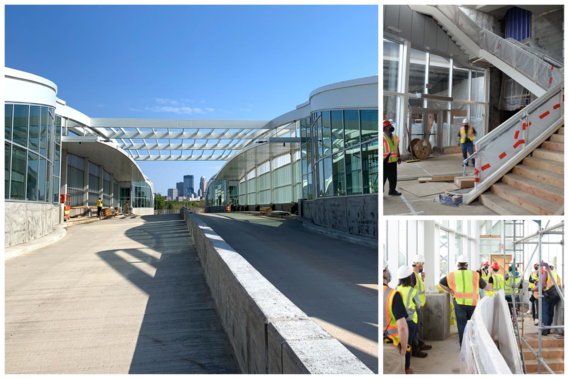
New station at I-35W & Lake Street taking shape
Metro Transit staff got an early look at the I-35W & Lake Street Station last week as construction on the new facility continues.
The two-story station will be a stop on the METRO Orange Line and a boarding area for several express routes and local routes that operate on I-35W and Lake Street. The station is in the center of I-35W, allowing buses to board and drop off customers while staying in designated MnPASS lanes. Other features include real-time signs, heat and light. The entire station will be ADA accessible.
Last week, a plan outlining recommended changes to several bus routes that will connect with Orange Line stations was released. Read more about those recommended changes on the Riders’ Almanac blog.

Efforts to expand the Rail Control Center (RCC) and maintenance areas at the METRO Blue Line’s Operations & Maintenance Facility are nearly complete.
The RCC, where supervisors monitor light rail service, is doubling in size while several new maintenance bays are being added. The expansion will make room for more staff and light rail vehicles at the facility off Franklin Avenue.
As part of the project, the facility’s washing and sanding bay was also expanded to accommodate three-car trains. The bay was originally bult to support two-car trains, which were used when the Blue Line opened in 2004; three-car train sets have been common for the past decade.
The new washing and sanding bay opened earlier this month, and remaining construction is expected to wrap up by this fall.
Current activities include the installation of mechanical and electrical systems, painting, and construction of overhead mezzanines where electro-mechanical technicians can work above trains on the pantographs.
When work on the maintenance area is finished, the facility will go from having nine bays to 14, including the body shop. There will be eight pits and three train lifts.
In July, the RCC’s 43 employees will relocate to a temporary facility for about four weeks so construction can be finished by sometime in August for their return.
Another 27 light rail vehicles will be put into service when the Green Line Extension opens. The first of these new vehicles recently went into revenue service and others will follow as they are shipped and go through testing.
There have been 91 light rail vehicles in the fleet since the Green Line opened in 2014.

Pronouns: she/he/they
Lives: St. Paul
Years of service: 6
Family: 3 children
How did you come to work at Metro Transit and what do you do?
Before coming to transit, my career followed a few paths. I started as a social worker, then opened a LGBTQ bar to serve my community. It was a great adventure, but the Great Recession forced me to close in 2008 and I lost everything. To make up for it, I earned a Commercial Drivers License (CDL) and worked in North Dakota during the oil boom. The work was long, hard, and stressful. It also separated me from my family, and as a non-binary person, I felt very isolated. I eventually came back to the Twin Cities and found work as a truck driver. Then after watching a bus, it dawned on me to apply to Metro Transit – instead of hauling product, I could haul people. As someone with a degree in social work, I prefer working with people. This desire eventually led me to apply and become a transit supervisor, where I can help both operators and customers.
What do you like the most about being “On the Clock”?
I like that there’s room for growth here. I started as a bus operator and eventually worked my way into becoming a transit supervisor. As a transit supervisor, I travel around in a van to support our operators on the road with a host of issues. As someone who truly enjoys working with people, it’s a great position for me. I begin a shift with this question, “What can I do to help today?” As someone who used to be a bus operator, I know how hard the job can be and that at times you can feel isolated. Having someone who knows what it’s like and can assist when things go wrong is invaluable. While I don’t hope for bad things to happen, I’m glad that as a transit supervisor, I’m able to use my social worker skills to help people during or after an issue occurs.
What are your favorite activities when you’re “Off the Clock”?
Years ago, one of my daughters helped raised chickens at her elementary school. She became very interested in it and eventually we brought chickens to our home in Midway. We raised three to four chickens at a time. Until you have a chicken, you don’t realize how social these birds are and how they each have different personalities. During the high times, they lay an egg once a day. That would give us far too many eggs to eat ourselves. So, we’d give many to friends and neighbors. Today, my two daughters have left for college, but my home hasn’t become an empty nest. I continue to raise chickens in my backyard with the help of my foster child.
Operators: Encourage customers to “Ride With Pride” in June
Pride Month is a celebration of the Lesbian, Gay, Bisexual, Transgender and Queer (LGBTQ) community. It is celebrated in June to commemorate the Stonewall riots, which occurred in June 1969 and served as a catalyst for the gay rights movement.
In recognition of Pride Month:
-
Bus operators are invited to use PR-Code 18 to display "Ride With Pride" on their overhead display.
-
A "Brunch & Learn" about allyship in the workplace will be hosted by the Council’s Pride Employee Resource Group (ERG). The online event will be held from 10 a.m. to 11 a.m. on Tuesday, June 22.
The Pride ERG hosts monthly discussions and serves as a support network. For more information, contact Dave Hanson or Nia Colebrooke.
The traditional Twin Cities Pride march will not be held but several other events are planned. The 49th Annual Twin Cities Pride Festival will be held in Loring Park on July 17-18. Learn more at tcpride.org.
|

Imee Clark, Facilities Administrator
Tell us a little bit about your background and your role at Metro Transit.
I was born and raised in the southern part of the Philippines, on an island called Mindanao. My mother is half Filipino and half Spanish (from Spain) and my father is of Malaysian, Burmese, and Middle Eastern heritage. I immigrated to the U.S. back in the ‘80s. I am happily married and have two wonderful children. I worked for American Medical Systems, and Northwest/Delta Airlines prior coming to work at Metro Transit as a facilities administrator.
What are some of the traditional foods you’d enjoy in an everyday setting?
I have so many favorites but pancit, Lechon and lumpia are the dishes I like the most. We serve these foods at parties, Fiesta celebrations and other special occasions. You can find Pancit, lechon and lumpia dishes in every Filipino restaurant menu across our country.
There are two kinds of pancit – Pancit Bijon, made up of long, thin, translucent rice noodles, and Pancit canton, made up of egg noodles. The noodles are stir fried with vegetables and the meat or seafood of your choice.
Lumpia are spring rolls with ground pork, chicken, or beef. We wrap the stir fried meat and vegetables in thin crepes called Lumpia wrapper, deep fry them to golden perfection, cut and serve. Lumpia is served as appetizer in many restaurants.
Being a Pacific Islander and growing up next to the ocean, I also eat a lot of fish – steamed, grilled or cooked in the stove with homemade sauces. And we have all kinds of sweets, like Leche plan, cassava cake, halo halo, rice cake, fruit salad and macaroni salad that are served as deserts. Halo-halo is one of my favorites.
What is a favorite food you enjoy at a special celebration?
Lechon, or roast pig, is the main attraction at every special occasion or celebration in the Philippines and it’s one of my favorite foods.
Where can you find Filipino food locally?
In Minneapolis, we have an upscale Filipino-American Bistro with a good selection of dishes called APOY on Nicollet Avenue. On Thursdays, they also have boodle fight kamayan, which is when you share a meal without dishes or utensils. It’s a fun dining experience to share with friends and family.

East Metro Garage bus operator LaShaun Buckner recently received a commendation from a customer who appreciates their attention to detail and calm demeanor. .
I had the pleasure to have LaShaun as my driver for my commute. I have had other great experiences with this driver prior. I have written reviews about other drivers before about how they stand out, but he’s a rockstar driver. I really noticed how cautious and safe he is. I see how LaShaun cares for riders, almost treating them as a guest than a passenger. If a passenger is unruly, he takes a calm approach that makes a person respect him and others. Metro Transit is lucky to have a driver like this. Thank you LaShaun and Metro Transit for your service.
|
The “Beginning Conversations on Race” series, facilitated by members of the Equity & Inclusion Team and Equity & Inclusion Coordinator Rachel Cagle, continues for the next three weeks. The first session was held on Thursday, May 27, but employees who were not able to attend are still invited to join future conversations.
Each session is scheduled to last about an hour and begin at noon. If you have not received a calendar invite, please email Rachel Cagle. Remaining sessions in the series include:
- Thursday, June 3: Economic Repercussions of Race
- Thursday, June 10: Whiteness as the Dominant Culture
- Thursday, June 17: Action through Allyship
Employees who would like support hosting smaller, guided group discussions about race at other times can find resources on the Equity & Inclusion page on MetNet and are invited to contact Rachel Cagle.
Save the Date: Juneteenth
The Equity & Inclusion Team is planning a virtual event and other recognition of Juneteenth, which will be celebrated on Monday, June 14. Also known as Freedom Day or Emancipation Day, Juneteenth is the oldest known celebration commemorating the ending of slavery in the United States. More information will be shared soon.

Recent staffing changes have been made to reflect an increased commitment to internal and external communications and outreach.
-
Howie Padilla (he/him/his) will serve as the Senior Manager of Public Relations. In his new role, he will advise senior leaders on a wide array of communications issues and serve as a communications liaison to the Metropolitan Council and our partner agencies.
-
Drew Kerr (he/him/his) will serve as Communications Manager. In his new role, he will focus primarily on internal communications and work closely with the Equity & Inclusion Team to develop and advance more effective ways to communicate with employees across the agency.
-
Sam O’Connell (she/her/hers) will serve as Assistant Director for Community Affairs. In this role, she will continue her existing duties overseeing outreach, engagement and communications for the Green line Extension and Blue Line Extension while managing Metro Transit’s Outreach and Customer Relations Departments.
The positions all fall under the direction of the Chief of Staff, Lesley Kandaras, who oversees the Administration, Communications and Media Relations and Equity and Inclusion departments.
A posting for a Transit Equity Senior Manager also recently closed. The manager will influence key decisions, plan and implement strategies that support equity best practices and lead a staff of two full-time employees focused on equity and inclusion
Reminder: Hirings, promotions, retirements and other employee milestones can be communicated through department-level emails and the Insights newsletter. Please send information to insights@metrotransit.org for inclusion in a future issue.
A mass shooting at a light rail facility in San Jose, Calif., this week is a reminder that all employees should have a plan in case they are confronted by an active shooter or hostile intruder.
Remember, if you feel threatened, see someone with a weapon, or find a weapon, immediately report it to a manager, a member of the Threat Management Team, or another person in authority. Metro Transit’s Threat Management Team representative is Police Chief Eddie Frizell.
If a situation turns violent, immediately call 911.
All of us can help create a safe workplace by:
-
Having employee badges visible when on duty.
-
Properly securing exterior doors.
-
Reporting suspicious individuals or behaviors to the Transit Control Center at 612-349-7317.
As a reminder, these resources are also available to staff:
-
Professional counseling services are available 24/7 through Sand Creek. For more information, call 1-888-243-5744 or visit sandcreekeap.com.
Housing vouchers will support effort to serve people experiencing homelessness: The Council’s Housing and Redevelopment Authority will receive 218 new emergency vouchers to help connect people experiencing homelessness to housing and housing stability. The vouchers will help expand a partnership with the Metro Transit Police Department’s Homeless Action Team. To date, the HAT team has helped more than 200 households find permanent housing. Learn more at metrocouncil.org.
Transit service on Memorial Day: Metro Transit buses and the METRO Blue & Green lines will follow Sunday/Holiday schedules on Memorial Day (Monday, May 31). Northstar will not operate. The Service Centers, Transit Information Center and Customers Relations/Lost & Found will be closed.
Buses replacing Green Line trains June 4 through June 7: Buses will replace Green Line trains between the Capital/Rice Street and Snelling Avenue stations from 7 p.m. Friday, June 4, through, the first scheduled pull-outs on Monday, June 7. Replacement buses are being used so crews can repair a rail break.
|