|
|
https://content.govdelivery.com/accounts/MNORGMETC/bulletins/2bce08c
|
|

From General Manager Wes Kooistra
Investing in transit builds community prosperity, improves our quality of life, connects people to opportunity and plays a critical role in addressing our climate crisis.
In 2019, Gov. Walz called for a transformational 10-year, comprehensive investment in our region’s transit system, including the build out of our Bus Rapid Transit network.
Last year, the Governor and Legislature took an important step toward advancing this vision by investing $55 million in state bonds to begin building the METRO D Line and METRO B Line arterial Bus Rapid Transit (BRT) projects.
On Tuesday, Gov. Walz announced his proposed 2022-2023 biennial budget. The spending plan is designed to address immediate state revenue shortfalls and to support those who have most suffered economically from the COVID-19 pandemic.
Unlike the Governor’s 2019 budget proposal, this year’s proposal does not call for a metro wide transit-dedicated sales tax. This is because the Metropolitan Council was fortunate to receive one-time, transit-dedicated federal relief funds that allow us to address our significant near-term needs in state fiscal years 2022 and 2023.
The first federal relief bill, passed last year, brought $226 million in transit funding to our region. The most recent relief package will bring another $186 million to support our region’s transit needs. These federal funds are shared among all transit providers and services in the region.
We are grateful for the portion of this federal relief allocated to Metro Transit. Absent these funds, considerably greater reductions in transit services and job losses would be required to balance our budget. With these funds, we can adjust service levels and manage job loss through attrition.
The one-time federal relief will cover significant bus, rail and Metro Mobility operating budget shortfalls over the next two years.
The federal relief funds will also allow us to advance delayed capital maintenance projects. These projects are critical to keeping our bus and rail infrastructure in a state of good repair.
Historically, we have had to choose between operating and essential capital maintenance demands in the uses of our limited Motor Vehicle Sales Tax revenues. Now, we can provide short-term relief to our operations and bring these critical capital projects immediately into our Capital Improvement Plan.
Moving forward with these capital projects will preserve our existing system, contribute to the recovery of the region’s economy and provide more contracting opportunities for disadvantaged BIPOC- and female-owned businesses.
Additionally, the federal relief funds will allow us to invest more resources in transit security initiatives to increase an official presence on our system. Safety on our transit system is a clear priority of our riders and operators, and a top priority of Metro Transit.
Gov. Walz first supported the policy of administrative citations for fare evasion in 2019, which would allow employees other than sworn police officers to inspect fares and issue citations. This change will enable the Council to develop an alternative citation with a lower fine handled in-house and not in the courts. We are hopeful this legislation will advance in 2021.
Finally, we must recognize that the federal COVID-19 relief funds offer temporary, short-term relief and only postpone the transit structural deficit, bringing greater challenges as a result of the longer-term revenue and cost implications of the pandemic.
In the long-term, transit requires a funding source that is reliable, sustainable and large enough to address the structural deficit and the capital maintenance needs of an aging system and to advance transit to make transformational change in our region’s mobility.
Continue reading: Council Chair Charlie Zelle on continued safety & security efforts, including the pursuit of an alternative to fare evasion citations
|

The family of a former Metro Transit operator celebrated his release from Regions Hospital this week after a 10-week battle with COVID-19.
Glenn Vierling, 74, was discharged on Wednesday, though he still has a ventilator and faces a long recovery. Vierling retired from Metro Transit in 2012 after nearly 37 years of service. His son Justin also spent 20 years as a bus operator.
Speaking to Fox 9, Vierling's wife of 42 years described the staff who looked after him as "angels" and thanked them for being by his side while he was separated from his family.
Watch the Fox 9 story on Glenn Vierling's hospitalization
Vaccine distribution for Met Council employees
Met Council leadership anticipates the next phase of distribution will include a significant number of frontline employees. State officials anticipate phase 1b will begin in February, depending on availability of vaccine doses from the federal government. Additional guidance on the 1b rollout may not arrive until mid-February. More information will be shared as soon as it is available.
Learn more about COVID-19 vaccine phases and planning
Review COVID-19 case data by worksite
Every Friday, the number of confirmed cases of COVID-19 reported to the Employee Resource Center in the previous week will be reported in Insights. Managers and supervisors are encouraged to post this information at work sites.
See the latest COVID-19 cases by worksite
Learn more about Metro Transit's COVID-19 response on MetNet
|
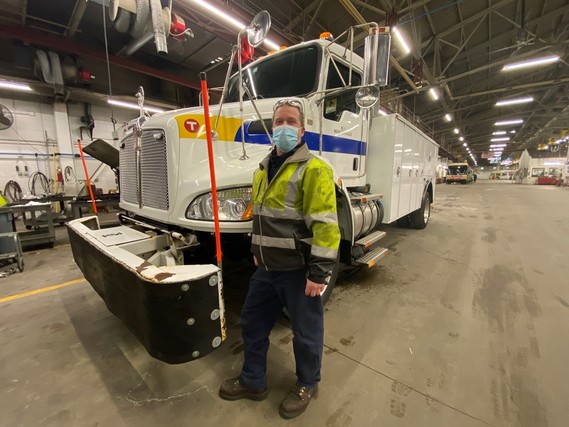
Heywood Mechanic Technician Dan Aasen with a rarely used tow vehicle.
Both Bus Maintenance and Light Rail Vehicle Maintenance beat annual goals that measure how frequently in-service buses and trains need to be fixed.
Buses traveled an average of 7,501 miles between road calls last year, just above the annual goal, while light rail vehicles went an average of 26,204 miles between failures, beating the annual goal of 25,000 miles.
In December, Bus Maintenance also averaged 9,893 miles between road calls, representing a 15-year high for the month.
"Last year's accomplishments are nothing short of amazing,” said Matt Dake, Director of Bus Maintenance. “It is not only the result of our highly committed team, but the great working relationships we have with partners in Transportation, the Transportation Control Center, Engineering and Facilities, and others.”
Bus and light rail maintenance departments hiring cleaners
Bus Maintenance and Light Rail Vehicle Maintenance are looking to bring on new employees who will help clean and maintain buses and trains.
Cleaners and Helper/Cleaners typically work evening/ night shifts and are responsible for cleaning vehicles inside and out, among other duties. The new hires will fill existing vacancies. Applications for Bus Maintenance’s Cleaner posting must be submitted by Wednesday, Feb. 3; applications for Light Rail Vehicle Maintenance’s Helper/Cleaner position are being accepted on a continuous basis.
Applications are also being accepted for electronic repair technician, stockkeeper and body shop supervisor. To learn more and apply visit metrocouncil.org/jobs.
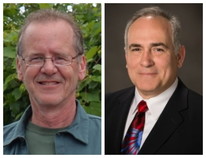
Stockkeeper David Steen, left, was tidying up at the end of the day and about to grab his coat when his chest tightened. He paced for a few minutes, then sat down at his desk. Breathing heavily and sweating profusely, he picked up the phone and called his manager, Chris Haefner, right.
The call likely saved his life.
Two weeks later and recovering at home, Steen reflected on the afternoon he suffered a heart attack at the Overhaul Base, where he works in the Brake Shop. While he doesn't remember every detail, one thing is clear: the actions of his co-workers made all the difference.
"The doctors told me if I'd gone just a couple more minutes without anyone intervening, I would have been gone by the time paramedics got there," Steen said.
Steen's left anterior descending (LAD) artery was fully blocked. The artery carries fresh blood to the heart and full blockage can quickly stop the heart – why the type of heart attack Steen suffered is sometimes referred to as a "widowmaker."
The most important step taken to save the crucial minutes Steen needed was Haefner's immediate decision to call 911. After placing the call, he ran to Steen's work area, briefly comforted him and directed a technician to flag paramedics at the designated bay door.
Others stepped in to clear the area and retrieve a nearby automated external defibrillator. The portable device wasn't used but could have helped to restore a normal heartbeat.
After 26 years in the U.S. Army and nearly six years in the Transit Control Center, Haefner is no stranger to emergency situations and says he often plays scenarios out in his mind. But he's never had to execute like this, he said.
Now, Haefner and Steen hope this story will serve as a reminder to all employees to think about how they'd respond if someone was in need.
Steen has thanked Haefner and others who came to his aid. But the gratitude goes both ways.
"For me, the reward is knowing that when there was a crisis and someone needed my help I was there to help," Haefner said. "Having the privilege, and it is a privilege, to be there for someone when they're in such a moment of distress is more than anything anybody can give you."
|
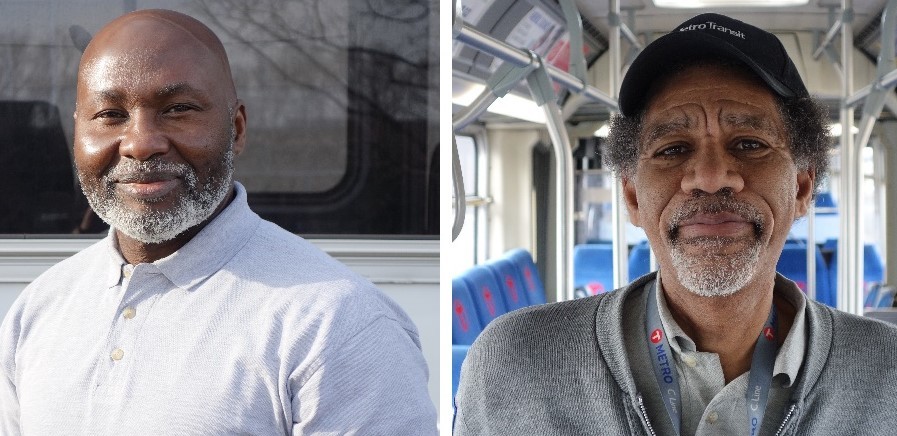
Two long-serving operators are celebrating their retirements this month.
East Metro operator Topee Jackson, above left, is retiring with 31 years of service. Jackson immigrated form Liberia to the United States in 1981. While pursuing a career as an electrician, he heard a radio commercial for part-time, weekend operators. He was always looking for extra income to send back to his parents in Liberia, so he applied. After a month on the job, he decided to go full time. "I found out I love driving a bus!" he said. "It's cool to be able to meet and talk with customers."
In retirement, he plans to spend time with his children and grandchildren. During winter, he'll travel to Liberia to fix up his childhood home, wrecked by the civil war, and to spend time with some family there.
Heywood Operator Richard Bledsoe, above right, is retiring with 30 years of service: Bledsoe spent his entire career at Heywood Garage where managers described him as quiet and hardworking. Customers regularly complimented him for his calm, quiet and consistent demeanor onboard no matter what was going on.
To celebrate a retirement, promotion or new hire, email insights@metrotransit.org.
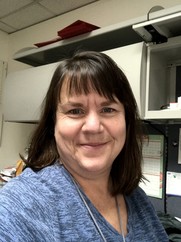
Across the organization, our work has been changed by the COVID-19 pandemic. These "In This Together" Q&As illustrate how we're adapting both on and off the clock. Read more interviews here.
How has the pandemic affected your day-to-day work?
I am the Industrial Hygienist here at Metro Transit and one of my jobs is approving the chemicals and Personal Protective Equipment (PPE) that can be used here, always looking out for the safety of our employees. The first several months of the pandemic there was a tremendous increase in product approvals for disinfectants and PPE. Materials Management was continuously requesting approvals for various items in a time when there were shortages nationwide. Responses were needed ASAP. Research on whether items were EPA approved against COVID-19 and how to apply the disinfectants was necessary before anything could be approved. Safety training that used to be in-person is now online. I really do miss the interactions with employees and being able to teach them in person. Safety is important in all we do.
What’s it like working through a pandemic?
There are many benefits from working from home – the commute being at the top of the list, especially now that the snow has arrived. I also like the extra sleep I get from not having to spend time commuting and getting ready each day. But I do miss the everyday interactions with my co-workers who are deemed on-site essential. They have been a great support for me and there are days I wish I could be there supporting them.
How has your life changed outside of work?
My volunteering has decreased substantially. I used to spend many of my days after work at a local nursing home. I didn’t realize how much I was getting out of it until it was all taken away. I do my best to support them from afar, but it just is not the same. We have all felt some isolation from family and friends, and so do I. We added a new puppy to our house, which has really brought joy and WORK to our lives. I am an avid gardener and will spend many hours this winter planning for next year. The seed catalogs are starting to arrive. Here’s to a peaceful and joyful new year for all!
|
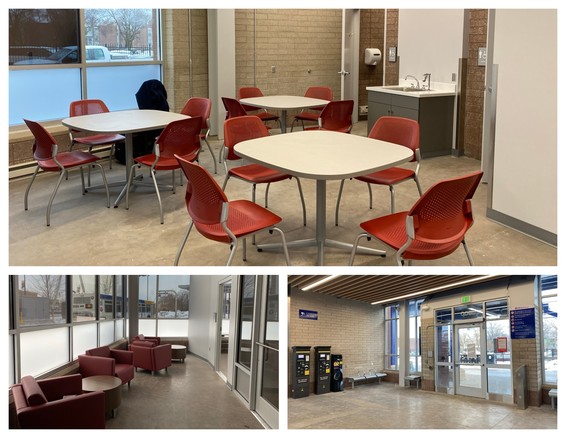
Renovations at the Brooklyn Center Transit Center (BCTC) have created a more welcoming space for customers and staff.
After more than six months of construction, most of the work has been completed and an indoor customer waiting area will reopen on Monday, Feb. 1.
The refreshed waiting area, below right, includes ticket and Go-To Card vending machines, real-time departure signs and improved public restrooms and lighting. The indoor waiting area will be open from 4 a.m. to 10 p.m. daily.
Areas for Metro Transit police, operators and transit supervisors, top and above left, were also improved. The facility now includes a quiet room that staff can use for spiritual needs or as a personal space.
New concrete, canopies and accessibility improvements were completed at the transit center last year. There are still a few items to be handled in the spring, including painting and fence replacement.
The Brooklyn Center Transit Center is one of the region’s busiest boarding areas and is served by nearly a dozen bus routes, including the 5, 19, 22, 724, and METRO C Line.
-
Equity & Inclusion Team expanding: Employees who are passionate about expanding the network of influence on our equity & inclusion goals will soon have a chance to join Metro Transit’s Equity & Inclusion Team. The team is expanding to support a range of efforts including internal communication improvements and celebrating diversity at Metro Transit and in our region. The team is committed to having representation from each work site. All employees are eligible to apply. Applications will be accepted from Friday, Feb. 12, through Friday, March 5. Team members meet regularly for at least one hour and take on other duties as assigned. Time spent working on behalf of the Equity & Inclusion Team is paid at an employee’s standard wage. New members will join the team this spring and should expect to serve a two year term. For more information, contact Sarah Berres.
-
W-2s now available in ESS: If you have previously consented to receive your W-2 electronically, sign on to Employee Self-Service (ESS) to access and print the form. If you have not yet signed up to receive a W-2 electronically, sign on to ESS and follow the instructions. For employees who choose not to receive an electronic W-2, paper W-4 forms will be printed and mailed by Feb. 1, 2021. Tax Form 1095-C, which provides proof of health insurance, will be available by March 2. Tax returns can be filed without the 1095-C. If you need help or have questions about ESS, ask your manager or coordinator. Questions about W-2 forms can be directed to payroll@metc.state.mn.us.
-
Feedback sought on Orange Line service plans: Feedback is being sought on proposed changes to 11 bus routes that will connect with the METRO Orange Line when it opens later this year. The most significant proposed changes include the elimination of routes 535 and 597, which will mostly be replaced by the Orange Line, and the addition of new route between the Orange Line and Normandale Community College. An online survey is open through February 22. Several virtual open houses will also be held in February. Proposed changes are expected to be finalized this summer and implemented this fall.
|
|
We at Metro Transit deliver environmentally sustainable transportation choices that link people, jobs and community conveniently, consistently and safely. |
|
|
Metro Transit’s employee newsletter, Insights, is published weekly. Employees are invited to submit comments, letters to the editor and story ideas.
Contact the editor at insights@metrotransit.org.
© 2020 Metro Transit
|
|
|
|
|