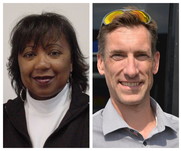
From Marilyn Porter, Director-Engineering & Facilities and Adam Harrington, Director-Service Development
For the past several months, we’ve been jointly leading efforts to ensure our facilities are safe for those working on site while planning for the return of those working from home.
With a lot of help from a lot of people, we’ve come a long way.
Throughout our buildings, you can find temperature screening stations, hand sanitizer dispensers, plexiglass dividers and decals reminding people to keep a safe distance. We’ve also installed air purification units in high-traffic areas and are looking into more advanced HVAC technology that could help further clean indoor air.
These and other efforts are described in our Employee Preparedness Plan, an evolving document where employees can find more information about our response to the COVID-19 pandemic.
In addition to our facility improvements, the document addresses efforts to identify and respond to cases of COVID-19 among staff and to keep our facilities and vehicles as clean as possible. If you have not yet reviewed this plan, we encourage you to do so and to let your manager know if you have any questions or concerns.
We are proud of the progress that’s been made and want to thank all those who have helped get us to this point. We are especially grateful for the facilities employees who have gone above and beyond for almost a year now, and for all the on-site staff who are doing their part by wearing face coverings, practicing social distancing and closely monitoring their health. This is a true team effort.
While we’re confident our workplaces are as safe as they can possibly be, we will continue looking for ways to improve and respond to evolving public health guidance. If you have ideas about how we can do better, please let us know.
Like employers everywhere, we are also thinking about how our workplaces may be permanently altered by this pandemic. Efforts to improve indoor air quality, for example, are likely not going to go away. Our office spaces may also become more flexible as some employees continue to telecommute part of the time.
While we’re putting a lot of effort into our pandemic response, many other facility projects are still moving forward. New fuel dispensers, hoists and energy efficient LED lights are making our facilities safer and more efficient. Renovations to the maintenance area at Nicollet Garage will begin mid-year.
For all the progress we're making, we know we must continue to move forward carefully, continuing current practices of physical distancing and wearing face coverings.
While we are excited for those who have not been in the office to enjoy our facilities again, staff who are not currently working on site should continue to plan on working from home through at least the end of June.
So, for those of you who are reporting to our facilities: Thank you for keeping these spaces as safe as possible as you provide essential services. And for those of you who are eager to return: Thank you for your patience. If we all continue to do our part, we’ll be together again soon.
Marilyn Porter and Adam Harrington are jointly leading Metro Transit’s efforts to create safe workspaces and prepare for the return of more employees. These efforts are coordinated through Metro Transit’s Incident Command, which oversees the agency’s overarching response to COVID-19 in coordination with the Metropolitan Council. Questions and feedback can be submitted online or through a manager or supervisor.
|

A new and more contagious variant of the virus that causes COVID-19 is leading public health officials to reinforce the precautions we can all take to protect ourselves and those around us. In practice, that means:
-
Distancing from individuals who aren’t a part of your household whenever possible. Breakrooms should be occupied only by a limited number of on-duty employees. Employees should not enter buildings more than 15 minutes early for their work.
-
Wearing face coverings whenever you’re indoors or around others – even if you’ve had COVID-19, and even after you’ve been vaccinated. Masks should be properly fitted and cover both the nose and mouth. Masks with multiple layers are more effective. Operators are encouraged to bring extra masks with them so they can be provided to customers who need them. Please see a manager if you need masks for distribution to customers or for yourself.
-
Seeking testing if you feel ill or fear you’ve been exposed. Several free testing options are available to employees and their family members. In most cases, no appointments or insurance is required..
Bulletin: Keeping Us All Health (issued January 19)
Download and post a “Masks are a must” poster at your worksite
Review a list of community testing sites
Learn more about Metro Transit’s COVID-19 response
New York Times: Here are steps you can take to protect yourself from the new coronavirus variant
Vaccine eligibility expands to include 65+ residents, educators
Vaccination efforts are expanding but there continues to be a very limited supply of COVID-19 vaccines in Minnesota. Currently, vaccines are available to residents who are 65 years or older, pre-K through grade 12 educators and child care workers. The Council continues to advocate that vaccinations be available to transit workers as soon as possible. At this time, the vaccine will not be required as a condition of employment. However, receiving the vaccine is highly encouraged.
Learn more about the COVID-19 vaccine and Minnesota’s vaccination efforts
Review COVID-19 case data by worksite
Every Friday, the number of confirmed cases of COVID-19 reported to the Employee Resource Center in the previous week will be reported in Insights. Managers and supervisors are encouraged to post this information at work sites.
See the latest data on COVID-19 cases by worksite
Find the latest transit, COVID-19 news on MetNet
Every week, the Transit Tracker will provide a round-up of news from across the transit industry and some of the latest COVID-19 developments. The Transit Tracker can be found on the Insights MetNet page. To suggest stories or offer feedback, email Drew Kerr.
|
Nearly all the lights at support and public facilities have now been converted to energy-efficient LEDs, the result of a two-year, all-out effort to replace as many lights as possible.
While conversion efforts will continue for the next few years, around 85% of the 20,000 light fixtures found at support and public facilities are now outfitted with LEDS.
Interior and exterior improvements have been completed at all the garages and the Overhaul Base. Future work will complete the conversion to LEDs at the Heywood Office, Transfer Road, the Transit Control Center and elsewhere.
In addition, LED lights were recently installed at several light rail stations and Park & Rides, including County Road 73 and the 28th Avenue Park & Ride.
Around $2 million has been put toward the lighting improvements in the past few years, an investment that is expected to be recovered in about five years. Generally, LED lights use about 75% less energy than incandescent lights.
“This is low-hanging fruit where you can really make a lot of impact,” said Jeff Freeman, a senior project coordinator who helps manager Metro Transit’s sustainability efforts.
As part of the conversion, fixtures have been removed, added or shifted to better illuminate workspaces. Timers that automatically dim or turn off lights when no one is in the area have also been installed.
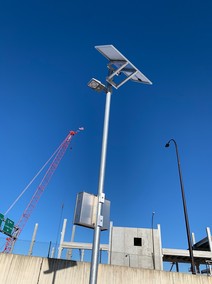
The improvements have also created opportunities to address safety concerns. New lights were installed at a parking lot behind the Green Line Operations & Maintenance Facility and solar-powered lights now illuminate a parking lot north of the Operations Support Center.
Employees who have feedback about lighting in their work area should speak with a manager or supervisor who can alert facilities staff.
Above left: A recently installed pole light outside the Operations Support Center runs entirely on solar power.
Team to seek input on Council-wide Climate Action Plan
Soon, staff will be invited to help shape a new Climate Action Plan to unify the Metropolitan Council’s climate change response. The plan will define strategies that guide efforts to reduce emissions and adapt to climate impacts in each of the Council’s divisions, including Metro Transit. In the coming months, staff will be invited to share their climate-related work and attend meetings. By March, a MetNet site about the effort will launch. The plan is expected to be adopted by the Council in 2022.
|
Feedback is being sought on proposed changes to11 bus routes that will connect with the METRO Orange Line when it opens later this year.
The Orange Line is a 17-mile Bus Rapid Transit (BRT) line that will operate largely along Interstate 35W between Minneapolis and Burnsville.
The most significant proposed changes include the elimination of routes 535 and 597, which will mostly be replaced by the Orange Line, and the addition of new route between the Orange Line and Normandale Community College. A new crosstown connection along I-494 has also been proposed.
Feedback will be sought from January 25 through February 22 in an online survey. Several virtual open houses will also be held in February.
Proposed changes are expected to be finalized this summer and implemented this fall.
Learn more about the METRO Orange Line Connecting Bus Service Study
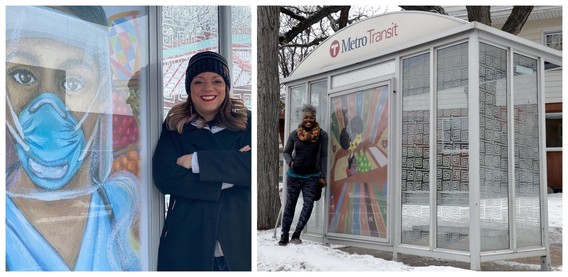
Melodee Strong, above left, and Timi Bliss, above right, are among five artists whose work will appear on buses and at waiting shelters over the coming months. Each piece was inspired by the COVID-19 pandemic and recent civil unrest.
In the image Bliss created, a depiction of her granddaughter Charlie and dog Sensei are surrounded by colorful sunrays and the words “Community” and “Resilience.” “I want people to look, smile and engage with it, and also to walk away with a sense of hope and happiness,” she said.
Continue reading on the Riders' Almanac blog

Metro Transit Police Department Sgt. David Lund appreciated Heywood Operator Scott Crompton’s help when dealing with a group of unruly passengers.
There were 20 people at the 38th Street platform who needed to disembark for the nightly Blue Line train pull-in. Some upset passengers still needed to go downtown, but the last northbound Route 22 bus already passed. So, they boarded the last southbound bus and demanded to be brought north. This generated a call for police service. Mr. Crompton drove his bus to the platform and boarded all 20 people. He was so gracious and helpful. I thanked him, and he simply replied, "Hey, this is my job." I am very grateful for his help. Had he not been there, I am not sure how my officers and I would have solved the problem.
|
-
Reminder – free counseling available to employees: Sand Creek EAP is available to all employees and members of their households to assist during this difficult time. Services include a 24-hour crisis hotline, short-term counseling and professional counselor referrals. They also have thousands of articles, videos and online seminars available at your convenience. For more information, call 1-888-243-5744 or visit sandcreekeap.com.
-
Apply to join community planning committee: Help ensure diverse voices are included as the Council continues its review of the Metro Transit Police Department by encouraging applications for a community planning committee. The committee will help design a survey and interview tool and plan online forums that will begin next month. Applications are being accepted online here. For more information, contact info@tcia.org.
-
Questions about 2021 salary increases: Non-represented employees and those represented by AFSCME, MANA and TMSA have been wondering about salary increases for 2021. Compensation is established in our collective bargaining agreements and most are not yet negotiated or finalized. In addition, step increases can’t be implemented until agreements are reached. Employees will be notified when more information is available. Negotiations with the ATU Local 1005 are also ongoing.
|