|
In this Issue
2020 has been a long, difficult year. We are all in this together and we will get through it. Together, we will continue to adjust to the COVID-19 pandemic, rebuild our economy, and address systemic racism in our state and region. Please continue to help slow the spread of COVID-19 and wear a mask, wash or sanitize your hands often, and stay six feet from others. I hope you have safe and happy holidays and look forward to a better 2021.
Thank you to the Metropolitan Council’s more than 4,000 employees who continue to adjust how we do our work and deliver essential services to the region. Together, we are continuing to provide transit service, helping provide special transit service for our frontline health workers, ensuring operations at the region’s wastewater treatment plants continue, supporting local governments with their work, and providing options to people who need housing. The pandemic has provided an opportunity for us to examine new ways for us to continue supporting our customers and the communities we serve.
- Transit ridership has been down significantly this year, but we have continued to operate local bus and rail service on regular schedules to assure passengers and operators can safely distance on our vehicles.
- Our contracted services group has continued to support Metro Mobility ADA-mandated services, and we have been able to augment services. Throughout the year, contracted services have supported grocery, goods, and food shelf delivery. In addition, contracted services have provided nearly 127,000 trips for our region’s healthcare workers.
- Staff have continued to engage communities, at a safe distance, in all aspects of the region’s planning and operations, including a survey of our transit customers about how they feel about transit, safety, and the impacts of community unrest on transit service.
Community conversation on Metro Transit system and police experiences
Earlier this fall, we finalized our partnership with the Citizens League to engage customers and communities in conversations about their experiences with the transit system and Metro Transit Police Department. This conversation will deeply engage community around questions of safety and the impact of interactions on and near our region’s transit system. The Citizens League team is putting pieces in place and conversations will be more prominent in community beginning soon. This initial phase of engagement will extend through spring 2021.
We are working to balance how we engage with community during the pandemic, but know how important this conversation is. We want to intentionally center our customers and communities in this process. They will be leading the way as we examine what safety really means for our operators, customers and communities riding our system. Stay tuned for more information about how to follow this process and connect with this work.
Legislature passes and Governor signs bonding bill, B Line for Saint Paul
In October, the Legislature passed and Governor Walz signed a bonding bill that authorizes $1.36 billion in general obligation bonds, $300 million in trunk highway bonds, and $100 million in housing infrastructure bonds. The bonding bill included funding for several Metropolitan Council priorities, including $55 million for Bus Rapid Transit, $5 million for Regional Parks and Trails grants, $5 million for Inflow and Infiltration Mitigation grants, and $29 million in pass-through grants to regional parks and trails. Most important for Saint Paul, the Metropolitan Council and Metro Transit can move forward with constructing the B Line. The B Line will be the next game-changer for transit in Saint Paul, providing faster and more reliable service from the Union Depot in Downtown Saint Paul to Uptown Minneapolis, along Selby, Marshall and Lake Street.
Como/Maryland and Rice/Robert in the mix for future Bus Rapid Transit Lines
Metro Transit has evaluated and identified the top candidates for future bus rapid transit lines as part of Network Next. Now, we are asking the community to rank the top corridors to help prioritize implementation using an online survey. The corridors to choose from for near-term implementation are Central (Route 10), Como/Maryland (Route 3), Johnson/Lyndale (Route 4), and Rice/Robert (Routes 62 and 68). Once prioritized, three corridors will be designated as the future METRO F, G, and H Lines. Take this short survey and let us know which corridor you think should be next and why.
Lake Street and Midway
The outrage sparked by the murder of George Floyd this year has made us all ask what we can do to end systemic racism and support the communities affected by it. Saint Paul's Midway and Minneapolis' Lake Street were most impacted by the unrest and we need to do what we can to support our communities. These neighborhoods have been incubators for small and minority-owned businesses. While the upcoming D Line and B Line BRT will bring significant investment to Lake Street, we still need to help our businesses and residents in whatever ways we can. Please support local businesses, neighborhood organizations, and charities rebuilding Lake Street and Midway.
Riverview Corridor Meetings underway
I serve on the Policy Advisory Committee for the Riverview Corridor, a modern streetcar concept that would run from Union Depot in Downtown Saint Paul to the Minneapolis-Saint Paul airport and the Mall of America. This is an important connection for Saint Paul and our region and I am committed to doing everything I can to make this vision a reality. Learn more about the Riverview Corridor by watching our first meeting from December 1.
Negotiations with Metro Transit
Thank you to those of you have contacted me urging Metro Transit to negotiate with the workers’ union, Amalgamated Transit Union Local 1005. Negotiations are underway and I am hopeful that we will come to a fair and just contract our frontline workers who keep our region moving deserve.
Blue Ribbon Committee
Just before Labor Day, Governor Tim Walz appointed a Blue Ribbon Committee to examine the mission and work of the Metropolitan Council. Specifically, the group was appointed to discuss and consider recommendations related to three key topics:
The committee has been meeting since September and will submit a report to the governor by December 31. To catch up on the meetings and see the final report when it’s submitted, visit the committee’s website.
Budget
The Metropolitan Council approved our 2021 budget on December 9.
The 2021 budget is balanced through the availability of programming federal Coronavirus Aid, Relief, and Economic Security (CARES) Act funding and use of reserves. Without federal CARES Act funding, we would be telling a very different story. Federal CARES Act funding is not enough by itself to cover all our lost revenues. However, CARES Act grants – along with a large use of one-time transit reserves, and a reduction of bus services to 80% and administrative reductions – allow us to present a balanced 2021 budget, with no increase to our general-purpose levy.
Learn more about the budget and let me know if you have any questions.
In Solidarity,
Kris Fredson
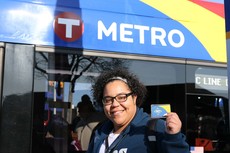
Refugees and residents receiving unemployment insurance may apply for the Transit Assistance Program (TAP), a pillar of Metro Transit’s commitment to equity. Since 2017, TAP has offered eligible riders the opportunity to ride for $1, less than half the regular adult fare.
Metro Transit recently won a “Management Innovation” award from the Minnesota Public Transit Association for broadening the reach of the TAP Program during the COVID-19 pandemic. More than 211,000 people in the Twin Cities region are currently unemployed, a 10.4% unemployment rate.
Nearly half of Black workers and 1 in 4 white workers have applied for unemployment benefits since March, according to the state. Between 1,000 and 5,000 refugees arrive in Minnesota annually. To be eligible for TAP, residents must qualify for programs like SNAP, Medical Assistance, or a Housing Choice Voucher.
Learn more about the Transit Assistance Program.
|
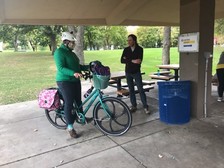
Design work for the METRO Gold Line is 60% complete and residents have the opportunity to see the designs for themselves. In September and October, residents reviewed designs in two online open houses and three outdoor pop-up station site events. Project staff also gathered feedback from the Met Council’s Transportation Accessibility Advisory Committee (TAAC). Feedback has mostly focused on pedestrian safety and connectivity, maintaining or improving traffic flow around stations, and minimizing construction impacts.
|
Metropolitan Council Environmental Services was recently honored by Utility of the Future Today, a joint initiative of clean water agencies, for being forward-thinking and innovative, and adding valuable service to communities.
The Council’s Environmental Services division is among 65 entities recognized this year for stewardship, resource recovery, partnership, and engagement. It marks the second year the wastewater treatment agency has received commendation for “Transformational Programming.”
“This is well-deserved recognition for the work that our Environmental Services division performs around-the-clock, 365 days a year,” said Council Chair Charlie Zelle. “We are nationally known for our excellent service at rates 40% below the national average for agencies of similar size.”
The Rush Line Project, which extends from White Bear Lake to Downtown Saint Paul, has completed 15% of its design work. This fall, the results of a Community Engagement Survey on station use and design were released and are being evaluated by community and project leaders. This will help further guide design that best serves the communities along this corridor.
Metro area residents who want to help shape regional policy and services are invited to apply for one of several advisory committees to the Metropolitan Council. The Met Council relies on these committees to help develop solutions that best serve the entire region.
We are seeking diverse perspectives – across geography, income, age, race and ethnicity, ability and life experiences – to inform our policy-making and operations. Visit our website for more information about the current committee vacancies and application process. Consider applying to serve on one of these four advisory groups:
District 13 residents can apply for openings on the EAC, TAAC, TAB and MPOSC. Priority will be given to applications submitted by December 31.
The Metropolitan Council Underutilized Business program (MCUB) is designed to help Minnesota-based businesses owned or operated by women, people of color and indigenous people, veterans and people living with disabilities to stand out when vying for public contracts. This year, one such company is supplying Metro Transit with gloves, masks, and cleaning supplies that are in short supply due to the COVID-19 pandemic. |