|
We at Metro Transit deliver environmentally sustainable transportation choices that link people, jobs and community conveniently, consistently and safely.
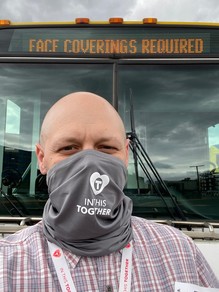
From Brian Funk, Deputy Chief of Operations-Bus
When we started the year, I was focused on bus operator recruitment and security, fleet planning and improvements to our Heywood Garage. Today, my days are largely consumed by our response to the COVID-19 pandemic.
And with good reason: More than 50 of our colleagues have tested positive for COVID-19, and the number of new cases in our state is on the rise. Here and across the world, people are asking what more can be done to protect public health while maintaining essential services like transit.
We have come a long way in the four months since health officials declared this a pandemic. But we still have a lot to learn, and a long road ahead. As the saying goes, this is a marathon, not a sprint.
What has been made clear over the past four months, however, is that our operators, maintenance staff and employees across the organization will not back down from this challenge. Our latest success came last weekend, when we returned to front-door boarding after installing custom protective shields across the fleet.
I had the opportunity to get back behind the wheel last week as we fine-tuned the barriers in partnership with training, safety and union leadership. While experiences like this are helpful, the reality is I do not spend my days in the driver’s seat or in the shop.
I do, however, greatly admire all the work that's being done and am fully committed to supporting front-line staff. This same commitment can be found across all departments and at all levels of the organization.
Moving forward, we will continue to show our support by carefully monitoring and responding to local conditions, remaining vigilant and adopting best practices.
In practice, that means distributing tens of thousands of face masks, providing enough service to limit overcrowding, using the best disinfecting measures available and making COVID-19 testing and leave available to those who need it. We’re also testing new products, including a promising disinfection system for onboard HVAC units.
Our focus on physical and mental well-being is as important as it’s ever been, too, and I encourage staff to review and use the resources that are available, including Sand Creek, Fit for Life and Peer Support.
While we face a long recovery, I am proud of what we've been able to accomplish and have never been more honored to be a part of this organization.
As we move forward, I want to again express my sincere appreciation not only for all the work that is being done, but for the way we are looking out for one another and the communities we serve. From my perspective, we are truly In This Together.
|

Help show the community we're In This Together by:
- Submitting a commendation through this online form
- Sending a card to any Metro Transit bus garage or light rail facility (find addresses here)
- Posting your appreciation on social media using #InThisTogether
- Creating an encouraging video that can be shared at the garages and on social media (send to Ryan Miller)
- Displaying an "In This Together" yard sign (for more information, contact Drew Kerr)
|
 Several long-serving employees have celebrated their retirements in recent weeks, including Gene Hayes, above left, and Bob Boyle, above right.
Hayes retired with 39 years of service, including 30 years at the Heywood Garage, where he was the highest-seniority driver. During his career, Hayes was honored as a 25-year safe operator and spent several years on routes 7, 9 and 10. Hayes said he always enjoyed interacting with customers and especially looked forward to the challenge of driving in winter weather. “Every day was a new challenge,” he said. “I never got comfortable – I just got more aware something could happen.”
Boyle began his career as a cleaner at the old Snelling Garage, and later worked as a technician at the Nicollet, South and Heywood garages, and in the Body Shop at the Overhaul Base. Boyle was among the first group of technicians to join light rail in 2002, and later became the shop foreperson. He retired with 44 years of service. "After 44 years, it's going to be a big change," he said.
Read more about the careers of Metro Transit's longest-serving retirees
Congratulations to these other recent retirees
Frank Stumpf, Transportation Manager-East Metro, 34 years of service
Timothy Daniel, #9478, Operator, Ruter, 26 years of service
Charles Karver, #6826, Operator, Ruter, 21 years of service
Steve Book, #5963, Mechanic Technician, Overhaul Base, 21 years of service
Roger Rust, #67250, Operator, East Metro, 13 years of service
Stephen Butler, #2448, Operator, East Metro, 10 years of service
Brian Conover, #70336, Operator, East Metro, 9 years of service
Douglas John, #72493, Operator, South, 8 years of service
Dan DeVries, #73310, Operator, Ruter, 7 years of service
Robyn Macklin, #73331, Operator, East Metro, 7 years of service
Help us celebrate retirements, new hires and promotions in Insights by sending information to insights@metrotransit.org.

Employees can now schedule a free COVID-19 test online through HealthPartners.
To make an appointment at a drive-up testing location, visit healthpartners.com, sign in as a guest or with your HealthPartners account and select "Start my screening." After answering several questions, you will be prompted to enter a five-digit employee code. Enter 10397.
Drive-up testing sites should be used by employees who are experiencing symptoms, such as cough, shortness of breath, a fever, muscle or body aches, vomiting, diarrhea, or new loss of taste or smell.
Employees who are not experiencing symptoms may schedule a test at the Heywood Well@Work Clinic by calling 952-967-7468.
Free tests are also being provided in areas with outbreaks, increasing cases, or other barriers to access existing test sites. Find a list of dates, times and locations and registration information on the Minnesota Department of Health's website.
Return to work survey coming soon
Employees who are working remotely will soon be invited to participate in a survey that will be used to inform plans to invite staff back to the office when it is safe to do so. Employees who are working remotely should plan to continue doing so through at least Thanksgiving, and potentially through the end of the year. Employees who are currently working on site are reminded that they must have their temperature taken before entering buildings and wear face coverings in most indoor settings. For more information, contact a manager or supervisor
Review the Met Council's COVID-19 Workplace Reset Plan
Metro Transit introduces "Ready to Ride?" campaign
Metro Transit has refreshed its COVID-19 messaging with the introduction of the "Ready to Ride?" campaign. The campaign continues to emphasize the importance of face coverings and personal hygiene, and encourages customers to use quick, contactless fare payment options, including the Metro Transit App and Go-To Cards. Front-door boarding and onboard fare collection resumed on Saturday, Aug. 1. Decals directing bus riders to exit out the rear doors will be installed next week. Operators and other Metro Transit staff are also distributing face coverings, promoting the Transit Assistance Program and collecting customer feedback this month.
Learn more about ongoing customer outreach efforts
Find the latest information about COVID-19
|
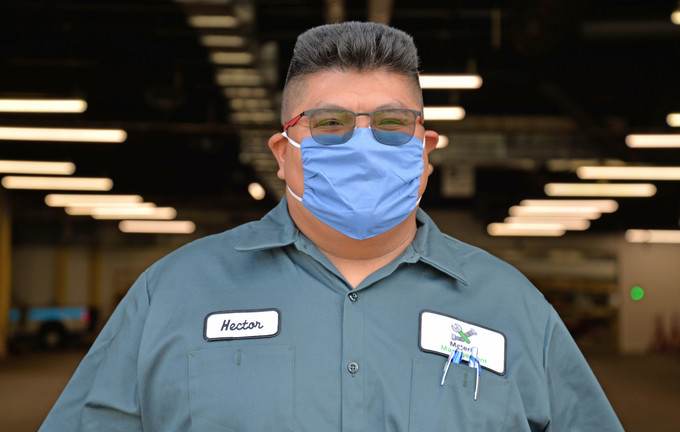 Across the organization, Metro Transit employees’ work has been changed by the COVID-19 pandemic. These "In This Together" Q&As illustrate how employees are adapting both on and off the clock. Read more interviews here.
How has the pandemic affected your day-to-day work?
Things were a little bit challenging at the beginning when wipes, masks and gloves were in short supply. We have more options now, and are seeing more of the things we need coming in every day. For me, I just need to keep an eye on my stock and make sure that if anything is depleting faster than usual I replenish it in time so I don’t run out.
What’s it like working through a pandemic?
I’ve been here about 18 months, and previously worked part-time washing and fueling buses at First Transit. While I was doing that job, I started seeing the importance of public transit to people from all walks of life. Now, everything has changed but people are still relying on public transportation. To me, it’s even more important now.
When I go to the store, I also think about all the people who are doing the best they can to bring things to the shelf. Right now, we’re all going though one challenge after another. But as humans, I think we’ll learn to see things in a different way and rise up – different but stronger.
How has your life changed outside of work?
To be able to take care of my family, everyone I work with and all those who depend on transit, I have to take care of myself. I’m washing my hands often, wearing a mask everywhere I go and only going out for necessary things, like trips to the grocery store.
On Sundays, I stay home with my family, watch movies, walk the dog and relax. I have two daughters, 18 and 21, and it’s like going back to when they were little – everybody is home and spending time together.
Employees who have HealthPartners medical or dental coverage through the Met Council can earn a $40 gift card by completing the HealthPartners Health Assessment in August.
The online assessment poses general questions about nutrition, exercise and sleep, as well as optional questions about emotional health and life satisfaction. The assessment will help participants get a better understanding of their overall physical and mental health, and inform future wellness programming at the Council.
To complete the assessment, visit healthpartners.com/wellbeing and login with your HealthPartners account. For assistance, call 800-311-1052.
Responses to questions that have been raised about the Metro Transit Police Department have been posted on MetNet. Printed copies will also be made available at garages.
The information was gathered as part of the Equity & Inclusion team's ongoing effort to solicit feedback from staff following George Floyd's homicide. Feedback was also addressed during an Equity Town Hall last week; background from the Town Hall and a summary of initial comments provided by staff are also available on MetNet.
The Equity & Inclusion team continues to invite feedback about how Metro Transit can address racism and advance equity in the workplace and in the community. The Equity & Inclusion team will present recommendations to senior Metro Transit leadership in September.
To provide feedback or learn more, send an e-mail to EquityMT@metrotransit.org. Feedback can also be submitted anonymously through this online form.
View the Metro Transit Police Department comment and response summary
From the General Manager: Equity goals must be addressed with intention
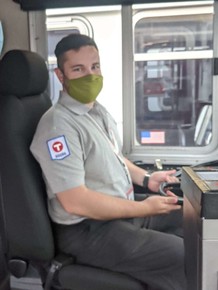
Many Metro Transit employees must continue to report to work in order to perform their duties. Among them is bus operator David Feldmann, a St. Louis, Mo., transplant who rides the bus everywhere. Feldmann has been car-free for the last 20 years.
How do you get to work normally? Has the pandemic changed it?
I started my bus operator training in March when the pandemic hit, but I thankfully was still able to take transit to work. Onboard, you notice the buses are less full. Due to service reductions, I always check the schedule ahead of my trip.
For my commute, I take Route 4 to downtown Minneapolis. After that, I can pick multiple routes to take me to Heywood, and I never wait more than two minutes for the last leg of my journey. What's great is that I always have options.
What do you like about your commute?
As a new bus operator, I pay particular attention to other operators transporting me. Recently, I noticed the skill and calm demeanor displayed by an operator who was faced with a challenge on Route 18. The bus was unable to make the detour around Blaisdell and Lake Street, so the operator pulled over and told the passengers what was going on, spoke to the Transit Control Center (TCC) and got us back on track. I was so impressed, I had to send a commendation. I've since told him in person how I appreciated his work.
How do you get around outside of your commute?
I've been taking transit since I graduated high school in St. Louis, Mo. Six years ago, when I arrived in Minnesota, I continued to use transit as my sole mode of transportation. My girlfriend and I use transit to go everywhere in the city. We usually ride routes 4 and 23 to get to the grocery store or to go out. Right now, however, we don't travel as often as before.
|

East Metro Operator Scott Orr has received several recent commendations, including this one from a Route 71 customer.
My bus driver this afternoon was a delight. He thanked every person getting on board for wearing a mask, called out the street names as we approached and announced the next stops well in advance. As we were crossing the river, he even suggested we enjoy a beautiful view of downtown. What an absolute delight, it really made my afternoon!
AJ Decker, St. Paul
|
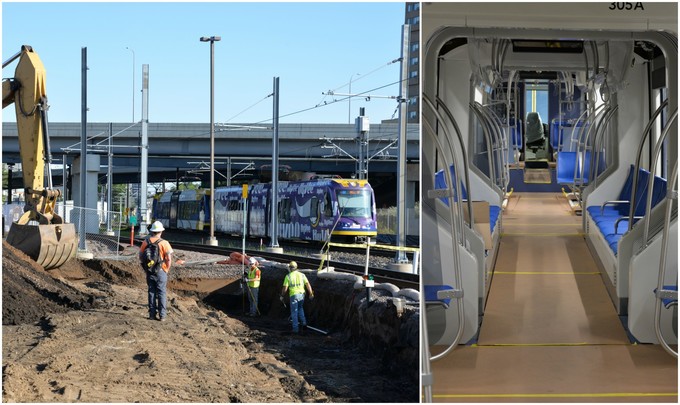
Preparations for an expansion of the Operations & Maintenance Facility continued this week, above left, as light rail vehicles that will be used on the Green Line Extension were worked on inside the facility, above right. The facility is being expanded to provide more room for the expanded fleet.
The METRO Green Line Extension (Southwest LRT) is another step closer to securing federal funding.
The project's Full Funding Grant Agreement (FFGA) moved forward this week with Congressional notification, a step required to receive federal funding. The FFGA is expected to cover nearly half of the costs associated with the $2 billion project.
Construction on the Green Line Extension began in late 2018, and expenses that are currently being incurred are eligible for future federal reimbursement. State, county and local funding is also being used on construction.
The Green Line Extension is expected to open in 2023, and will serve Minneapolis, St. Louis Park, Hopkins, Minnetonka, and Eden Prairie.
Separately, the Met Council and Hennepin County announced this week that they would explore alternative alignment options for the METRO Blue Line Extension. Plans called for co-locating light rail on a freight rail corridor owned and operated by BNSF, but discussions with BNSF were unsuccessful.
Learn more about the Green Line Extension
View the print version of this week's Insights or continue reading on MetNet
Metro Transit’s employee newsletter, Insights, is published weekly. Employees are invited to submit comments, letters to the editor and story ideas. Contact the editor at insights@metrotransit.org.
© 2020 Metro Transit
|