|
We at Metro Transit deliver environmentally sustainable transportation choices that link people, jobs and community conveniently, consistently and safely.

From General Manager Wes Kooistra
The horrific killing of George Floyd led many organizations, companies and civic leaders to make bold statements about the urgent need to confront longstanding inequities in our region.
We have pledged to critically assess what we are doing and what more we can do to address racism and barriers faced by our customers and employees. We know that we need to be more deliberate and intentional in how we advance equity in our service delivery and in our organization.
I asked employees to tell us how we can do better and tasked our Equity & Inclusion team with summarizing what we heard. The input we received was presented during an Equity Town Hall on Wednesday and can be reviewed on MetNet.
Thank you to all the hundreds of employees across the organization who raised their voices and who want to see us hold ourselves to a higher standard.
As I told those who participated in this week’s town hall, it is clear that while we have had good intentions, we have also been too passive in our approach to equity and we must do more. More means more actions, not more words.
This work does not have a beginning or an end. In fact, we must make equity a deeply ingrained part of our culture, reflected in our budgets, work plans and hiring practices.
While the conversation must continue, I have also made it known that we cannot wait to act. To that end, we are taking several steps that will have an immediate and meaningful impact on what we do and how we do it. Some examples include:
- Expanding our Transit Assistance Program (TAP) so individuals who are receiving unemployment benefits or have been declared refugees or asylum seekers can access reduced-cost fares.
- Changing the Better Bus Stops project into a program that will be an ongoing component of our Capital Budget development.
- Inviting community feedback on an ongoing basis and independent of any particular project, an effort that will begin in earnest this month.
- Developing metrics to evaluate our progress in advancing equity in transit.
- Formally assessing how quarterly service changes impact low-income communities, beginning with changes that will be made this September.
- Continuing to advocate for a change in state law that would reduce the penalties associated with fare evasion, and finding ways to increase the presence of non-sworn personnel on transit.
This is just a start. Feedback received before and during this week’s Town Hall will shape additional recommendations that will be presented by the Equity & Inclusion team this September.
Those recommendations are intended to provide more specific direction on the steps we can take to support more equitable outcomes, and will reflect input from frontline staff and management in every department.
I encourage employees to continue sharing feedback as this work continues. Comments can be submitted through e-mail, an anonymous online form, or through any of the representatives who serve on the Equity & Inclusion team. As General Manager, I have committed Metro Transit’s leadership team to this work and we should be held to our actions, and not our words.
The same is true for you. This isn’t just a challenge to leadership, it is a challenge to each of you who must also feel personally responsible for this work. Saying that more needs to be done is the simple part. Identifying what to do and committing to action is the hard work that we all share.
Learn more and provide additional feedback
Review a summary of comments received to date and a list of initial actions on MetNet. Answers to questions raised during the town hall will also be posted here soon, along with additional information that responds to questions that have been raised about the Metro Transit Police Department. Printed materials will be distributed to work sites.
Comments can continue to be submitted by e-mail to EquityMT@metrotransit.org or through an online form.
Support upcoming outreach efforts
Throughout August, Metro Transit staff will be asking customers for feedback to learn more about how they've been impacted by COVID-19, George Floyd’s homicide and the aftermath that resulted in the destruction of community resources.
Feedback collected through surveys and meetings will help inform near-term decisions and future public engagement efforts. Employees who are interested in gathering feedback can contact Jae Halverson. Sign up to help staff a future event here (continue to check back as more dates will be added).
In addition to gathering input, the outreach events will be used as an opportunity to share information about the Transit Assistance Program (TAP) and to distribute masks. Around 50,000 masks will have been distributed by the time scheduled outreach activities conclude.
View the dates, times and locations for future mask distribution events
|

Employees are reminded that free COVID-19 testing is available through HealthPartners. Tests can be administered at the Council's Well@Work clinics or at HealthPartners and Park Nicollet drive-up sites throughout the region.
To make a drive-up test appointment call, 952-853-8690 and tell the sheduler you are a “transit essential worker.” To make an appointment at the Well@Work Clinic, call 952-967-7468. Results will be provided in two to three days.
Employees may be tested regardless of whether they are showing symptoms. Symptoms include, but are not limited to, cough, shortness of breath, a fever, muscle or body aches, vomiting, diarrhea, or new loss of taste or smell.
To date, 51 Metro Transit employees have tested positive for COVID-19, and 44 have returned to work.
Front-door boarding resumes August 1
Customers will resume boarding through the front door on Saturday, Aug. 1, when onboard fare collection will also resume. All in-service buses will be equipped with temporary shields or permanent barriers before front-door boarding resumes, and customers are being encouraged to pay their fares with a Go-To Card or the Metro Transit App. Floor clings will also be installed to direct customers who can do so to exit out the back door.
Find the latest information about COVID-19
|

When Jory Ackerman began as a part-time bus operator, he was a little uncertain about his new career path. The bus, he said, “felt about as wide as it did long.”
But he enjoyed the relative freedom, interacting with passengers and grew increasingly confident behind the wheel.
Ackerman's comfort as an operator led to a 30-year career as a bus and train operator -- a career that came to a quiet ending when he retired earlier this month.
Ackerman's career was nearly evenly divided between bus and light rail, where he was among a class of 13 bus operators who were trained to support an expansion of the Hiawatha Light Rail Transit line that came shortly after its 2004 opening. While light rail was very rules-oriented, Ackerman said he found operating the train to be "very relaxing."
In retirement, he looks forward to “living out the dream of becoming a beach bum with no responsibility, no rules and no briefings.”
Read more about past employees who have retired with 30+ years of service
|
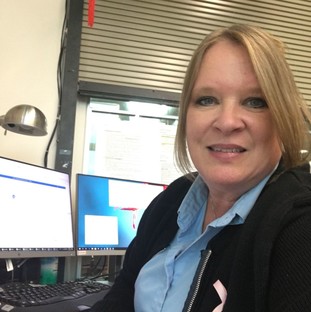
Across the organization, Metro Transit employees’ work has been changed by the COVID-19 pandemic. These "In This Together" Q&As illustrate how employees are adapting both on and off the clock. Read more interviews here.
How has the pandemic affected your day-to-day work?
When the pandemic first came, dispatchers were swamped due to calls from operators who wouldn't be coming in for their shift. We're the first point of contact before an operator begins a shift and we fill shifts when they are vacant. With lots of vacant shifts, I worked hard to fill them so our customers who need transit weren't left stranded.
Once the service reductions came, however, finding operators to fill trips became less of an issue and that part of my job returned to a bit of normalcy. Now, I spend more time trying to set my operators up for success by making sure they have all the disinfectant they need to wipe down their workstation and farebox before pulling out.
What’s it like working through a pandemic?
Even though these are unprecedented times, I always make sure to come in with a positive attitude, not just for myself, but for the people around me who are still working. We continue to wash our hands, wear masks, and socially distance ourselves to help lower the chances of spreading the virus.
There are 350 operators here at East Metro, and I know almost all of them by name and employee number. They're like family to me, and I hope no one gets it. I'll keep coming into work to do my job, and do what I can to help slow the spread.
How has your life changed outside of work?
Like everyone else, I wear a mask and wash my hands often when I go out in public. But I go out less than I used to, have stopped clearance hunting inside stores and only rarely see my 75-year-old parents, always outside and at a distance. We try to keep in touch with video chat, but I wouldn't call that seeing my mom -- she usually has the camera pointed at her forehead! While I wish we could see each other more, it's for the best that I do what I can to lower their chances of catching the virus.
|

Heywood Operator Brian Maertens recently received the following commendation from a customer who appreciated the way he handled a difficult passenger.
I appreciate the driver not letting too many people on the bus and seeing how many got off before letting anyone else on.There was a fellow holding the back door open while talking and not exiting during a stop. The driver asked him to please exit the bus as he explained people were waiting to get on. The guy wanted to argue but eventually got off. The driver displayed patience, restraint and was admirably firm.
|
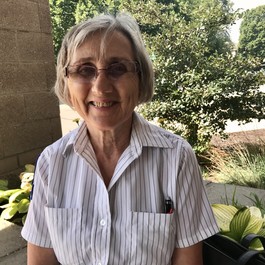
A Fit For Life Wellness Champion at Nicollet Garage, Gayle Gilman walks to and from work, eats farm fresh vegetables and exercises regularly.
So it was a bit of a surprise when, in June, Gilman found herself at the hospital after excruciating and unrelenting pain led to a sleepless night. Diagnosed with a herniated disk, she spent three days pacing the hallways with a walker and facing the prospect of surgery before being released and instructed to enter physical therapy.
“I was really surprised by what happened,” Gilman said this week. “But looking back, I realized I’d done a lot of gardening, wasn’t bending over the right way and was probably feeling a little too invincible.”
Gilman believes her nearly 21 years as a bus operator may also have contributed to her recent back problems. Many operators are plagued by back, hip and knee pain.
“We’re out there stopping and starting constantly, and if you’re not using the right body mechanics that creates a lot of stress on your body,” she said.
After a month at home, Gilman recently returned to work and only occasionally feels soreness or jabs of pain. While she has been cleared to drive, she spends most of her time preparing instruction materials at the garage.
She continues to go to physical therapy, stretches and walks several times a day and is following advice in Stuart McGill’s book, “Back Mechanic.”
Gilman is also sharing her story as an example of how focusing on your health can help when there’s a need to focus on recovery.
“Most people don’t seem to want to change until something dramatic happens, but by then it’s a whole lot harder because you may be handicapped in a way,” she said.
Participate in the Better Back Campaign
Employees are invited to participate in a four-week Fit For Life program focused on back mechanics and posture. Participants in the Better Back Campaign, which begins on August 3, will receive educational e-mails and help setting goals. Sign up here to receive weekly e-mails, or look for more information in future issues of HR Connect. For more information, contact Wellness Coach Ashley Starr.
Complete Health Assessment by August 31 to earn a $40 gift card
Employees who have HealthPartners medical or dental coverage through the Met Council can earn a $40 gift card by completing the HealthPartners Health Assessment in August.
The online assessment poses general questions about nutrition, exercise, and sleep, as well as optional questions about emotional health and life satisfaction. The assessment will help participants get a better understanding of their overall physical and mental health, and inform future wellness programming at the Council.
To complete the assessment, visit healthpartners.com/wellbeing and login with your HealthPartners account. For assistance, call 800-311-1052.
|
Improvements to the way service updates are created and sent to customers will take effect today.
Using a new system, alerts about bus stop closures, trip cancellations and other service changes will be shared simultaneously through text messages, e-mails, social media and Metro Transit's website. The information will also be pushed automatically to third-party information providers, like Google and the Transit app.
Customers who have signed up to receive Rider Alerts through text message or e-mail will also receive more descriptive messages. Existing Rider Alert subscriptions will carry over to the new system. Nearly 38,000 people have signed up to receive Rider Alerts.
New software that will provide more accurate predicted real-time departure information will also be put to use in the coming weeks. For the first time, customers who access this real-time information will also be notified if a bus stop has been closed or if a trip has been cancelled.
For more information about the new alerts system, contact Transit Information Project Manager Bre Grand. For more information about the new real-time departure information system, contact Real-Time Customer Information Project Manager Laura Matson.

Ben Rajkowski promoted to Transit Information Manager
Ben Rajkowski will serve as the new Manager of Transit Information, Bruce Howard, Director of Transit Information and Marketing, announced this week. In his new role, Rajkowski will oversee the Transit Information Center, Transit Information Services and several improvement projects.
Rajkowski joined Metro Transit as a TIC Representative in 2003, spent several years as a Transit Information Supervisor and most recently served as an Assistant Manager in Transit Information.
Rajkowski's promotion follows John Howley's earlier this year.
|
The COVID-19 pandemic is presenting new challenges across the organization. But advances are still being made. These monthly progress reports will provide a glimpse at how Metro Transit is adapting to new realities while holding true to its Guiding Principles.
For the past several years, Metro Transit has made a concerted effort to create stronger connections between fixed route transit and shared mobility services, including bike, scooter and car sharing. That work was set to continue in 2020 with an expanded network of mobility hubs, where transit and other transportation options come together.
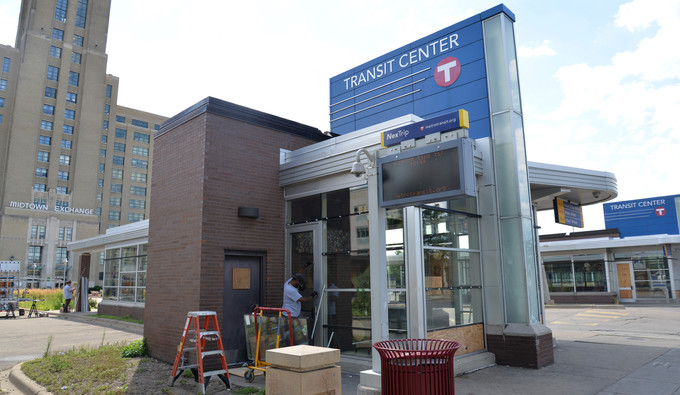
The City of Minneapolis intends to bring more than a dozen mobility hubs to locations throughout the city before the end of the year, but progress has been delayed by the pandemic and the civil unrest that followed George Floyd’s homicide. An effort to involve community in planning for a mobility hub at the Chicago-Lake Transit Center, above, has also been delayed but will move forward when there is community support to do so. The transit center and surrounding areas were heavily damaged during recent demonstrations; repairs to the transit center began wrapping up this week.
Learn more about what's happening and what's next for Metro Transit's shared mobility work on MetNet and contact Shared Mobility Program Manager Meredith Klekotka for more information.
Want to provide an update on your work? Contact the editor.
 Crews ran new pipes and relocated equipment that funnels sand into light rail vehicles at the Blue Line's Operations & Maintenance Facility this week, the latest sign of progress on an expansion of the Minneapolis support facility.
The sanding equipment is being temporarily moved to storage bays on the west side of the building while the existing washing and sanding bay is expanded to accommodate three-car sets. The current sanding and wash bay was built for two-car configuration and requires multiple train movements.
Sand is piped into storage tanks on light rail vehicles and released to provide more traction when trains are operating in wet or icy conditions.
The expanded washing and sanding bay, on the east side of the building, is expected to be completed and in use next spring.
On the north end of the facility, crews are tearing out concrete to make way for new enclosed maintenance areas. The building is being expanded as the light rail vehicle fleet grows to support the Green Line Extension.
To date, five of the 27 new light rail vehicles that will be used on the Green Line Extension have arrived in Minneapolis. The vehicles will be commissioned and tested before going into service.
Learn more about the Green Line Extension
Employees who have scheduled recurring meetings in conference rooms at the Metro Transit Police & Office Facility are asked to cancel future reservations that are no longer needed. Canceling reservations that are no longer needed will allow those who are working on-site to book larger rooms that allow for social distancing.
Employees who are reserving shared spaces should plan to spend 15 minutes disinfecting surfaces before and after their meeting and schedule their reservation accordingly.
For more information, contact Saralyn Romanishan.
Reminder: Parking in the Blue Lot, on the south side of the Heywood Office, is reserved for visitors and ADA parking. Employees who do not have access to priority parking areas at the Metro Transit Campus may park in a parking lot across from the Minneapolis Farmer's Market on East Lyndale Avenue North, between Glenwood Avenue North and Third Avenue North.
Parking in that lot is available to Metro Transit employees Monday through Friday, from 6 a.m. to 6 p.m., on a first-come, first-served basis. When parking in the lot, employees must visibly display their Metro Transit parking placard.
For more information contact Spolinsky Jacox.
Review commute resources and parking rules for the Metro Transit Campus
View the print version of this week's Insights or continue reading on MetNet.
Metro Transit’s employee newsletter, Insights, is published weekly. Employees are invited to submit comments, letters to the editor and story ideas. Contact the editor at insights@metrotransit.org.
© 2020 Metro Transit
|