|
We at Metro Transit deliver environmentally sustainable transportation choices that link people, jobs and community conveniently, consistently and safely.

From Adam Harrington, Director of Service Development
Scheduled service changes are always a blend of science and art.
Ridership, construction, operator and customer feedback, social distancing guidance and staffing levels all influence our decision making. We also make estimates about where added service can better serve new and existing riders.
Those same considerations factored into the service changes taking effect next month. But layered on top of these factors is one of the biggest challenges we’ve ever faced – the COVID-19 pandemic and our response to it.
Uncertainty about the number of available operators and how soon people will return to transit led us to ask operators to pick their next work assignments based on two service level scenarios -- one representing about 65% of regular service levels, and another that is closer to 80%.
Schedules that will go into effect on June 13 will keep service at about the same level it’s at today – roughly 65% what it was at the beginning of the year – with some minor adjustments to add peak-hour service. Light rail and Northstar schedules will remain as is.
As more operators return, we may add more service before the next scheduled service changes take effect this fall.
While ridership has leveled out at about 75% below normal, there is reason to believe more customers will be back in the coming months. Conversations with downtown business leaders and others suggest a slow return to work starting this summer, and some retailers and restaurants are starting to reopen.
There remains a lot to learn about the lasting impacts COVID-19 will have on commuting habits, schools and the large events we've become such an integral part of. The next round of schedule changes was moved from August 22 to September 12 so we could better account for the developments that take place in the months ahead.
While we focus on the near-term, we are also thinking of the future. Plans for additional Bus Rapid Transit lines are progressing and we will continue to develop a long-term vision for our bus network, Network Next, over the next year.
As we continue to adapt, I want to express my sincere appreciation for the work that’s being done not just in Service Development but across the organization.
Support has come from many corners – Finance and Strategic Initiatives, which provide and interpret the ridership data we need to make informed decisions; Marketing & Transit Information, which clearly present our plans to the public; and of course, our bus and rail operations departments that put our service plans into action.
Together, we are doing all we can to help our organization, our customers and our community safely get through this crisis without losing sight of the long-term goals we’ve all worked so hard to achieve.
|

All Metro Transit employees can now get tested for COVID-19, whether or not they are showing symptoms. Free tests are available at HealthPartners and Park Nicollet drive-up sites and at the HealthParners Well@Work Clinic at the Heywood Office. To make a drive-up test appointment call 952-853-8690 and tell the sheduler you are a “transit essential worker.” To make an appointment at the Well@Work Clinic call 952-967-7468. Results will be provided in two to three days.
Child care leave policy to be adjusted
With changes likely effective June 13, child care leave will still be available but not at the same level as before. Council employees who cannot work remotely and are caring for a child whose summer school, place of care or regular childcare provider are unavailable due to COVID-19 will be eligible to take up to 12 weeks of paid leave at two-thirds their regular pay rate. Those teleworking will continue to do so through the summer and may use the child care leave intermittently, if needed. Employees who go on leave may supplement their pay or extend their leave using accrued leave balances. To access paid leave, employees must submit a request form and additional information about why other suitable childcare is unavailable. More information about the Council’s updated Paid COVID-19 Leave policy is expected to be shared soon.
New Stay Safe MN order takes effect
Minnesota's stay-at-home order expired and was replaced by new direction, Stay Safe MN, on Monday, May 18. The order continues to encourage Minnesotans to stay close to home but allows for gatherings of friends and family of 10 people or less and allows for limited re-openings of retail businesses, restaurants and salons.
Read more about how the new order impacts work at the Council
Where to find the latest information about COVID-19
|
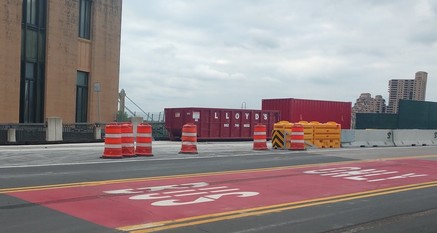
A bus lane will help buses move in and out of downtown Minneapolis as repairs are made to the 102-year-old Third Avenue/Central Avenue Bridge spanning the Mississippi River.
State-led bridge repairs began on Monday, reducing general traffic on the bridge to one lane in each direction. Between these general purpose lanes, a new bus lane was created so buses could bypass traffic. Portions of the bus lane have been painted red to redirect traffic.
Until noon each day, the bus lane will be used by buses entering downtown from Northeast Minneapolis; beginning at 12:10 p.m., buses departing downtown Minneapolis will use the bus lane.
Transit signals and city traffic control agents will also be used to help maintain reliable service during construction.
Routes 10, 17, 25, 250, 264 and 270 will use the bus lane. Some routes that would normally operate on the Third Avenue Bridge are not in service due to COVID-19 related service adjustments.
In January, the Third Avenue Bridge will close for two years. During that time, buses will be rerouted to the Hennepin Avenue Bridge to the north.
Metro Transit and the City of Minneapolis continue to discuss opportunities for temporary and permanent bus lanes and other transit advantages throughout the city.
Learn more about the 3rd Avenue bridge project
|

Heywood Operator Michael Alexander recently impressed a Route 18 customer with his safe driving skills.
I was on a northbound Route 18G this morning and the driver was amazing. I did not think it was possible to drive an articulated bus along such narrow streets but he killed it! He made the turns safely, kept us on schedule and was friendly.
Kelly Prosen
Minneapolis
|
State lawmakers adjourned earlier this week without approving a bonding bill or acting on proposed security measures related to transit. The funding and policy proposals may be addressed in an upcoming special session.
Gov. Tim Walz had proposed $55 million in state bonding to advance two planned Bus Rapid Transit lines, the METRO D Line and METRO B Line. The D Line will substantially replace Route 5, and the B Line will substantially replace Route 21. In March, Walz proposed funding for additional police officers and civilian and sworn personnel to enhance real-time camera monitoring and support fare compliance efforts.
The legislative process was disrupted by the state's response to COVID-19, which led lawmakers to reprioritize and adapt to remote work.
Planning for the D Line and B Line are ongoing. With full funding, construction on the D Line could begin in 2021, and construction on the B Line could begin in 2022.
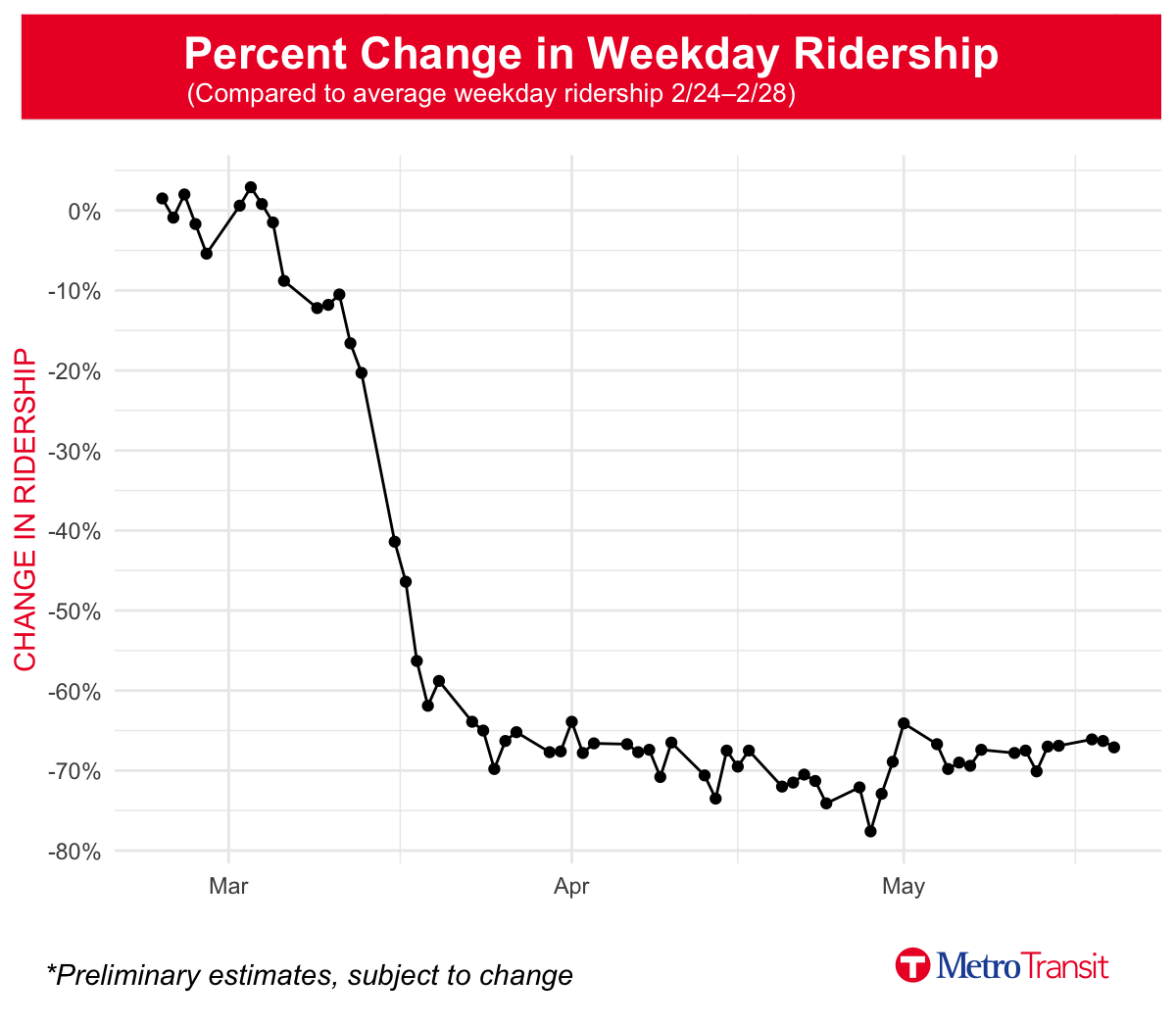 April was an unusual month for Metro Transit – and the data proves it.
In the first full month of the state’s stay-at-home order, ridership was down about 72% compared to the same month last year. In all, more than 1.9 million rides were provided in April, as average daily ridership hovered between 50,000 and 70,000 rides per day.
If current ridership patterns hold, about 35 million rides could be provided this year, less than half the ridership projected at the beginning of 2020. Annual ridership hasn't fallen below 57 million rides since at least 1900.
The COVID-19 pandemic impacted several other performance measures. For example:
- Bus on-time performance rose to nearly 91%, reflecting the shift to rear-door boarding and a decline in vehicle traffic. On-time performance is a measure of how often vehicles are departing within one minute before or five minutes after their scheduled departure times.
- The monthly rate of bus and customer accidents reached one of its lowest levels in 16 years, at 2.8 accidents for every 100,000 miles. April was the fifth-lowest monthly bus accident rate since 2004, and March 2020 was the lowest bus accident rate since March 2004, when workers were on strike.
The average distance between bus failures also rose to 9,230 miles in April, the best performance for that month since 2003. April’s performance was attributed largely to a continued emphasis on preventative maintenance, as well as a recent focus on cooling systems. The average distance between light rail vehicle failures exceeded the monthly goal at 37,769 miles.
For more information about Metro Transit's Key Performance Indicators contact Rachel Dungca at rachel.dungca@metrotransit.org.
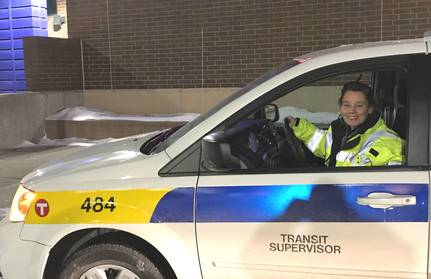
Staff across the organization are contributing to Metro Transit’s response to the coronavirus. Employees will be invited to talk about how their work has changed, and what it’s like to serve during a pandemic, in Insights each week. To share your story or suggest someone who is doing outstanding work, e-mail insights@metrotransit.org.
How has the pandemic affected your day-to-day work?
Without the pandemic, I would be thinking about special events, like Minneapolis Open Streets events and the Celebrate Northeast Parade. Since all events are on hold or cancelled, my work is somewhat different. I now focus on being available to operators so they know they aren’t alone. I check our facilities, keep up-to-date on the latest developments and standard operating procedures and respond to emergency situations. Recently, I was involved in the mutual aid request to move at risk individuals from Dorothy Day to a hotel in downtown St. Paul.
What’s it like working through a pandemic?
It has been an odd, surreal experience so far. While I’ve been aware that something like this could happen, it doesn’t prepare you for the reality of the situation. A pandemic is a slow-moving disaster -- maybe too slow for our modern short attention spans. From reports of the emergence of a novel virus on the other side of the world to a pandemic, only a few short months have passed. Now, even the simple task of refueling my car has become complicated. Uncertainty and frequent changes have become the new normal.
I love my job and being on the front lines with the operators doing all I can do to support them. Focusing on safety, staying vigilant, being prepared and embracing uncertainty, for me, will be the way to get through this.
How has your life changed outside of work?
I used to visit my mom and stepdad once a week. I would play music with my stepdad, mostly jazz standards. I play guitar and he plays accordion and upright bass. Afterwards, my mom and I would go out for dinner at Manning’s in southeast Minneapolis. She is 81 and I don’t dare visit them now. My sister, who is a nurse in the emergency room of a large hospital in Virginia, had the virus. She told me it’s no joke. I will take her advice and take all precautions.
I keep trips to the store at a bare minimum. I have a lot of projects at home to keep me busy. It’s spring and time to get the gardens ready. But I’m missing our old world -- live music, going out to eat, retirement parties, randomly running into people you know. Like most of us, my hair is getting longer. Not sure what to do about that. I’m looking forward to getting back to normal.
|
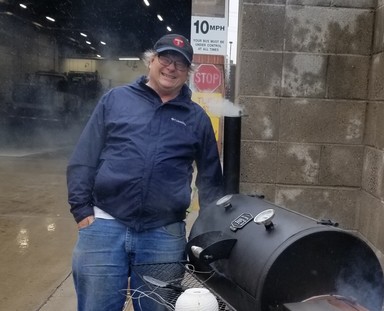
Job: Bus operator
Years of Service: 14
How did you come to work at Metro Transit and what do you do?
After high school, I found out that college wasn’t for me. I took a career assessment that told me sales was a good career choice for my personality. So I went to a local technical school to learn sales and marketing, which led to a 19-year career with a pager company. Later, I started doing sales and inventory for vending machines — this is where I first encountered Metro Transit, by stocking the machines at Nicollet Garage. After the company went through massive layoffs, I found myself wondering what to do next. A friend who worked at South Garage said, “Why don’t you drive a bus?” I thought, well, if those guys can drive that big rig, so can I. Fourteen years later, here I am.
What do you enjoy the most about being “On the Clock”?
I really like what I do because I discovered a hidden benefit of this job: the people you serve and opportunities to have an impact on their lives.
About 10 years ago, on Route 2, I drove a little old lady to church every Sunday morning. She'd been playing the organ at that church for 74 years. On my last day on that route, I made an announcement about who she was and why she’s a hero in her community. The riders on the bus clapped and gave her a “sitting ovation.” Another time, I met a single mother on her way to a job interview. She paid her fare, but I heard she was short on money to get a sitter for that interview. As a single parent myself, I told her to stop at the front on her way out so I could shake her hand. I gave her some cash to help her out. People who work hard deserve breaks.
I never expected this job to be a place where I could do little acts of kindness, but it’s the best part of my job.
What are your interests when you’re “Off the Clock”?
I love photography, especially landscapes and wildlife. I’m mostly self-taught, but am now taking courses with my good friend from high school who made photography his life. In a few years, I plan on making photography my retirement gig. I already have a list of places I want to shoot. At the top of the list is Alaska, so I can capture a moose in the wild. I’ve tried in Minnesota, but haven’t caught one yet. Cambodia is next. My wife is Cambodian, and I’ve never been there. All the temples there provide a fantastic opportunity for landscape shots. And although I’ve captured the Northern Lights here, I plan to capture them in the best place in the world: Iceland.
Want to share your story or suggest a co-worker for an On the Clock/Off the Clock profile? E-mail insights@metrotransit.org. Read previous profiles on the Rider's Almanac blog.
|
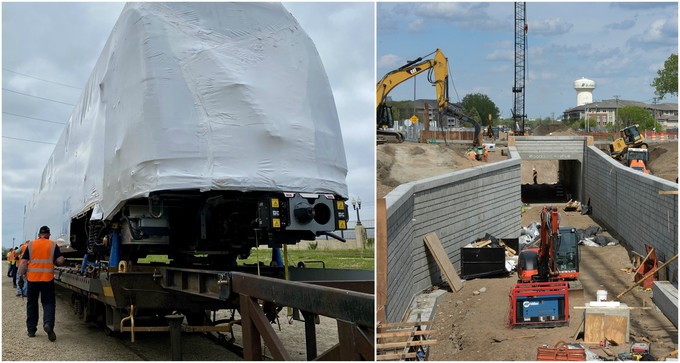 Photos by Trevor Roy, left and Jeff Syme, right
Two light rail vehicles that will be used on the METRO Green Line Extension arrived on Thursday, marking another step forward in the effort to extend light rail from Minneapolis to Eden Prairie. At right, crew are also working on an underpass that will bring the Cedar Lake Trail beneath Wooddale Avenue. The new underpass is adjacent to the future Wooddale Avenue Station and is one of several improvements that are being made to the regional trail as part of the light rail project. For the latest information on the Green Line Extension visit metrocouncil.org.
Twin Cities Pride festivities, including the Pride Parade and Pride Festival, have been canceled due to the coronavirus pandemic. The annual celebration of the LGBTQ+ community was scheduled to be held in downtown Minneapolis in June.
While there won't be any Pride gatherings, Metro Transit would like to celebrate and show its support for the LGBTQ+ community, including members of the community who work at Metro Transit. To learn more about sharing your Pride story, please contact Ryan Miller at ryan.miller@metrotransit.org.
View the print version of this week's Insights or continue reading on MetNet.
Metro Transit’s employee newsletter, Insights, is published weekly. Employees are invited to submit comments, letters to the editor and story ideas. Contact the editor at insights@metrotransit.org.
© 2020 Metro Transit
|