|
April 2019
More families choose to cremate and MR&C eliminates the paperwork
The numbers of cremations in Minnesota are increasing. In 2009, there were 37,851 deaths in Minnesota; 47% of families chose cremation. Although death data for 2018 is not final, preliminary data shows that 66% of families chose cremation.
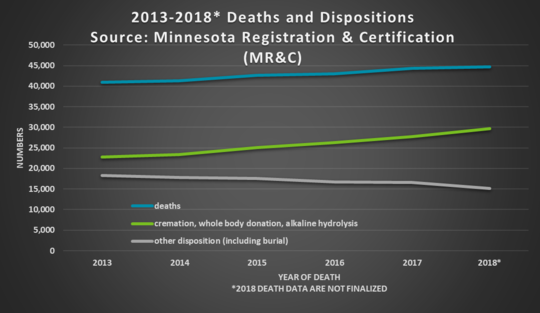
During death registration, one of the standard items collected is the method of disposition of the decedent’s body. Disposition types are burial, cremation, whole body donation, entombment, and removal from the state. The "cremation" disposition type includes alkaline hydrolysis, sometimes known as "green cremation". Information about disposition appears on death certificates and informs public health. The Office of Vital Records (OVR) sends disposition information to the National Center for Health Statistics as part of our routine data reporting. OVR also shares information about deaths with Mortuary Science and the Minnesota Center for Health Statistics at the Minnesota Department of Health.
In Minnesota, the medical examiner or coroner in the county where the death occurred must authorize a cremation, whole body donation or alkaline hydrolysis. Minnesota Registration and Certification (MR&C) helps facilitate these authorizations. MR&C allows many users to work together to create a death record and to take care of certain activities associated with final disposition. Funeral directors, morticians and their staff initiate death records. MR&C notifies medical certifiers (physicians, advanced practice registered nurses, or physician assistants) to provide the cause of death and certify the record.
If the death is a homicide, suicide or accidental, MR&C routes the record to the medical examiner or coroner in the county where the death occurred. Together these professionals register deaths and file records in MR&C. When the method of disposition is cremation, MR&C routes the death record, even when it is a natural death, to the medical examiner or coroner to authorize the cremation electronically. MR&C notifies the funeral home when the medical examiner or coroner approves the cremation. Funeral homes can print permits from MR&C for cemetery or crematory personnel.
Beyond registering deaths, OVR uses MR&C to:
- register births
- report fetal deaths
- secure storage for millions of vital records
- report data
- issue vital records documents
OVR supports MR&C, and the nearly 10,000 professionals who use it every day.
Minnesota is among 11 states that will receive funding to involve fathers – especially those who do not live with their children – in state programs and policy-making efforts for children and families.
The Fatherhood Research and Practice Network is distributing $10,000 state planning mini-grants for the new initiative. The grantee in Minnesota is the Minnesota Fathers and Families Network. The Office of Vital Records State Registrar Molly Crawford and Field Services Representative Sally Almond helped secure the grant for Minnesota.
According to a Fatherhood Research and Practice Network news release, “grantees will involve a wide array of stakeholders, including administrators in key state agencies such as child support and child welfare, to conduct planning activities aimed at improving father involvement and generating more reliable funding for community-based fatherhood programs.” In Minnesota, the key agencies are the Department of Human Services and the Department of Health, Office of Vital Records and Fathers’ Adoption Registry. The awards will help to support strategic planning efforts, interagency teamwork, and data collection activities designed to produce system change.
The project runs from February 1 to September 30, 2019.
|
Watch for an email with Vital Records News Survey in the subject line. The Office of Vital Records will soon distribute a short survey about Vital Records News. Let us know how we can improve the newsletter by responding to the survey and sharing your insights and ideas.
|