|
February 2025
Ideas and Suggestions for Restorative Practitioners
February is Black History Month! Founded by Dr. Carter G. Woodson in February 1926, what was formerly known as Negro History Week became a month-long Black History Month celebration of African American life, history and culture. The Black History Month 2025 theme, "African Americans and Labor," from the Association for the Study of African American Life and History focuses on the ways that "work and working of all kinds - free and unfree, skilled, and unskilled, vocational and voluntary - intersect with the collective experiences of Black people." Read more about the 2025 Black History Theme Executive Summary.
Equally important to whom we celebrate is how we celebrate. One way is to connect Black history to Black Joy. Read about Black Joy: Resistance, Resilience and Reclamation from the National Museum of African American History and Culture.
Included in the month of February is also Minnesota's Missing and Murdered Indigenous Day of Remembrance on February 14. The annual event aims to honor Indigenous relatives who are missing from the lives of their loved ones. Read more about the Missing and Murdered Indigenous Relatives Office (MMIR) and the Missing and Murdered Relatives Day of Remembrance and Action. Be part of the action by wearing red on February 14 for our missing and murdered Indigenous women, girls, boys, LGBTQ, two spirit and transgender relatives.
May this month allow us to reflect and seek a path forward that creates just and equitable learning environments for all.
Deepen Your Practice
Restorative Practices Circle Training
Register for the Restorative Practices Trainings in person February 24-27, 2025 at the Minnesota Department of Education (MDE). Restorative practices (RP) are an approach schools can use to improve school climate and repair relationships, based in the knowledge and worldview of many Indigenous cultures. The trainings will be facilitated by restorative practices trainers who work in or with schools. Trainings include:
- Circle 1: Building Community, February 24-27, 9 a.m.-4 p.m. Fee: $330
- Restorative Chats, February 24-26, 9 a.m.-4 p.m. Fee: $250
- Circle to Repair Relationships, February 24-26, 9 a.m.-4 p.m. Fee: $250
- Circle to Teach—Elementary, February 24-25, 9 a.m.-4 p.m. Fee: $165
- Circle and Fun, February 26-27, 9 a.m.-4 p.m. Fee: $165
Registration is handled by Lakes Country Service Cooperative. All trainings must be pre-paid at the time of registration. Registration closes February 14, 2025. For more information and to register, please visit the Restorative Practices Circle Trainings, February 2025.
Retrieve Your Learnings
Research indicates that exclusionary discipline increases misbehavior and exerts secondary harm, especially for Black students. To address this, many schools across the nation have implemented restorative practices. In Fostering Belonging, Transforming Schools: The Impact of Restorative Practices, Sean Darling-Hammond reviews the distinction between restorative programs and restorative practices. He found that:
- Exposure to restorative practices improved students' academic achievement and reduced suspension rates and duration.
- The effects of restorative practices on academic outcomes were positive for all students while stronger for Black and Latino/a students, thus reducing discipline gaps and achievement gaps.
- Schools that increased their use of restorative practices saw improved student behavior and school safety.
- Access to restorative practices was not equitable across student groups.
Based on his findings, these are implications he offers:
- Shift from a culture of exclusion to a relational culture.
- Develop staff master.
- Ensure that students of all backgrounds gain access to restorative practices
- Empower sustained implementation.
Read more about Fostering Belonging, Transforming Schools: The Impact of Restorative Practices.
Build Your Knowledge
Circle of Love
Love is central to many communities. It is one of the Seven Grandfather teachings: love for oneself, for others, for the creator and for the world. It comes from the African Burundi proverb, "Where there is love, there is no darkness." As we consider the relationships and communities we are part of, the everchanging world we live in, and the action we can take, let us consider how love can play a part.
Prompt: Share your name and something you love.
Opening: "The moment we choose to love we begin to move against domination, against oppression. The moment we choose to love we begin to move towards freedom, to act in ways that liberate ourselves and others." - bell hooks
Prompt: What resonates with you from the wisdom shared by bell hooks?
Prompt: What is your definition of love?
Prompt: Tell a story of when you experienced love.
Prompt: What do you imagine a world full of love could be?
Closing: As one of the Seven Grandfather teachings shares, "knowing love is to know peace." May you accept love sincerely and give love freely.
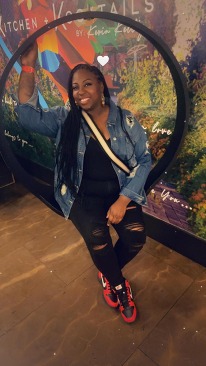
Getting Acquainted with Restorative Practices Trainer: Fallon Henderson
Fallon is a dedicated mother of three—two sons and a daughter—who balances family life with her passions for writing, storytelling and collecting shoes. She loves traveling, exploring new cultures and finding inspiration in the world around her. Deeply committed to service, she is passionate about supporting youth on their journeys, empowering them to reach their full potential while making a positive impact in the community. She is an avid writer and storyteller, passionate about weaving narratives that resonate with people from all walks of life. When she is not crafting stories, she enjoys collecting unique and stylish shoes, always on the lookout for that perfect pair to add to the collection. Traveling is another love, with a thirst for exploring new cultures, places and experiences.
With a heart for service, she is dedicated to supporting others, especially youth, in their personal and professional journeys. Whether through mentoring, volunteering or simply lending a helping hand, she believes in the power of community and is committed to making a positive impact on the lives of those around them. Learn more about Connected Restorative Voices LLC. Fallon can be contacted at Msfallon83@gmail.com.
|
Resources
Webinar: Using Circles to Support Individual and Community Mental Health in a Climate Disaster
Free webinar with Samuel Johann and Kay Pranis on February 19, 11 a.m.-12:30 p.m. The southernmost state of Brazil, Rio Grande do Sul, experienced catastrophic flooding in September, 2023, and then at an even larger scale in May, 2024. That part of Brazil has a fourteen year history of training Circle keepers and building capacity to use Circles. In partnership with key colleagues and local institutions Samuel Johann, a resident of a city in the flooded area, brought together his experience as a Circle keeper with his experience working in disaster situations with Doctors Without Borders to respond to the extraordinary level of trauma caused by the flood. Samuel will describe the United Nations framework for understanding and responding to mental health impacts of disasters and will discuss where Circles can fit in that conceptual model. He will share the experience of using Circles in the acute phase of the disaster in Brazil. One of the partnerships supporting this work was with Kay Pranis who had previously trained Samuel as a Circle instructor. Kay will reflect on the effectiveness of Circle for building resilience in the face of overwhelming, widespread trauma. Register to attend.
Restorative Practices Training
Save the dates for Restorative Practices training. Registration links will be sent when available.
- Metro: Roseville Area Middle School, June 23-26
- Bemidji: Voyageurs Expeditionary School, June 9-12
- Cloquet: Fond du Lac Ojibwe School, Date to be determined
Further Information
For further information about Restorative Practices, visit MDE's Restorative Practices webpage or contact Grace Yang, 651-582-8777 Restorative Practices Consultant for the Minnesota Department of Education.
|