|
An update from Academic Standards, Instruction and Assessment
Vol. 2, No. 10: June 3, 2024
Note: There will be no July edition of Educator Edition.
Seeking Educators and Community Members for MCA/Alternate MCA Review Committees
The MCA and Alternate MCA (currently known as MTAS) Test Development team values collaborating with educators and community members interested in being part of annual committees that review test materials before they are added to these tests for field testing.
Committee member groups include:
- Science, Math, and ELA classroom teachers with experience teaching the standards in grades 3–8 and high school.
- Special Education Teachers—all licensures, but particularly teachers who work with students with significant cognitive disabilities to review the alternate assessment.
- Multilingual learner educators.
- Community members.
Please consider sharing this Review Committee registration link and summary with educators or community members to elevate more voices in this review process. By registering once in the database, individuals indicate interest in being invited to future committees. Each year, invitations are sent out based on expertise in grade level and content areas as committees are formed. Individuals can decline or accept the invitation based on their availability.
Each MCA and Alternate MCA Review Committees meets virtually, typically from 8:30 a.m. to 4 p.m., for two to four days. Most committees occur June–August, but there are also passage review committees that meet in February. Participants are paid a $160 honorarium per day for their participation, or the district or charter will be reimbursed for any substitute costs.
Back to Top
MDE Seeking Public Feedback on Revised MTAS/Alternate MCA Eligibility Requirements
MDE is updating the eligibility requirements used to identify students who have significant cognitive disabilities and should take the alternate assessment in place of the MCA. The revised guidelines will go into effect starting in spring 2025, when the newly redesigned alternate assessment, the Alternate MCA, first becomes operational in science.
As part of the revision process, MDE is holding a public review period to collect feedback from district staff and community members on the latest draft of the eligibility requirements. This feedback will ensure that multiple perspectives throughout Minnesota are considered in the development of the final version of the document.
After reviewing the eligibility requirements on the Testing 1, 2, 3 Alternate Assessment page, please complete the Eligibility Requirements and Decision-Making Tool survey, which is open until June 17. If you have any questions, please contact Lauren Walker or Stacie Stensrud at alt.assessment.mde@state.mn.us.
Back to Top
Social Studies Standards Update
The 2021 K–12 Academic Standards in Social Studies were adopted on March 11. The revised standards are scheduled for full implementation in the 2026–27 school year. Resources supporting implementation of the standards will be available on the Social Studies Implementation webpage.
Back to Top
Culturally Responsive Arts Curriculum Institute & Cohort
What: The Culturally Responsive Arts Curriculum Cohort is a three-day professional development opportunity to support arts educators in identifying inequities in their arts curriculum and ways to make it more culturally responsive.
Who: Educators providing arts instruction and/or providing arts curriculum oversight, development, and support.
Where: Summer Institute will be held in the Twin Cities metro area, plus three professional development days (two virtual, one in-person).
When: July 9–11; School year PD days are to be determined.
How: For more information and to register, please visit MDE’s Culturally Responsive Arts Education webpage.
Back to Top
Native Arts Institute and Cohort
What: This cohort supports K–12 arts educators to design meaningful and authentic learning experiences about Dakota and Ojibwe arts, learning with Iyekiyapiwiƞ Darlene St. Clair; artists, makers, and performers from Tribal Nations in Minnesota; and MDE arts specialists.
Who: K–12 educators providing arts instruction aligned to the Minnesota academic standards in the arts.
Where: Summer Institute location TBD; School year PD days: two virtual, one in-person, location TBD
When: July 23–25, plus three 2024–25 school year PD days.
How: For more information and to register, visit MDE’s Culturally Responsive Arts Education webpage.
Back to Top
AI Minnesota Thought Leaders 2024 Summit: The Learner Experience in the Age of Artificial Intelligence
Who: K–12 Educators, Administrators, Counselors, Coaches
What: The AI Minnesota Thought Leaders 2024 Summit is an in-person professional learning experience designed to build a coalition of Minnesota thought leaders across education, industry, policy and beyond, to explore Generative AI’s potential for improving student outcomes and building consensus on necessary changes to education policy relative to Gen AI.
Where: Tech High School, St. Cloud
When: June 17
How: Register for the AI Minnesota Thought Leaders 2024 Summit
Back to Top
Summer Elementary Social Studies Professional Development
What: The Minnesota Council for Economic Education (MCEE) is hosting a day-long opportunity for K–8 educators focused on integrating economics with history, geography, citizenship and government and ethnic studies. Hear from experts in elementary social studies education as schools prepare for implementation of the social studies standards in 2026–27, including MDE social studies and ethnic studies content specialists.
When: June 18, 8 a.m.–3 p.m.
Where: University of Minnesota, St. Paul Campus
How: Register through MCEE at Econ Olympics.
Back to Top
Centering Muslim Youth Identity in Arts Education: Fostering Creativity, Identity, and Family and Community Engagement
What: This free, two-day institute will support K-12 arts educators and administrators in reimagining how arts education can meaningfully include the voices and perspectives of Muslim students, families, and communities.
Who: This is designed for K-12 arts educators and administrators serving Muslim students. Educators in all arts areas are welcome, and music educators and administrators are especially encouraged to attend.
Where: Twin Cities metro location, TBD
When: Aug. 1, 8:30 a.m.–4:30 p.m., and Aug. 2, noon–7 p.m.
How: To register, please fill out this Centering Muslim Youth Identity in Arts Education registration form. Registration is first come, first served. Registrants will receive a confirmation email. Contact Alina Campana, arts specialist, if there are questions.
Back to Top
Empower {MN:CS}
Who: K–12 Educators, Administrators, Counselors, Coaches
What: Empower {MN:CS}, presented by MDE, Northern Lights Collaborative for Computing Education, Raspberry Pi Foundation, CSforAll-MN, and CSTA-MN, is an in-person professional learning experience designed to provide K–12 educators with the guidance, support, and resources to create a computer science pathway in their school districts.
Where: University of Minnesota
When: Aug. 13–15
How: Register on the Empower {MN:CS} website
Back to Top
English Language Arts Office Hours Starting in June
Who: District and school leaders, K–12 ELA educators, literacy coaches, and anyone whose work connects with ELA and/or the reading MCA.
What: Monthly office hours hosted by MDE’s ELA Standards and Reading Assessment teams. Drop in to ask any question related to the 2020 ELA Standards, standards implementation, or the Reading MCA.
Where: Virtual (Zoom)
When: Every second Tuesday of the month from 3–4 p.m., starting in June. No meeting in July.
How: Find dates and Zoom links on the ELA Standards webpage under Implementation Support. If you’re not able to join but have any questions related to ELA Standards, contact Kristin Bauck.
Back to Top
Share Your Solar Curriculum
Who: K–12 educators.
What: The Minnesota Solar for Schools program is holding a contest to highlight examples of excellence in energy curriculum across the state. The winners of this contest will be invited to share their solar curriculum along with up to four students or other staff at the 2024 Minnesota State Fair.
When: Rolling deadline with initial deadline of June 3.
How: If you have any questions at all, feel free to visit the curriculum contest tab on the Minnesota Department of Commerce website's Solar for Schools under “Engaging Students in Renewable Energy.” Or reach out via the Solar for School’s email: SolarforSchools@state.mn.us.
Back to Top
Research Highlights Reciprocity Between Reading, Writing, and Exchanging Ideas
“Writing strengthens reading and reading strengthens writing.”
– Deane & Traga Philippakos, 2024, p. 770
The first important concept to consider named in the introduction to the 2020 MN K–12 Academic Standards in English Language Arts (ELA) is reciprocity between strands. Reciprocity is the idea that the three strands—1), Reading, 2) Writing, and 3) Listening, speaking, viewing and exchanging ideas (LSVEI)—are mutually beneficial and best support student learning when taught in relationship with each other. The 2020 ELA Standards Committee attended to abundant research that shows that students who learn skills through writing instruction better master aligned skills in reading instruction (2020 ELA Standards, p. 4). The takeaway is that students should have ample opportunity to write and talk about what they read, and vice versa.
Three recent articles published in The Reading Teacher, a journal from the International Literacy Association, discuss the important connections between reading and writing specifically.
In “Writing and Reading Connections: A Before, During, and After Experience for Critical Thinkers,” Deane and Traga Philippakos (2024) argue that connected writing and reading nurtures thinking across skills. Writing can help learners get ready for reading and reflect on what they have learned both during and after reading. Reading also plays an important role in writing. Often students write about what they have read. They also read their own writing and their classmates’ writing in order to move through the revision and editing process.
Additionally, reading and writing are often connected in terms of literary elements such as author’s purpose. Deane and Traga Philippakos (2024) explain that students understand written arguments better if they have had sufficient practice creating arguments of their own, and they are likely to write better arguments if they have had practice reading and responding to the arguments of others (p. 770). Identifying arguments while reading and writing to argue are both represented in the 2020 ELA Standards.
Kim and Zagata’s (2024) “Enhancing Reading and Writing Skills through Systematically Integrated Instruction” discusses how reading and writing are related. The authors cite a recent meta-analysis of a large body of research, which showed that “students who are strong in word reading tend to be strong in spelling and vice versa, and similarly, students who are strong in reading comprehension tend to be strong in written composition and vise versa (Kim, Wolters, & Lee, 2024)” (p. 1). The article includes an Interactive Dynamic Literacy Model:
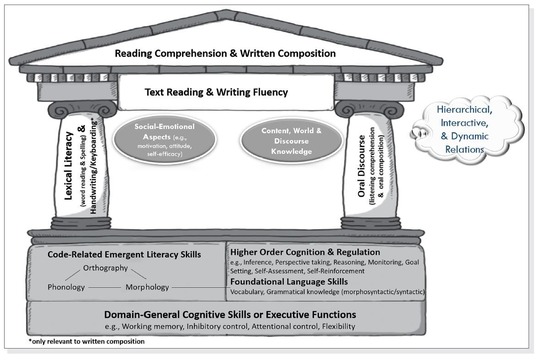 This model demonstrates the hierarchical, interactive, and dynamic relationship between reading and writing. The article offers three implications for this reciprocal nature of reading and writing:
- Districts and schools should leverage assessment data in reading and writing to inform effective reading and writing instruction,
- It is important to take not an either-or approach, but both when developing lower order skills and supporting the development of higher order skills, and
- Reading-writing connections should be made visible to students.
The final article we share today is Mohr et al.’s (2024) “Evidence-Based Practice to Enliven Integrated Reading-to-Writing Instruction.” The authors highlight six evidence-based instructional practices—including details about each practice and recommendations for implementation—that support the reading-writing connection:
- Integrated Reading and Writing via Genre Study
- Drop Everything and Write
- Goal Setting and Progress Feedback
- Rubric-Guided Peer Feedback
- Disciplinary Writing to Learn
- Problem-Based Argumentative Writing
Each of these evidence-based practices can support the “synergistic power” (p. 6) of reading and writing taught together.
As you move through the implementation phases of the 2020 ELA Standards, we hope you consider, discuss, and plan for ways for students to make connections between reading, writing, and exchanging ideas within authentic learning experiences. If you have any questions or would like more information about the reciprocal nature of the ELA standards, please contact MDE ELA Specialist Kristin Bauck.
Sources:
Deane, P., & Traga Philippakos, Z. A. (2024). Writing and reading connections: A before, during, and after experience for critical thinkers. The Reading Teacher, 77(5), 770-780. https://ila.onlinelibrary.wiley.com/doi/abs/10.1002/trtr.2284
Kim, Y. S. G., & Zagata, E. (2024). Enhancing reading and writing skills through systematically integrated instruction. The Reading Teacher, 77(6), 787-799. https://ila.onlinelibrary.wiley.com/doi/full/10.1002/trtr.2307
Mohr, K. A., Jones, C. D., Chamberlain, K., DeCoursey, K., Robertson, M., Summers, C., & Bagley, M. (2024). Evidence‐based practices to enliven integrated reading‐to‐writing instruction. The Reading Teacher, 77(6), 909-917. https://ila.onlinelibrary.wiley.com/doi/abs/10.1002/trtr.2321
Back to Top
Division of Academic Standards, Instruction and Assessment
Sign up to receive the Educator Edition newsletter
Manage Preferences | Unsubscribe | Help | MDE Website
|




