Special Education Division
Director: Robyn Widley
September Special Education Directors' Forum
The first Special Education Directors' Forum of the school year will be held Friday, September 6, 2019, beginning at 9 a.m. in Conference Center B, Rooms 15 and 16, Minnesota Department of Education (MDE), 1500 Highway 36 W., Roseville, Minnesota 55113. The September Forum will feature updates and information from the Special Education and Compliance and Assistance Divisions, Minnesota Administrators for Special Education, legislation, alternative assessment, Comprehensive Early Intervening Services (CEIS) and dyslexia. The forum will be available for remote viewing courtesy of MediaSite. Watch the Special Education Directors' listserv for more information. We look forward to seeing you.
For more information, contact Robyn Widley, 651-582-1143.
Federal Determination: Minnesota "Meets Requirements" and Improving Graduation Rates
The U.S. Department of Education’s (US DOE) Office of Special Education and Rehabilitative Services (OSERS) released state determinations on implementation of the Individuals with Disabilities Education Act (IDEA) for Part B and Part C for fiscal year 2017. IDEA requires each state to report annually to the US DOE on its performance under its State Performance Plan (SPP). Specifically, each state must report in its Annual Performance Report (APR) the progress it has made in meeting the targets established in its SPP. IDEA details four categories for determination: meets the requirements and purposes of IDEA, needs assistance, needs intervention or needs substantial intervention. While this information is not new for many of you, we include background information each year for those who may not be familiar with the OSERS determinations process.
Starting in 2014 and continuing the past five years, US DOE has weighted compliance and results data equally in making each state’s Part B determination. Beginning in 2015, the US DOE used both compliance and results data for Part B and Part C state determinations. The US DOE used multiple outcome measures that include students with disabilities' participation in state assessments, performance in reading and math on the National Assessment of Educational Progress (NAEP), and graduation and dropout rates. The use of student testing and other outcome measures was a major shift in 2014 from years past and affected many states’ standings related to their overall determination. This Results Driven Accountability (RDA) framework includes both educational results and functional outcomes for students with disabilities and results with the compliance requirements of IDEA.
This year, Minnesota, along with 20 other states and territories, is in the "Meets Requirements" determination category for Part B. Minnesota also met the "Meets Requirements" determination for Part C, making us one of only 14 states to meet in both areas, an increase from 13 states last year. This is Minnesota’s fifth year for being in the "Meets" category for both Part B and Part C, making Minnesota one of only three states that has consistently been in the "Meets" category five years running. We continue to have much to celebrate about the quality work teachers and administrators are doing across the state for students with disabilities. We acknowledge and thank you for all the work you and your staff put in each day to serve all students and appreciate your continuing efforts.
To read Minnesota’s Part B SPP/APR and State Systemic Improvement Plan (SSIP), please visit OSEP’s GRADS360° website. If you have questions or would like more information about the SPP/APR or SSIP, please contact Carolyn Cherry.
Register Now for Individualized Education Program (IEP) Services Fall Training
MDE and the Department of Human Services (DHS) will conduct IEP Services training sessions around the state in October and early November. These sessions are designed for third-party billing coordinators, special education directors and administrators. An agenda will be sent out mid-September.
View the training registration form on the DHS website for times and locations and to register for the training. Space is limited and seating is not guaranteed for those who do not register before the September 20, 2019, deadline. Confirmation emails for the previous week’s registrants will be sent each Friday.
Please contact Kristin Smith (DHS) if you need to cancel or make changes to your reservation. Any changes or cancellations must be received 72 hours prior to the training to avoid additional charges.
If you have questions, contact Jesusa Williams, Jenny Roth (DHS) or Julie Neururer (MDE).
Minnesota Gathering for Person-Centered Practices
The Minnesota Gathering for Person-Centered Practices (PCP) is an annual two-day event for individuals with disabilities and their family members, advocates, business partners, educational and community-based organizations who are interested in PCP and Positive Behavioral Interventions and Supports (PBIS). The purpose of the Gathering is to create connections, dialog, share successes and learn together how we continue moving Minnesota in the direction of a being a person-centered place for people with disabilities to live. This year the Gathering is celebrating its fifth year and honoring how Minnesota has advanced PCP.
For more information about the September 24-25, 2019, Gathering, to be held at the Eagan Community Center, 1501 Central Parkway, Eagan, MN 55121, visit the Gathering website or contact MDE's PCP team.
Supporting Students with Disabilities to Become College- and Career-Ready
The Minnesota Department of Education and Regional Education Laboratory (REL) Midwest are hosting a Minnesota Administrators for Special Education (MASE) Fall Conference pre-session from 12:30 to 4 p.m. on Wednesday, October 23, 2019 at Cragun’s Conference Center, Paul Bunyan Room I. The Supporting Students with Disabilities to Become College- and Career-Ready pre-session will focus on effective strategies to prepare students with disabilities to become college- and career-ready.
The event will cover existing research on evidence-based practices, tools and resources to support students and provide examples from special education administrators from around the state. The event will include a question-and-answer session with the presenters and conclude with table discussions in which participants will create an action plan based on the resources and lessons learned at the event.
Register for Supporting Students with Disabilities to Become College- and Career-Ready on the conference website. If you have questions or would like additional information, please contact Cora Goldston, 312-690-7391.
Assistive Technology (AT) for School Administrators and Leaders
MDE is sponsoring two sessions highlighting the important role that both school administrators and AT leaders play in guiding the provision of quality AT services. Although they may not realize it, administrators, including building principals, are critical to the provision of AT services that efficiently and effectively meet the needs of students with disabilities.
Sessions will focus on components of leadership, management, supervision, program development and advocacy. Dr. Penny Reed will discuss key components of successful administrator influence, providing practical suggestions and useful resources. Although these webinars are open to everyone, registration is required by November 15, 2019. On December 3, 2019, participants will learn how to get the most benefit from their AT budgets. On January 14, 2020, they will discuss roles and responsibilities for AT leaders. All participants will receive a copy of Leading the Way to Excellence in AT Services: A Guide for School Administrators.
Register on SurveyGizmo beginning September 15, 2019, for AT for School Administrators and Leaders. For more information, contact Kursten Dubbels.
Distance Services Guidance
The role of distance technology in education is expanding and can be beneficial to building learning relationships and engaging students regardless of location. Distance technology may be useful in serving students receiving special education services, which presents IEP teams with unique opportunities, considerations and challenges.
The term "distance services" includes the provision of special education and related services via distance technology. This document is intended to provide guidance related to licensure requirements and billing practices for special education services provided via distance services.
Licensure
When contracting for evaluations or special education services, a district shall contract with personnel who hold appropriate licenses issued by the Professional Educator Licensing and Standards Board (PELSB) or commissioner of education (See Minnesota Rules, part 3525.1550, subpart 1).
Districts can check which licenses educators hold through License Lookup on the PELSB website.
Billing Practices
The cost for the provision of special education services is coded the same way in both Uniform Financial Accounting and Reporting Standards (UFARS) and Special Education Data Reporting Application (SEDRA), whether in person or via distance technology. The current system does not differentiate between a cost incurred for service provision delivered in person or via distance technology. Coding practice for district-employed staff members or a contracted provider is the same regardless of whether the service is provided in person or via distance technology.
Third-Party Billing
The Minnesota Department of Human Services allows Medicaid reimbursement for telemedicine services for some IEP or Individualized Family Service Plan (IFSP) health-related services. Telemedicine is defined as the delivery of health care services or consultations while the child or youth is at an originating site and the licensed health care provider is at a distant site. Eligible recipients of telemedicine coverage are children or youth who are Medical Assistance (MA) eligible and have an IEP or IFSP in which the service provided is identified.
For assistance with questions regarding licensure, contact PELSB, 651-539-4200.
For assistance with questions regarding special education finance, contact Paul Ferrin, 651-582-8864.
If you have questions regarding telemedicine and Medicaid reimbursement, contact Julie Neururer, 651-582-8660.
Optimizing Outcomes for Students who are Deaf or Hard of Hearing
Kathy Anderson and Mary Cashman-Bakken enjoyed meeting several Minnesota special education directors this spring over discussions of the National Association of State Directors of Special Education (NASDSE) document Optimizing Outcomes for Students who are Deaf or Hard of Hearing. Others are scheduled to hear the overview presentation this fall. As a reminder, now is the time to start determining your Optimizing Outcomes self-review implementation team for the coming school year. The Regional Low Incidence Facilitators (RLIFs) around the state are ready and willing to assist you with this project.
Kathy and Mary worked on discussion templates for each chapter of the Optimizing Outcomes document and will be sharing these with the RLIFs in August. The RLIFs will then share the templates at the four regional Deaf/Hard of Hearing Community of Practice (DHH CoP) meetings this year. It is expected RLIFs and DHH CoP members will review approximately two chapters per meeting. These templates should be helpful to you as your district team discusses your DHH services and fills out the Chapter 9 Implementation: Deaf and Hard of Hearing Program and Service Review Checklist. View the checklist on the NASDSE website.
We are looking forward to reading these implementation checklists and success/gap summary forms from your districts. The checklists should be given to your RLIF by the end of May 2020 so we can start to prioritize closing the gap on equity both regionally and statewide. We will be checking in with directors and RLIFs periodically throughout the coming school year to see how we can be of assistance to you as you complete this important work.
We want to thank you for assisting us in this endeavor as we identify gaps and strengths in our services for DHH students in Minnesota. If you have any questions, please feel free to contact Kathy Anderson or Mary Cashman-Bakken.
New Children’s Therapeutic Services and Supports (CTSS) Recertification Form and Process
Effective August 6, 2019, the Children’s Therapeutic Services and Supports (CTSS) Recertification application has been modified, updated and incorporated into the current CTSS application (DHS-3610). Download the CTSS application from the DHS website. All community and school providers will use this new form to recertify their agency in providing CTSS. The CTSS Webpage has been updated to reflect the new recertification process and provide guidance on how to submit a recertification application.
Contact the CTSS Review Team at 651-431-2225 if you have questions or comments, or email CTSS Community or CTSS Schools.
Pathways to Life Summer Transition Program Set for 2020
The Pathways to Life summer transition program provides experience to address the specific needs of students who are DHH and Deaf-Blind. This summer was the first year of this transition camp held at the Minnesota State Academy for the Deaf (MSAD). Thanks to your district support, funds from MSAD, MDE, the Department of Employment and Economic Development and Minnesota Hands and Voices, this camp provided opportunities for 12 students from 11 different school districts throughout the state to increase independence in their school, home, community and work environments. Over 50 activities covering the five main transition areas identified in the students’ IEPs were provided. We look forward to providing opportunities through extended school year support again in 2020.
Next year’s Pathways to Life program is scheduled for June 14-26, 2020. Additional information on this camp will be sent out early in September. If you need more information, contact Mary Cashman-Bakken.
University of Kansas Expert Meets with Special Education Division
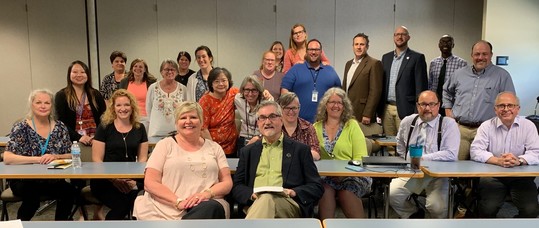
Dr. Michael Wehmeyer, in St. Paul for the American Association on Intellectual and Developmental Disabilities conference, joined the Special Education Division at its quarterly meeting on June 25 (see banner photo above) for a discussion on issues pertaining to the education and support of youth and adults with intellectual and developmental disabilities. Dr. Wehmeyer is the Ross and Marianna Beach Distinguished Professor in Special Education and Chairperson, Department of Special Education, as well as Director and Senior Scientist at the Beach Center on Disability, all at the University of Kansas. He specializes in self-determination, positive psychology and disability, transition to adulthood, the education and inclusion of students with extensive support needs and technology use by people with cognitive disabilities.
Family, School, and Community Partnerships for Students with Disabilities
MDE's Elizabeth Watkins recently contributed a chapter on the roles of interpreters and cultural liaisons when working with parents and the collaborative training model that has been developed for speech-language pathologists and interpreters who work with diverse parents and children for the book Family, School, and Community Partnerships for Students with Disabilities. For more information, visit the Springer Science+Business Media website.
PACER Center Accepting Applications for Project KITE
Project KITE is a series of five free workshops that travels to your Minnesota location. These workshops bring together education professionals and the parents of children with whom they work. Through collaborative trainings, teams learn about assistive technology designed to enhance learning and increase inclusion of students with disabilities.
Three separate teams with three members per team are needed to make a complete training group. All three teams must be from a similar geographic area.
Each single team is built around a focus child (aged 3-8) and consists of:
- A parent of a child with special needs.
- A classroom teacher.
- A related service provider working with the child, for example, special education teacher, speech therapist, paraprofessional, occupational therapist, etc.
- Each team member must apply individually.
Assistive technology can be as simple as a pencil grip or as complex as an iPad. When used effectively, it can open doors to new skills and abilities for a child with a disability. During Project KITE, teams of parents and professionals learn and work together to discover and try assistive technology that can benefit their student and the classroom.
Project KITE includes:
- The loan of an iPad loaded with useful learning and communication apps for the duration of the program.
- Free year-long membership to the PACER Simon Technology Center assistive technology lending library.
- Useful technology trainings with a PACER assistive technology specialist and ongoing support.
For more information or to submit an application, visit the PACER website.
PACER Center Resources for Transition-Age Students
Starting in grade 9, or sooner if appropriate, Minnesota students on an IEP are included in IEP discussions whenever transition is discussed. Under grants from MDE, PACER continues to provide information and support related to the topic of transition to parents and transition-age youth, including:
Resources for students and youth
-
PACER’s website for Transition-age youth, Transitioning to Life after High School, provides information and videos on training/college opportunities, employment stories, independent living, assistive technology, advocating for myself, get involved, get connected and my disability rights.
-
PACER’s Students and Young Adults section includes other topics for youth, including youth workshops-tech for teens, summer recreation, sports and camps, and publications and downloads.
Resources for parents and guardians
Parent Special Education Information includes information on the special education process, improving communication with school staff and school discipline.
Back to top
Supervisor: Lisa Backer
Early Childhood Special Education (ECSE) Transportation
“A school district must provide the necessary transportation to and from the home
of a child with a disability not yet enrolled in kindergarten for the provision of
special instruction and services that are provided in a location other than the child’s
home.” This deceptively simple statement is the cause of much confusion. In an
effort to clarify your early childhood special education transportation
responsibilities, the ECSE Team has posted a recently developed guidance
document on the Part C and Part B resource page of the MDE website. For more information, contact Susanne Thomas.
Back to top
https://content.govdelivery.com/accounts/MNMDE/bulletins/25a4bbf
|