|
Minnesota’s new school and district accountability system includes a measure of consistent attendance, in addition to academic achievement, academic progress and graduation rates. This change presents an opportunity for district and school leadership teams to engage in equity-focused conversations about the data, the reasons students are not in school, and positive strategies to increase attendance.
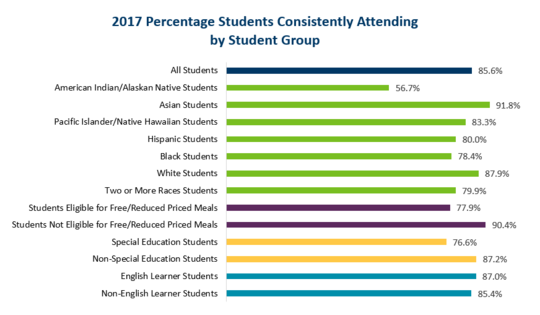
Minnesota set a goal to reach 95 percent of students consistently attending school, with no student group below 90 percent, by the year 2020. The data show that we have work to do together to reach this ambitious goal.
At a statewide level, low-income students, students of color, American Indian students, and students with disabilities are far more likely to be chronically absent than their peers. For example, in 2017, white students reached 87.9 percent of students consistently attending, while American Indian and black students were at 56.7 percent and 78.4 percent respectively. The data below provide the consistent attendance rates for each student group.
Each district and charter school received 2015, 2016 and 2017 consistent attendance data in the secure reports on the MDE Data Center on Thursday, April 5. This includes both individual student data as well as school and district summary results that will be used in the new accountability system. Students are considered consistent attendees if they are in attendance at least 90 percent of the days enrolled. Feel free to see this FAQ and overview for more information on the consistent attendance indicator.
I encourage you and your teams to take a close look at the data for each student group. The data will help inform conversations with stakeholders about the root causes for why students are not in school, the challenges some students may face, and the supports that need to be put in place to ensure all students and families are engaged and welcomed at school. Long-term, sustained success will come from addressing the root causes for why students are not regularly in attendance.
Minnesota’s new accountability system uses multiple indicators, averaged over three years, to identify schools and districts for support. Districts already have most of the data that will be included in the release of accountability results in August 2018. I encourage you to take a comprehensive look at your consistent attendance rates, graduation rates, and previous year assessment results to identify areas of need and continue conversations with stakeholders about how the strategies and budget in your World’s Best Workforce plans are addressing your needs.
I look forward to meeting with many of you throughout the month of April as I head out on the road with my team to discuss our partnership to implement Minnesota’s new accountability and support system under the Every Student Succeeds Act (ESSA). This flyer includes registration information for these meetings.
 Back to top
ITEMS OF INTEREST
The Minnesota Department of Education (MDE) is recruiting new districts/charter schools to participate in the Kindergarten Entry Profile (KEP). The KEP supports schools and districts in measuring what children know and are able to do at entry to kindergarten and can inform practice and programming. Participants choose from a menu of high quality, comprehensive assessment tools that are aligned to Minnesota’s early learning standards, the Early Childhood Indicators of Progress (ECIPs) and the state’s K-12 academic standards. All KEP approved assessment tools rely on authentic (i.e. observation-based) assessment and do not require any changes to curriculum or instruction.
Districts/charter schools choosing to participate in the KEP select the assessment tool that best fits their community needs, and MDE (1) covers the cost of the online subscription; and (2) provides training on the tool for teachers/administrators. Data from the KEP can also be used to inform other initiatives, including World’s Best Workforce plans and supporting coherence in prekindergarten through third grade teaching and learning.
If you are interested in participating in the KEP or have any questions, please email Jon Vaupel. Stay tuned, as the Division of Early Learning Services will also offer interest webinars in the upcoming months.
Back to top
As required by state law, the 2009 Minnesota K-12 Academic Science Standards are being reviewed and revised during the 2018-19 school year. The science standards are reviewed only once every ten years, so it is important to establish a highly qualified, diverse committee that understands best practices in science education and the range of student needs across our state. Candidates are now being sought to review and revise the science standards. Serving on the committee requires an intense time commitment of at least one three-day and nine full-day committee meetings from August 1, 2018, through May 1, 2019. The initial three-day meeting is scheduled for August 1-3, 2018, at the Minnesota Department of Education (MDE) and is required of all committee members. Applications will be accepted March 30-April 23, 2018. Committee members will be announced on the MDE website on May 18, 2018.
Visit the MDE science webpage to read the Assumptions for Guiding the Standards Committee’s Work, review the timeline, and access the online application. The deadline for applying to the committee is Friday, April 23, 2018.
For more information about the standards review process, contact John Olson 651-582-8673.
Please share this message with curriculum coordinators, science educators and other members of the public who may be interested in applying for the Science Standards Committee.
Apply for the Science Standards Committee.
Back to top
Every tax season, cybercriminals use a variety of scams to steal identities for financial gain. Tax-related identity theft occurs when someone uses your stolen social security number to file a tax return claiming a fraudulent refund. If you believe you have been a victim of tax identity theft you should immediately file a complaint at identitytheft.gov and then contact one of the three major credit bureaus to file a fraud alert. The IRS provides information to help protect yourself at www.irs.gov as well as printable resources such as Identity Theft Information for Taxpayers Publication. The Federal Trade Commission (FTC) is another great source for information and resources pertaining to tax related identity theft as well as privacy and online security tips.
Contact Michael Virnig, MDE Information Security Analyst, at 651-582-8514, for additional information or if you have any questions.
Back to top
The Minnesota Department of Education (MDE) is partnering with the Midwest Regional Education Lab (REL) to host a series of regional meetings in May. This is an opportunity for districts and charters to engage in dialogue with other districts around the work they are doing related to WBWF in their local settings.
The purpose of these meetings is to offer districts/charters a chance to network around the work they are doing now and find ways to get better. After a scan of over 100 WBWF summary reports, the REL professionals will share their findings and point out the strengths and challenges they observed in the practices referenced in the summaries. We will spend time focused on meeting teams where they are now and moving forward around the work of WBWF within local contexts. Our three-hour sessions will focus on the continuous improvement process, goal setting, and sharing of practices among districts.
We encourage districts and charters to join us. Please see the flyer with more information and to register.
Back to top
PROFESSIONAL DEVELOPMENT AND TRAININGS
MN Math Leaders Networking sessions and Math Teacher Webinars are sponsored by the Minnesota Department of Education and MN Math Leaders, a committee of the Minnesota Council of Teachers of Mathematics. The 2017-18 MN Math Leaders Networking sessions and Math Teacher Webinars will focus on implementation of collaborative structures to improve mathematics teaching and learning.
Access webinar details and register.
Back to top
The School
Safety Technical Assistance Center is offering two McGrath Bullying and
Harassment: Minimize the Risk trainings in May. The workshops are designed to
help school districts and charter schools meet the Safe and Supportive Schools
Act requirement to train all staff on the bullying prohibition policy and how
to identify, intervene and respond to bullying. During the Bullying and
Harassment Investigation Trainings: From Complaint Intake to Investigation
trainings, participants will walk through all the steps of intake, inquiry and
investigation. This training is recommended for school building principals or
their designee or other staff responsible for handling bullying complaints and
investigations.
Upcoming Trainings
- Monday, May 7, 8:30 a.m.-5 p.m. (includes lunch) at the South Central Service Cooperative, 2075 Lookout Drive, North Mankato. Learn more and register for the training.
- Friday, May 11, 8 a.m.-4:30 p.m. (includes lunch) at the Minnesota Department of Education, Conference Center A, Room 13, 1500 Highway 36 West, Roseville. Learn more and register for the training.
Back to top
Schools are invited to join School Design for Individualized Learning, a school design experience developed to help schools reimagine the purpose and focus of school to meet the needs of all students in today’s world. This work is operated by 2Revolutions, a national education design lab, in partnership with the Bush Foundation.
Read the one-pager for more information.
To join us, please come learn more at an interactive orientation to the design experience, all meetings are 5-7 p.m. with a light dinner served:
- April 23, Blandin Foundation in Grand Rapids, MN
- April 24, St. Cloud State University in St. Cloud, MN
- April 25, Hamline University in St. Paul, MN
- April 26, the Lincoln Community Center in Mankato, MN
Register to attend the Bush Foundation School Design Institute (SDI) Orientation. Visit the website for more information. If you have questions, email Elizabeth Stephens.
Back to top
Black students represent 10.7% of Minnesota’s total student population; however, black students account for 38.8% of suspensions, expulsions, and exclusions. Special education students represent 13.8% of the total student population and 42.1% of suspensions, expulsions, and exclusions, and American Indian students represent just 1.6% of the total student population but 6.2% of suspensions, expulsions, and exclusions. As part of Minnesota’s focus on equity and addressing inequities in our education systems, the Minnesota Department of Education in partnership with the Midwest Comprehensive Center will be offering a number of new supports for districts. These activities are open to all districts, and are designed to support districts as they work to address disproportionate rates of suspensions and expulsions for students of color, American Indian students, and special education students.
Access additional information and register for the kickoff webinar and convenings.
Back to top
|