State of the Range looks ahead as IRRR marks 85 years
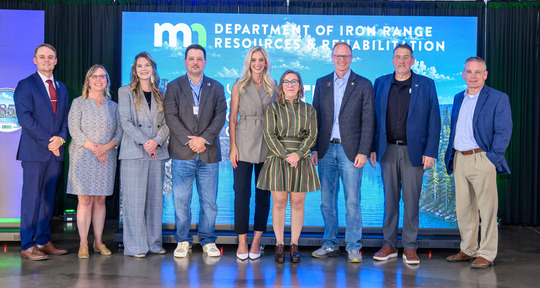 State of the Range speakers gathered following the program at the Minnesota Discovery Center in Chisholm. Pictured from left are Ryan Malich, Iron Range Resources & Rehabilitation (IRRR) executive director of Development; Whitney Ridlon, IRRR director of Community Development; Dr. Jessalyn Sabin, Minnesota North College president; Cliff Cain, Pulsar Helium/MiningMinnesota; Kristen Vake, Iron Mining Association executive director; IRRR Commissioner Ida Rukavina; Sen. Rob Farnsworth, IRRR Advisory Board chair; John Arbogast, United Steelworkers District 11; and Kevin McKinnon, Minnesota Department of Employment and Economic Development deputy commissioner.
Nearly 300 community, business and industry leaders gathered Wednesday, Sept. 9, at the Minnesota Discovery Center in Chisholm for the third annual State of the Range hosted by Iron Range Resources & Rehabilitation (IRRR). The event also celebrated the agency’s 85th anniversary and focused on the region’s economy, mining, workforce, education and community and business development.
Commissioner Ida Rukavina reflected on IRRR’s history and its mission to diversify the regional economy while recognizing mining’s important role. Created by the Minnesota Legislature in 1941, IRRR reinvests a portion of Taconite Production Tax revenues generated by mining into businesses, communities and people across the Taconite Assistance Area.
Rukavina said the region is navigating both opportunity and significant economic challenges. Mining and manufacturing layoffs have affected hundreds of workers and their families, while schools, communities and businesses continue to face changing economic conditions.
|
At the same time, IRRR supported more than 230 grants and business loans totaling more than $63 million in fiscal year 2026. Combined with investments from other state and federal sources, local governments, businesses, nonprofits and private partners, more than $477 million was invested across the region.
Rukavina also discussed independent research commissioned by IRRR in partnership with the Northland Foundation and Blandin Foundation examining long-term demand for Minnesota iron ore. The research identified four key themes: mining is changing, innovation creates opportunity, the region is experiencing disruption and renewal, and Minnesota is competing in a global market.
The program brought together perspectives from mining, labor, emerging industries, higher education and economic development. Regional updates were provided by Sen. Rob Farnsworth, chair of the IRRR Advisory Board; Kristen Vake, executive director of the Iron Mining Association; John Arbogast of United Steelworkers District 11; Cliff Cain of Pulsar Helium, speaking on behalf of MiningMinnesota; and Dr. Jessalyn Sabin, president of Minnesota North College.
|
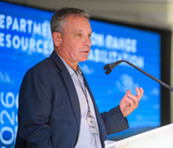
Minnesota Department of Employment and Economic Development Deputy Commissioner Kevin McKinnon highlighted the longstanding partnership between DEED and IRRR. He said the agencies’ missions align around expanding, retaining and attracting businesses, investing in community vitality, supporting workforce development and attracting tourists.
McKinnon pointed to several projects where the agencies have worked together to support business investment and redevelopment across the region, including projects in Grand Rapids, Virginia, Hibbing and Ely. He emphasized that partnership is essential to economic development and said DEED and IRRR will continue working together to help build the future of the Iron Range.
|
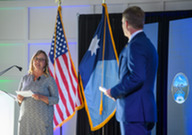
IRRR Director of Community Development Whitney Ridlon and Executive Director of Development Ryan Malich highlighted the agency’s development work under the theme “Building Communities. Growing Businesses. Moving Forward Together.”
They emphasized that IRRR’s role extends beyond providing grants and loans. Development projects often require communities, businesses, lenders, contractors, schools, nonprofits and government agencies to combine financing, technical expertise and other resources to move projects forward.
Examples included affordable housing development in Grand Rapids, community revitalization through United Way of Northeastern Minnesota’s Day of Action, Pohaki Lumber’s expansion in Virginia and Central Avenue Design’s redevelopment of a vacant property in Nashwauk.
Looking ahead, Ridlon and Malich identified housing, childcare, workforce, regional capacity and development-ready sites and buildings among the needs continuing to surface across northeastern Minnesota. They emphasized using partnerships and flexible financing tools to address needs that may not fit neatly within a single program or funding source.
|
In closing, Rukavina emphasized that a resilient regional economy will depend on multiple industries and investments rather than any single solution, including mining, manufacturing, tourism, technology, education, entrepreneurs and small businesses.
She also underscored the role Minnesota’s natural resources will continue to play in the region and beyond.
“The ore beneath the Iron Range helped build this region. It helped build Minnesota. And it helped build America. Minnesota’s minerals still have an important role to play in America’s future,” Rukavina said. “We will continue our mission to diversify an economy highly reliant on mining, while recognizing a fundamental truth: Nearly everything we produce and manufacture depends on the ore, minerals and raw materials that make modern life possible.”
|

Rukavina returned to the importance of people and partnerships as IRRR enters its next chapter.
“Our natural resources have shaped this region. But our greatest resource has always been our people,” she said.
Attendees concluded the evening with a social hour and networking in Taconite Square.
|
|