March 4, 2026
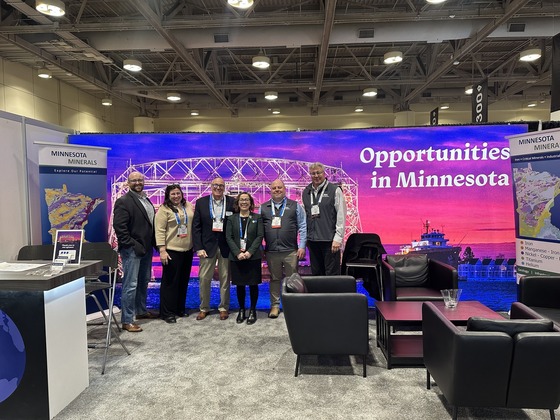 IRRR Commissioner Ida Rukavina, Climate and Energy Policy Advisor Jason Janisch and representatives of the Minnesota Minerals Coordinating Committee joined thousands of global industry leaders at the annual PDAC convention in Toronto.
Iron Range Resources & Rehabilitation (IRRR) Commissioner Ida Rukavina, Climate and Energy Policy Advisor Jason Janisch and representatives of the Minnesota Minerals Coordinating Committee participated in the Prospectors & Developers Association of Canada (PDAC) International Convention, Trade Show & Investors Exchange held March 1–4 in Toronto, Canada. The group hosted a booth at the convention’s trade show, connecting with industry leaders, investors and stakeholders from around the world.

Throughout the week, participants engaged with industry representatives, explored emerging technologies and discussed innovation shaping mineral exploration and mining. The convention provided an opportunity to exchange ideas, strengthen relationships and learn about new tools and approaches influencing the future of mineral and resource development, while helping position Minnesota as a competitive and reliable location for mineral investment and innovation.
“PDAC provides an important opportunity to connect with industry leaders from around the world and highlight the strengths of Minnesota’s mining sector,” said Rukavina. “It also allows us to learn about emerging technologies and trends that will help shape the future of mineral development and economic opportunity for communities on the Iron Range.”
PDAC is considered the world’s premier mineral exploration and mining convention, drawing more than 32,000 attendees from over 125 countries, along with 1,300 exhibitors and 700 presenters for educational programming, networking events and business opportunities. The mineral exploration and development sector represented at PDAC employs more than 711,000 individuals globally.
|
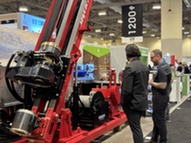
Participation in PDAC also provides an opportunity to highlight northeastern Minnesota’s long history of responsible mining. With more than 140 years of mining expertise, the region is supported by a highly skilled workforce, world class mineral resources, extensive rail and port access, reliable power grids and strong industrial infrastructure that position Minnesota well for future mineral development and long-term economic growth.
Minnesota’s taconite industry remains a cornerstone of the state’s economy, generating more than $4 billion in economic impact annually and supporting thousands of good-paying jobs across the region.
Since it began in 1932, the PDAC convention has grown in size, stature and global influence, becoming one of the industry’s leading forums for sharing knowledge, advancing innovation and building relationships across the global mining sector.
Learn more about the PDAC convention.
|
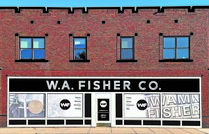
Small business owner Jeff Leese made energy efficient improvements to his W.A. Fisher Co. building located on Chestnut Street in downtown Virginia. The project entailed a steam conversion to natural gas, interior lighting upgrades, the addition of new air conditioning and heat elements and the acquisition of a new commercial paper cutter.
Iron Range Resources & Rehabilitation (IRRR) provided a $20,000 Business Energy Retrofit (BER) grant to support the project. The BER program is designed to help small business owners in the Taconite Assistance Area (TAA) make energy improvements to their buildings. It is funded by IRRR and administered by Arrowhead Economic Opportunity Agency (AEOA). BER grants help business owners achieve results such as reduced utility bills, improved building aesthetics and increased building life.
|

“The BER grant has reduced the burden of extra overhead for my business allowing me to allocate more funds to my workforce and resources that help grow my business,” said Leese. “I am very grateful for grants such as these that are available to small businesses such as myself.”
W.A. Fisher began business in the building in 1922, first becoming popular for its printing of outdoor maps of the Boundary Waters, Quetico Provincial Park, Voyageurs National Park, Lake Vermilion and other historical lakes. More than 100 years later, the full-service ad agency is still serving clients. A staff of 15 professionals does about 95% of the company’s work inhouse, everything from website development to digital ad campaigns, from simple color copy printing to elaborate production of billboards, large displays and binding. They launch successful marketing campaigns for small and large businesses and organizations, both local and far away clients.
|

Leese grew up in Virginia and graduated from University of Minnesota-Duluth before returning to his hometown in 2010 to begin his journey with W.A. Fisher. He worked in various positions there before being promoted to president in 2017 and acquired full ownership of the business in 2025. He and his wife reside on the Iron Range with their three children.
Since BER’s inception in 2013, more than 800 grants have been awarded to help small businesses, which are an imperative part of the region’s economy, communities and workforce. Learn more about BER grants.
Learn more about W.A. Fisher Co.
|
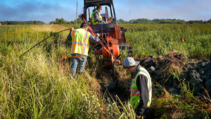
Paul Bunyan Communications (PBC) extended one of the fastest rural all-fiber optic networks in the United States, the GigaZone™ to approximately 100 unserved and underserved locations. The project included the areas of Dark Lake, Clear Lake, Lake Fourteen and Lake Leander in or near Great Scott Township and the area near the Iron Range Retriever Club and Four Mile Lake in Mountain Iron. Iron Range Resources & Rehabilitation (IRRR) supported the project with a $217,000 Broadband Infrastructure grant to PBC. Total project investment is estimated at $808,960.
The extension to the Great Scott and Mountain Iron locations was part of a larger project led by PBC last year that included other areas across rural St. Louis County.
|
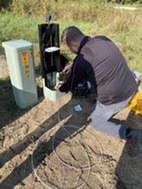
The GigaZone is currently available to more than 60,000 locations in Minnesota and serves over 36,000 customers across rural and often sparsely populated areas.
“Broadband has become a cornerstone for regional economic growth, remote education, telehealth services and numerous other community initiatives in northern Minnesota,” said Craig Boyer, PBC’s chief financial officer. “The Great Scott project served an area that likely would not have received basic broadband service without external assistance. The grant from IRRR enabled the project to move forward, along with additional funding from St. Louis County.”
|
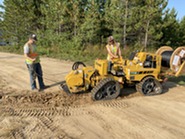
The locations now have access to fiber optic fast GigaZone internet and WiFi, digital voice services and Managed IT business services. The PBC cooperative is also northern Minnesota’s certified Apple Service Center and an authorized DIRECTV dealer. Anyone interested in getting connected to the all-fiber optic broadband network may sign up for service. People may sign up online or by phone. To check if a specific location is in the project area and to sign up for service, visit www.gigazone.com.
Email Whitney Ridlon or call her at 218-735-3004 for Broadband Infrastructure grant information.
|
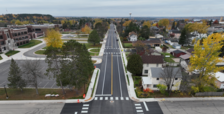
The city of Ely, in partnership with St. Louis County, completed a large-scale roadway improvement project to Harvey Street, the community’s main thoroughfare. The project involved utility upgrades and road reconstruction to Harvey Street and adjacent streets, avenues and alleys, specifically from Central Avenue to Ninth Avenue East. Sanitary and storm sewer lines and water mains were replaced or improved. New sidewalks, curbs, gutters, signage and dark-sky compliant streetlights were installed. Iron Range Resources & Rehabilitation (IRRR) supported the project with a $200,000 Public Works grant to the city of Ely. Total project investment was $4.214 million.
|
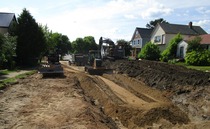
“Harvey Street is one of the busiest streets in Ely and now has a fresh look, providing two 11-foot driving lanes with eight-foot parking lanes on each side,” said Harold Langowski, clerk-treasurer for the city of Ely. “There were road closures and some traffic delays during the reconstruction, however the completed project is a great asset to our community. Residents, businesses, schools and tourists all benefit from this project.”
Langowski explained that because Harvey Street is a County State Aid Highway (CSAH), St. Louis County paid for the majority of the project using Municipal State Aid Funds. The project is part of the county’s ongoing efforts to update infrastructure. St. Louis County is Minnesota’s largest county spanning approximately 7,000 square miles.
|
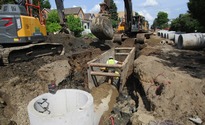
“Investing in public infrastructure is central to our mission at Iron Range Resources & Rehabilitation,” said Commissioner Ida Rukavina. “Partnering with the city of Ely and St. Louis County on the Harvey Street improvements helps ensure the community has the infrastructure needed to support local businesses, residents and visitors while strengthening the long-term vitality of the community.
Email Chris Ismil or call him at 218-735-3010 for more information about Public Works grants.
|
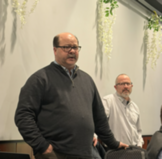
Brownfield redevelopment efforts in Grand Rapids are showing tangible results, but they require patience and specialized expertise, a city official said following a recent Lunch & Learn event focused on site cleanup and reuse.
The Lunch & Learn was held Monday, Feb. 23, in Grand Rapids at Rapids Brewing Company.
Rob Mattei, the city of Grand Rapids’ director of community development, said a key theme of the session was that redeveloping former industrial and commercial sites often comes with additional challenges. However, with skilled technical assistance and persistence, positive outcomes can be achieved.
|
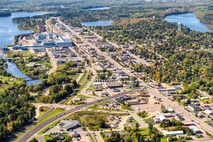
The projects highlighted during the presentation were all priority sites for the Grand Rapids Economic Development Authority and the city.
Among them were the redevelopment of the former Ainsworth OSB plant, now home to HWY 35 LLC, and the downtown redevelopment of Block 19, the site of Rapids Brewing Co.
The Ainsworth project brought industry back to a building that had been vacant since 2008, Mattei said. The Block 19 redevelopment helped catalyze the revival of the Grand Rapids downtown business district.
|
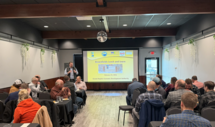
Looking ahead, Mattei said continued education will play an important role in advancing brownfield efforts across the region.
“As a region, I think educational opportunities like the Lunch & Learn events help us all understand that there are professionals and funding sources that can assist communities with the complexities and added cost of repurposing sites,” he said.
The Lunch & Learn series, hosted by Iron Range Brownfields, connects community members, property owners and local leaders with professionals working on cleanup and redevelopment projects across the Taconite Assistance Area. The Grand Rapids session was sponsored by the Grand Rapids Economic Development Authority, Range Association of Municipalities and Schools and Iron Range Resources & Rehabilitation.
Learn more about Iron Range Brownfields.
Pictured top left are Rob Mattei, director of community development, city of Grand Rapids and Ted Hubbes, senior scientist, Braun Intertec.
|
|