Feb. 17, 2021

Eveleth was one of 12 northeastern Minnesota communities that received a Taconite Area Community Relief grant from Iron Range Resources & Rehabilitation. The city received a $200,000 grant and combined it with $50,000 of its own money to create a lending pool of $250,000. Eveleth to date has provided $166,250 in loans to 17 businesses negatively impacted by the COVID-19 pandemic. The loans combined impacted 79.5 full time jobs. Additional loans with the remaining $83,750 could be provided to other Eveleth businesses in the coming weeks.
“Eveleth businesses have suffered significantly during the COVID-19 pandemic,” said Jackie Monahan-Junek, Eveleth city administrator. “With the grant money from Iron Range Resources & Rehabilitation, we structured a forgivable loan program to ensure that businesses could receive the help they needed. Some of the funding recipients have been part of the city’s economy for decades, and one business was brand new. They were all impacted and needed relief.”
|
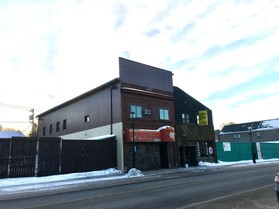
The 17 businesses received 100% forgivable loans up to $12,000 on the condition that they remain open for two years from the date of disbursement.
Eggy's Red Garter was one of the businesses that received a COVID Relief loan. Owner Deb Judnick and her husband Craig have owned Eggy's for 30 years and closed the main street bar March 17 last year due to statewide restrictions for bars and restaurants. The Judnicks repainted the bar’s interior during the three-month closure, while also reporting to their other jobs. Deb is an administrative assistant at the nearby city of Virginia’s fire department which made her an essential worker during the pandemic. Craig is a member of the Local 49 Union which represents heavy equipment operators, mechanics and stationary engineers in the road, highway and bridge construction industry.
|

Eggy's reopened mid-June with reduced hours, however the summer brought a decrease in business levels due to cancellations of community events, parades, Eggy's annual golf scramble, private parties and major holiday celebrations. In mid-November Minnesota reported a spike in COVID-19 cases and a shortage of hospital beds. Restaurants and bars closed a second time for indoor service, Nov. 18 through Jan. 11. Eggy's reopened in mid-January and operates daily 10 a.m. to 10 p.m. Business levels haven’t yet reached 100% due to the reduced hours of operation, as well as the closure of the nearby curling club and bonspiel events which accounted for winter patronage.
“The pandemic has presented financial setbacks for our bar, yet we are extremely grateful to our loyal customer base,” said Deb. “We have five part-time employees and fortunately have been able to retain them. This has been an extremely challenging time for small business owners, but our local Miners National Bank and the city’s forgivable loan program are helping sustain the bar.”
|
Iron Range Resources & Rehabilitation structured the Taconite Area Community Relief program so that Eveleth had funding and flexibility to provide aid to local businesses as the city saw fit. The economic development agency is committed to helping local communities and their businesses persevere through the COVID-19 challenge. Learn more about Iron Range Resources & Rehabilitation COVID Relief programs.
|
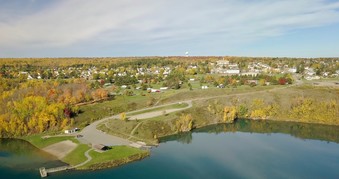
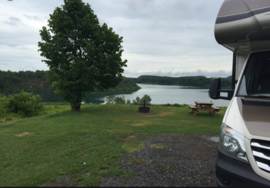
The city of Gilbert made improvements to the utilities, beach area parking and water access at its 57-unit Sherwood Forest Campground adjacent to Lake Ore-Be-Gone. A master plan was also created for the campground’s future growth and development. Iron Range Resources & Rehabilitation supported the project with a Mineland Reclamation grant.
The campground offers full hookup utilities, remote tent sites, horseshoes and volleyball. It reaches full capacity most of the camping season. The campground is located along the paved Mesabi Bike Trail and minutes from the Iron Range Off-Highway Vehicle State Recreation Area.
|
Future plans include:
- 15 new camp units to the north and 26 units to the south.
- A new shower building.
- Boat landing improvements and beach enhancement.
- Additional parking.
- Hiking/walking trails.
- Office facility expansion into a trailhead with informational signs, OHV/ATV trail information and trail mapping.
- Tree planting.
|
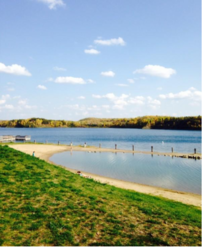
The 140-acre Lake Ore-Be-Gone is an artificial lake that was formed decades ago by the flooding of three open-pit iron ore mines formerly owned by LTV Mining/Erie Mining Co. Iron Range Resources & Rehabilitation assisted with the original reclamation work of the mine pit and campground area. The agency helped develop beaches, a swimming area, public boat landing, fishing pier and docks and sunken attractions for scuba divers. The lake has earned national notoriety among divers because of its crystal blue clear waters where they can see a sunken school bus, cars, U.S. army plane, rail cars, boats, platforms, a jeep, a Huey helicopter and old mining equipment. Watch scuba diving in Lake Ore-Be-Gone.
“Gilbert’s campground and Lake Ore-Be-Gone area is an excellent example of how mining-impacted land in northeastern Minnesota can be transformed for the betterment of the region’s residents, environment and economy,” said Linda Johnson, Iron Range Resources & Rehabilitation mining reclamation director. “The campground brings tourism revenue into the region and gives local residents a unique public amenity to enjoy.”
For Mineland Reclamation grant information email Jim Plummer or call him at 218-274-7006.
Aerial photo courtesy of CAVU.
|
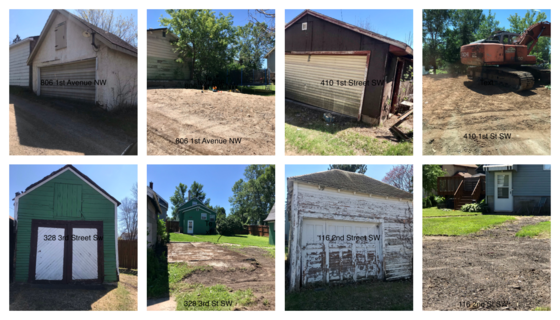 The city of Chisholm demolished 13 dilapidated structures using Residential Redevelopment grants from Iron Range Resources & Rehabilitation. During the past three fiscal years the city removed:
- 9 houses.
- 13 garages.
- 3 accessory structures.
Local governments are often presented with the financial challenge of removing abandoned and dilapidated structures. Since 1982 the Residential Redevelopment program has provided funding for demolition within the agency’s service area to pave the way for a cleaner, healthier environment, more attractive communities and new construction.
“The demolition eliminated public health and safety concerns posed by the blighted structures,” said Mandy Galli, Chisholm building official, zoning administrator and safety director. “Those spaces may now be used for future development of new homes, garages or green space which add to the appeal of Chisholm’s neighborhoods.”
Grants may be awarded to cities, townships, counties and tribal units of government to demolish dilapidated single-unit residential homes, residential duplex homes of no more than two units, garages, sheds and barns. Grant money is still available to communities this fiscal year. A maximum of $3 per building square foot or 75% of demolition costs including basements, whichever is less is eligible.
Learn more about the Residential Redevelopment grant guidelines.
Email Danae Beaudette for information or call her at 218-735-3022. Iron Range Resources & Rehabilitation funds its grants through taxes paid by Minnesota’s mining industry.
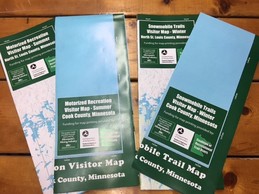
The Coalition of Recreational Trail Users (CRTU) printed a motorized trail map encompassing all legal riding opportunities for ATVs and snowmobiles within Cook, Lake and St. Louis counties, including all of Superior National Forest. Iron Range Resources & Rehabilitation supported the project with a Culture & Tourism grant.
10,000 color maps were printed and are being distributed to trail users at the Minnesota Department of Natural Resources (DNR) information centers in St. Paul and the three northern counties; the United States Forest Service (USFS) district offices within the Superior National Forest; and the chambers of commerce and tourism bureaus across northeastern Minnesota.
|
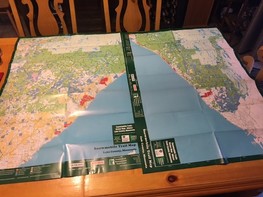
CRTU began developing the map in digital format several years ago. The group partnered with USFS, DNR Forestry Parks & Trails Division, the three county land managers and a professional GIS/cartographer to create the digital map. The collaboration of organizations provided all of the digital road and trail data that was combined to make the map. The map includes not only all available riding trails, but also other prominent landmarks, lakes and highways. The digital map is available on Avenza Maps and Polaris Ride Command apps which may be downloaded in the Google Play and Apple App Store.
“Several maps existed prior to our collaboration, but none included every possible legal trail and riding area across the three counties,” said Ron Potter, CRTU member. “Our goal was to include local, county, state and federal trail lands to create one comprehensive map. We digitized it first and then printed it to bring more riders to northeastern Minnesota.”
|
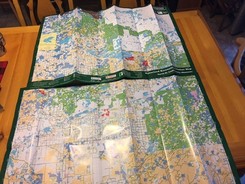
The printed map was designed to expand winter and summer tourism activity through additional snowmobile and ATV use. The map is a trip planning aid that can encourage riders to remain in the area longer because it shows additional riding opportunities across all public land throughout the region. No other printed maps identify the extent of legal riding trails across all three northeastern Minnesota counties.
Other funding partners for the map printing included Federal Recreation Trail Program and CRTU. Email Danae Beaudette for Culture & Tourism grant information or call her at 218-735-3022.
|
Iron Range Resources & Rehabilitation invests resources to foster vibrant growth and economic prosperity in northeastern Minnesota. Culture & Tourism grant applications will be accepted March 1-31. The grant assists nonprofits by supporting strong arts, culture, heritage and recreational activities that enhance the quality of life and economy.
Past project examples include:
- Splash pad in two community parks: Hibbing, Deerwood.
- Veteran’s history project: Itasca County.
- Wheel park: Ely.
- Native American cultural programming at sled dog marathon: Grand Marais/North Shore.
- Capital improvements to Finnish homestead museum: Embarrass.
Full applications should be submitted with all required documentation no later than March 31 in order to be considered for a grant. Learn more about the Culture & Tourism grant guidelines. Iron Range Resources & Rehabilitation funds its grants programs through taxes paid by Minnesota’s mining industry.
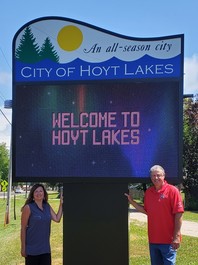
Pictured: The city of Hoyt Lakes used a Culture & Tourism grant to add a new electronic marquee outside the Hoyt Lakes Arena to inform residents and tourists of community events.
|
|