Oct. 2, 2019
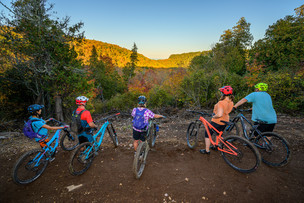
A new 17-mile stretch of purpose-built mountain bike trail will open next spring that connects a cluster of trails at Britton Peak in Tofte to Lutsen. The new connection creates 35 total miles of wilderness trails that include 24 miles in Tofte/Lutsen and 11 in Grand Marais.
“The North Shore is wide-known for outdoor adventure, and we are seeing a lot more mountain bikes on cars traveling up here,” said Paul Nordlund, Superior Cycling Association vice president and project manager. “This new trail gives our local businesses one more offering for their guests.”
Nordlund believes this project along with several others throughout the region are helping to poise northeastern Minnesota to become a national mountain biking destination. Mountain bike trail systems in the region that are either developed or on the horizon include Redhead in Chisholm, Tioga in Cohasset, Giants Ridge in Biwabik, Cuyuna Lakes Recreation Area in Crosby, Hidden Valley in Ely, and Split Rock Wilds in Lake County.
The bicycling industry in the State of Minnesota supported an estimated $777.9 million of economic activity in 2014, including 5,519 employees and $208.8 million in wages, salaries and benefits. The manufacturers and wholesalers connected to the industry generated $616.6 million in economic activity. (Source: “Economic Contribution of Bicycling Industry in Minnesota” report by Minnesota Department of Transportation and University of Minnesota.)
|
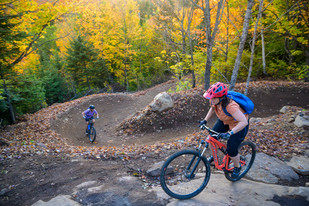
According to Nordlund, mountain biking is transforming the North Shore community and economic landscape. The area’s expanding trail system in the Lake Superior Highlands has a uniqueness not found in other parts of the nation. He said that uniqueness is drawing riders from Thunder Bay, Duluth and the Twin Cities.
“Mountain bikers here see scenic vistas overlooking the Superior National Forest. They traverse through rugged terrain, river valleys, old growth forests and dramatic changes in elevation,” said Nordlund. “And they seldom have to cross a road which makes our trail system highly sought after and a rarity in the United States.”
Iron Range Resources & Rehabilitation provided a Regional Trails grant which helped pay for the trail construction, rehabilitation of existing adjacent trails, trailhead enhancement and signage. Other project partners included Federal Trails Recreational Program, Greater Minnesota Regional Parks & Trails Commission, Cook County Grand Marais Economic Development Authority, Visit Cook County, Lutsen Tofte Tourism Association, Lutsen 99er mountain bike race, Cook County, and the United States Forest Service.
“Without the grant from Iron Range Resources & Rehabilitation, the trail would dead-end and riders would have to return to their starting point at Britton Peak,” said Nordlund. “Now mountain bikers can travel through from Lutsen to Tofte or Tofte to Lutsen. We’ve created a much more desirable riding experience that will attract more users.”
Images courtesy of Bryan Hansel Photography.
|
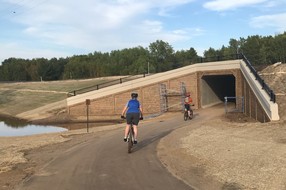
A new multi-use trail tunnel below Highway 6 in Crosby opened this month. The tunnel creates safe connectivity for cyclists, hikers, cross country skiers, snowshoers, ATV riders and snowmobilers using the Cuyuna Country State Recreational Area (CCSRA). The tunnel’s design resembles the entrance to a mine shaft, paying homage to the region’s iron ore mining industry.
Crosby was recently named as a “Best Place to Live” and one of “America’s Smartest Towns” by Outside magazine. The award resulted from the way the community transitioned from a mining-based economy to one centered around adventure recreation. Crosby rebranded itself as a mountain biking mecca through the development of a 30-mile trail system spread across 800 acres surrounding reclaimed mining lands. An additional 45 miles are planned over the next three years. According to the Cuyuna Lakes Chamber of Commerce, 185,000 people visited CCSRA last year.
|
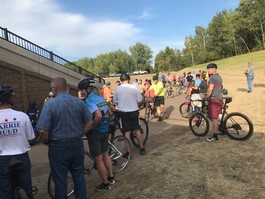
“The tunnel is located at a key connection point that has experienced past traffic complications between vehicles and trail users” said Lisa Sova, Crosby city administrator. “The Cuyuna State Recreation Area receives thousands and thousands of visits each year, and the new tunnel enhances the overall trail experience.”
Iron Range Resources & Rehabilitation provided a Regional Trails grant which helped pay for tunnel construction. Other funding partners included Minnesota Department of Transportation, Minnesota Department of Natural Resources and the city of Crosby.
|
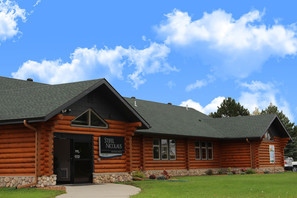
The city of Virginia utilized a Commercial Redevelopment grant to support the interior demolition of a building near downtown Virginia that was formerly occupied by Natural Harvest Food Co-Op. The demolition paved the way for new building owner Dana Pahkala to lease to her employer, Stifel, which is a brokerage firm that has operated in Virginia since 2009.
Pahkala leased a second space within the building to North St. Louis Soil and Water Conservation District. Pahkala also utilized a Business Energy Retrofit and a Downtown Building Rehabilitation grant to further assist with the renovation, making the building more energy efficient and code compliant. The building was transformed into a two-tenant office complex, enhanced the development along Virginia’s peripheral downtown corridor, and increased the city’s tax base.
Email Chris Ismil or call him at 218-735-3010 for grant information.
|
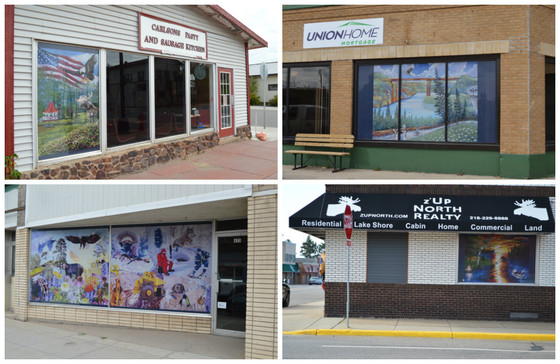 The downtowns of eight Mesabi Iron Range communities added reproductions of nine original paintings, graphics and collages to their storefronts. The downtown beautification project, called “The Art of the Community” was led by Iron Range Tourism Bureau (IRTB) and the Lyric Center for the Arts in Virginia.
Area artists were asked to submit artwork fitting the theme "Looking Forward: Creating and Celebrating the Future of the Mesabi." Each piece of art chosen was scanned and printed on vinyl and then installed on storefront windows. The artists, their featured projects, and the addresses of the newly-covered storefronts can be viewed here.
"This project highlights our talented local artists, improves the aesthetics of some of our buildings, and creates new and brighter images in our downtowns," said Beth Pierce, IRTB executive director. "A downtown is the heart of a community for local residents and visitors. I would like to see additional images added throughout the Iron Range to make our communities even more welcoming to visitors, residents and new businesses."
IRTB is a nonprofit destination marketing organization serving the communities of Aurora, Biwabik, Buhl, Chisholm, Eveleth, Gilbert, Hibbing, Hoyt Lakes, Mountain Iron and Virginia. Communities and businesses interested in sponsoring an artist to add a storefront image can email Beth or call her at 218-749-8161.
This project was supported by a Culture & Tourism grant from Iron Range Resources & Rehabilitation through taxes paid by Minnesota’s mining industry. Email Danae Beaudette or call her at 218-735-3022 for more grant information.
|
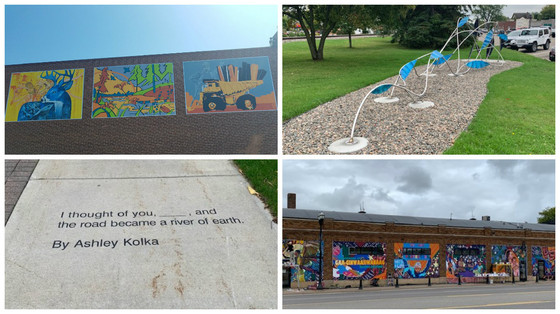 The City of Grand Rapids enlisted local artists to create public art throughout the downtown area, including murals on building facades, concrete-stamped sidewalk poetry, three sculptures and numerous lamppost banners. The art is located in highly visible locations, and the overall theme encompasses the history, culture, traditions and diversity of the city’s past and present.
The Grand Rapids Arts and Culture Commission developed in 2015 a roadmap for the city to further advance its arts and culture offerings. The commission solicited public participation in the roadmap process, and one of the goals that emerged was to embed public art into the city’s streetscapes.
“The Grand Rapids community recognizes that public art is an important component in our economy. Minnesota’s Arrowhead region is second only to the state’s metro area in generating income from arts and culture tourism,” said Sonja Merrild, Grand Rapids Arts and Culture Commission chair. “Not only is art an industry in and of itself, it also creates attractive downtowns and places to which local people and visitors are drawn.”
According to the roadmap findings, the use of public art can greatly benefit a city’s physical environment. Further, capital improvement projects such as sidewalks, street redesigns and roundabouts can easily integrate artistic components that enhance the aesthetic appeal of public areas and business districts.
This project was supported by Downtown Streetscapes grants from Iron Range Resources & Rehabilitation through taxes paid by Minnesota’s mining industry. Email Whitney Ridlon for information or call her at 218-735-3004.
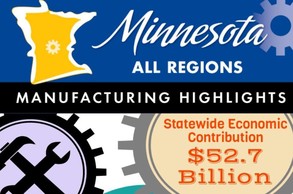
Manufacturing is crucial to the strength of our economic well-being. In recognition of the industry and over 8,400 manufacturers making a wide range of products, Gov. Tim Walz has proclaimed Oct. 1-7 as Minnesota Manufacturing Week.
Read the proclamation.
During the week – and throughout the month – manufacturers are opening their doors to tours by the public and especially students learning about what it’s like to work in a modern facility.
Manufacturing contributed $52.7 billion to the state’s economy in 2018, representing 14% of the state’s gross domestic product.
Jobs in manufacturing tend to be high-quality jobs that pay well. The average manufacturing job paid $67,098 in 2018 – 15% higher than the typical job in Minnesota. Minnesota has nearly 322,000 jobs in manufacturing, with a total payroll of $21.6 billion. When you include jobs supported indirectly by manufacturing – such as sales, shipping, professional services – that impact rises to over 1 million jobs.
Manufacturing plays a critical role in the growth of Minnesota’s economy. The jobs in the modern manufacturing industry are typically high-quality jobs with good, family-sustaining wages.
|

An interactive fundraising workshop and panel discussion for small and mid-size nonprofits is set for Tuesday, Oct. 22 at the Mountain Iron Community Center from 5 p.m. to 8 p.m.
The workshop will be led by Jerritt Johnston of True North Consultants, which specializes in organizational performance and growth for nonprofits, for-profits and government agencies.
Key concepts to be covered in the workshop include:
- Tips for building relationships with potential donors.
- Strategies to engage everyone in the organization.
- Identify roadblocks to individuals and organizations.
- Individual reflection on strengths and areas for growth.
- Practice implementing a fundraising template.
Light refreshments will be served.
To register, contact Sara at 218-735-3020 or sara.ferkul@state.mn.us. Please leave your name, organization, phone number and email. Registration deadline is Tuesday, Oct. 15.
The workshop is sponsored by True North Consultants and Iron Range Resources & Rehabilitation.
|
|