Feb. 7, 2019
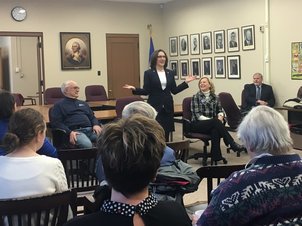
Newly appointed Department of Education Commissioner Mary Cathryn Ricker began a listening tour on Friday, Jan. 25 at her alma mater Hibbing High School (HHS). She was joined by family members, former teachers, current faculty, students, community members and local elected officials for a conversation about how to ensure that every student in Minnesota experiences a high quality education.
Ricker was born and raised in Hibbing where she excelled in academics, athletics and marching band. She earned degrees from University of Saint Thomas and University of Minnesota and taught in classrooms in Saint Paul and St. Cloud, Minnesota, Washington state, South Korea and Yemen. She is a third-generation teacher (her father and grandfather were teachers on the Iron Range), and she has held leadership roles in the St. Paul Federation of Teachers and the national American Federation of Teachers.
Ricker and the listening session attendees discussed the need for smaller class sizes which Ricker emphasized provides teachers the opportunity to build stronger relationships with students as well as greater lead-time in providing students with feedback. In addition, the group talked about wrap-around services that support children in all aspects of life such as medical, dental, mental health, developmental screening and behavioral intervention.
|
“Growing up in Hibbing, every message I received was that my community wanted me to succeed,” said Ricker. “From marble steps entering the high school, to out-of-state school trips, to courses offered in consumer sciences and international languages. All of these experiences left imprints that I carry with me today as I begin work to build on Minnesota’s strong schools, universities and colleges.”
Ricker will visit schools and communities throughout the legislative session.
Learn more about Commissioner Ricker.
Watch Ricker's “Coffee and Karaoke in the Car with the Commissioner” which was filmed on her return car ride from Hibbing to Saint Paul.
Pictured above right: Commissioner Mary Cathryn Ricker speaks at the HHS listening session with community members and school faculty.
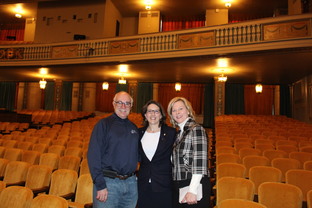
Picture above left: Senator David Tomassoni, Commissioner Ricker and Representative Julie Sandstede tour the HHS auditorium.
|
The Minnesota Department of Natural Resources (DNR) earlier this week announced that it will seek debarment of India-based Essar Global and its affiliates from doing business with the State of Minnesota, including holding state mineral leases.
The action is in response to Essar’s recent acquisition of $260 million in private debt related to the Mesabi Metallics iron ore mine in Nashwauk, which potentially repositions Essar as an investor in the project.
According to DNR officials, Essar has a long and troubled history in Minnesota involving failure to meet construction and other deadlines, as well as leaving contractors with tens of millions of dollars in unpaid bills. In addition, Essar owes the state and Itasca County approximately $64 million in unpaid debt associated with infrastructure development at the project site. Essar’s involvement in northeastern Minnesota began in 2008 when it broke ground at the Nashwauk site with the goal of constructing the region’s first steel mill. However, in 2016 the project went into bankruptcy and in 2017 emerged under the control of Chippewa Capital Partners. The project is now known as Mesabi Metallics.
“Our agency’s goal is to ensure that the state and local communities derive maximum benefit from the high value ore at the Nashwauk site,” said DNR Commissioner Sarah Strommen. “Essar’s past involvement in the project has delayed the realization of those benefits for over a decade. We are taking every action to help ensure that this site is developed to its best and highest use.”
 Fairview Range is expanding its Mountain Iron clinic by 3,120 feet which will make room for three additional physicians, including a general surgeon. The expansion will also help support Northwoods Surgery Center, a partnership between Fairview Range and Dr. Bridget Sundell in the nearby city of Virginia. Northwoods offers patients the convenience of having surgeries and procedures safely performed outside a hospital setting.
“We have exceeded the capacity of our existing space in Mountain Iron,” said Heidi Lahti, director of Ambulatory Care at Fairview Range. “The expansion (scheduled for completion this spring) will enable us to grow our primary and specialty care for the entire family so people at all stages of life have access to quality physicians close to home.”
Fairview Mesaba Clinics – Mountain Iron serves a rural population of approximately 59,000 people, drawing from both the east and north Iron Range areas. Fairview Health Services (FHS) based in Minneapolis is one of the largest not-for-profit integrated health care systems in Minnesota with facilities throughout the state. It has two hospitals and urgent and primary care clinics in northeastern Minnesota, including locations in Grand Rapids, Hibbing, Mountain Iron and Nashwauk. In partnership with the University of Minnesota, FHS has a statewide network of more than 5,000 doctors and providers.
“Quality health care is not only essential to our region’s existing residents, it is essential to economic development,” said Mark Phillips, Iron Range Resources & Rehabilitation commissioner. “Robust medical facilities that offer a diverse spectrum of services attract health care professionals and their families to work and live in our region.”
Iron Range Resources & Rehabilitation supported this project with a Development Infrastructure grant to the City of Mountain Iron Economic Development Authority. The agency’s grants are funded through taxes paid by Minnesota’s mining industry. Email Chris Ismil or call him at 218-735-3010 for information.
The Drill Core Library in Hibbing has temporary use of a mobile laboratory that scans drill core and identifies minerals it contains using hyperspectral imaging. The equipment is on loan from Australian-based company, Corescan, which has provided its imaging technology to the Australian iron mining industry.
16,000 linear feet of Minnesota rock core samples will be scanned to help the Minnesota Department of Natural Resources (DNR) better understand what is beneath the earth’s surface in the region. The core samples being examined date back to drilling from up to 60 years ago and originate from the Mesabi and Cuyuna iron ranges and specifically from areas near Biwabik, International Falls and Crow Wing County.
The scans will provide information on which minerals are prevalent and how mineral deposits form, in particular minerals such as manganese, gold, iron, vanadium, cobalt and titanium. When the project is completed, the DNR will post the results online for access by the public and researchers around the world.
“Minerals are an important part of Minnesota’s natural resource economy,” said Don Elsenheimer, DNR geologist. “The data from this project can help the DNR manage public lands, promote mineral exploration and development, and generate revenue on trust lands that benefit public schools across the state.”
Core samples have been traditionally examined by breaking off pieces of rock core and shipping them to a laboratory. The Corescan technology can instead examine a sample in about 12 minutes and keeps the sample intact without it ever leaving its storage site. Hibbing is one of only seven other sites in the world where the Corescan mobile labs are operating. Other sites include Alaska, Peru, Argentina and Australia.
|

The core library contains about 3 million linear feet of core samples, which is about the distance between International Falls and Chicago. The specimens have been collected since the early 1900’s and are legislatively required to be archived and stored at the Hibbing DNR library. Public tours of the core library are available and must be scheduled in advance.
Iron Range Resources & Rehabilitation supported this project in partnership with Minnesota DNR. Email Linda Johnson for information or call her at 218-274-7007.
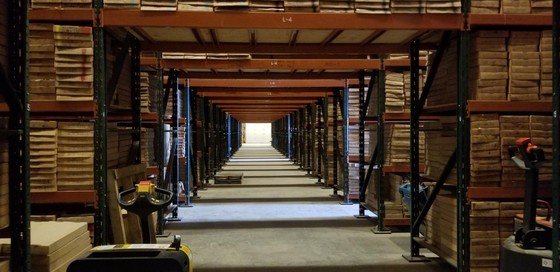
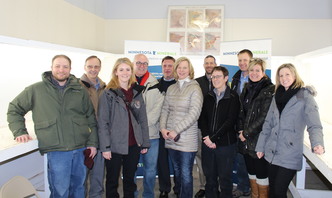
Pictured top to bottom: Hibbing DNR Drill Core Library's storage area for the rock core samples; attendees at the Corescan open house at the Hibbing DNR Drill Core Library on Friday, Jan. 25; rock core samples.
|

East Range Joint Powers Board, Iron Range Tourism Bureau, Laurentian Chamber of Commerce and Tower Economic Development Authority were successful in their bids to become Blandin Broadband Communities (BBC). They will have access to technical expertise, planning assistance and an opportunity to obtain financial resources to implement their broadband initiatives.
The BBC program is designed to advance broadband in rural Minnesota communities which is critical to economic development, education, workforce, healthcare and quality of life. It is a collaboration between Blandin Foundation, St. Louis County and Iron Range Resources & Rehabilitation.
Three of the communities will hold public meetings in February. Priorities and projects will be identified to improve internet access and usage. Community members are encouraged to attend, even those having little or no technical knowledge. Input from all residents, non-profit organizations, community groups and businesses is needed.
-
Feb. 11 - Laurentian Chamber of Commerce (Eveleth, Gilbert, Mountain Iron, Virginia and surrounding area communities and businesses) 4-7 p.m. at the Mountain Iron Community Center. For reservations email Melissa or call 218-741-2717.
-
Feb. 12 - Iron Range Tourism Bureau (Hibbing to East Range tourism) 9 a.m.-12 p.m. at Mesabi Station in Eveleth. For reservations email Beth or call 218-749-8161.
-
Feb. 20 - East Range Joint Powers Board (Aurora, Biwabik, Hoyt Lakes and Town of White communities and businesses) 5-8 p.m. at Aurora Community Center. For reservations email East Range Joint Powers Board or call 218-239-3671.
Six other communities in the region went through the 2017/2018 BBC program including Aitkin County, Bois Forte/Cook/Orr, Chisholm, Ely, Hibbing and Mountain Iron-Buhl.
|
|