|
|
Dec. 5, 2018
 Northern Lights Manufacturing, a Virginia, Minnesota-based producer of roofing and siding parts for the construction industry was acquired by Vertex Metal Roofing with the intent to expand its product line and distribution reach.
Northern Lights fabricates starter strip for siding, drip edges for roofs, and several types of flashing for building construction. Vertex Roofing specializes in manufacturing and installation of metal roofs and has locations in Virginia and Hermantown, Minnesota as well as in Arizona. The two entities will operate together as Northern Lights Manufacturing at a facility located in Virginia’s Industrial Park where they will manufacture and sell their roofing and siding products to distributors across the United States, and the distributors in turn will sell the products to builders.
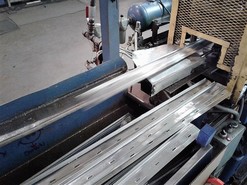
The facility is being renovated to accommodate additional equipment and fabrication lines. Added to the equipment fleet will be two Computer Numerical Control (CNC) metal folding machines and a metal roofing roll former. The machines will convert raw steel metal coils into specific sizes and lengths of sheet metal that can then be bent into various products.
Northern Lights Manufacturing is owned by Travis Peterson and Paul Jelle, both Iron Range natives. Peterson is a graduate of the Mesabi Range Technical College carpentry program. The two entrepreneurs founded Vertex Metal Roofing in 2009 after seeing the need for a roofing product that would last a lifetime and endure longer than a traditional roof shingle. Vertex quickly became the top metal roofing company in northern Minnesota and eventually expanded into Arizona and Wisconsin.
|
 “Metal roofing is gaining market share in the roofing industry at a rapid rate,” said Peterson. “With the new larger building, we intend to develop and diversify our products and produce them on a larger scale and bring to a larger market.”
Northern Lights Manufacturing currently provides its products to distributors, wholesalers, building supply houses and lumberyards throughout the United States. Peterson and Jelle aim to grow their client portfolio and subsequently create additional living wage jobs in the Iron Range. The company currently employs 13 full time workers.
Peterson also owns ABC Seamless Altobelli Peterson Construction of Eveleth.
Iron Range Resources & Rehabilitation supported this project with a bank participation loan to help with the building and equipment purchase. The agency’s loans are funded through taxes paid by Minnesota’s mining industry. Email Scott Sundvall for more information or call him at 218-735-3015.
|
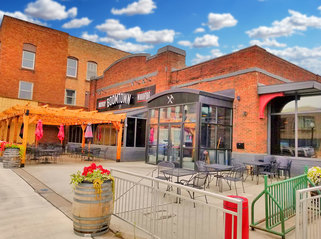 Iron Range native and restaurateur Jessica Lietz received her first Business Energy Retrofit (BER) grant in 2013 at the age of 26 when she bought and re-opened The Whistling Bird on main street Gilbert, located two blocks away from her home at the time. The restaurant originally opened in the 1990’s and was an Iron Range favorite for many years until it closed in 2007. Lietz recognized the potential for quality dining options in the region, and the BER grant enabled her to re-open the restaurant with reduced start-up costs by replacing an aging inefficient electric furnace.
“I was able to allocate my financial resources into starting and growing the business as opposed to sinking money into replacing old equipment or paying exorbitant utility rates for an inefficient heating system,” said Lietz.
Lietz built upon her success in Gilbert and opened two more restaurants, Boomtown Woodfire in Eveleth in 2015 and Boomtown Brewery in Hibbing in 2017. Like the Whistling Bird, both buildings were restaurants that had closed under previous ownership. She received a BER grant for each location that replaced outdated inefficient walk-in freezers and coolers.
|
 “I saved on business loan interest rates because I borrowed less money for start-up,” said Lietz. “The BER grants played a significant role in structuring smart financing for our restaurants.”
Lietz is a graduate of Virginia High School and University of Minnesota Duluth. With an original career goal to be a dentist, Lietz holds bachelor’s degrees in biology and chemistry. Her and her husband Erik now own Lietz Properties LLC which owns the three restaurants that combined employ approximately 150 full and part time workers.
Since BER’s inception in 2013, 285 grants have been awarded to help small businesses with energy efficiency upgrades that can result in reduced utility bills, improved building aesthetics and increased building life. The program is funded by Iron Range Resources & Rehabilitation and administered through a partnership with Arrowhead Economic Opportunity Agency (AEOA). To learn more email Vince Meyer at AEOA or call him at 218-735-6828.
Pictured are exterior and interior shots of Boomtown Brewery in Hibbing.
|
 Hibbing Community College (HCC) will offer its culinary program in Grand Marais to help meet the demand for skilled kitchen workers in Cook County’s hospitality-based economy. The county has more than 50 food establishments and resorts, and many have had to reduce hours of operation, increase overtime for existing employees, and condense menus as a result of the culinary workforce shortage.
“The workforce shortage has stressed the bottom line of many of our restaurants,” said Kelsey Kennedy, Cook County Higher Education (CCHE) program coordinator. “The culinary program will strive to produce an influx of skilled kitchen staff as well as grow local culinary workers, enabling the area’s restaurants to return to full operational capacity and in some instances grow and expand.”
HCC’s program offered on the North Shore will be led by a credentialed culinary instructor, and students may choose either a 17-week Culinary Arts Certificate (16 credits) or a 34-week program to earn a One-Year Culinary Arts Diploma (31 credits). Curriculum includes food handling and safety techniques, planning and production, personnel management, cost control methods, nutritional menu planning, food presentation and banquet service. Bonus programming also includes resume building, future employment options, healthy living, and business and leadership skills.
Classes will be 7.5 hours per day, Monday thru Thursday in the new, state-of-the-art culinary classroom at Cook County High School. It is an “Earn While You Learn” program in which students can be connected to a paid culinary job part-time during the school term and full time during the summer months or upon graduation. Students will work and learn side by side with chefs in many of Cook County’s world-class kitchens, and some resorts will offer housing in conjunction with employment. Northeast Minnesota Office of Job Training’s (NEMOJT) Talent Development Program will work with approved employers to help cover partial training and tuition costs.
|
 The certificate and diploma will be from HCC and will indicate to potential employers that the student has the skills necessary to be hired in upper level kitchen positions such as kitchen manager, food production manager, chef (most locations will require additional work experience), sous chef, banquet chef and cook/supervisor.
The idea of bringing a culinary program to the North Shore originated from Cook County Workforce Solutions (CCWS), a coalition formed to create solutions to the shortage of skilled employees in Cook County. The coalition works to recruit new employees from outside the region and to create educational opportunities that aid in attracting and developing workers. Coalition partners include CCHE, HCC, ISD 166, Cook County Chamber of Commerce, Cook County/Grand Marais Economic Development Authority, North Shore Health, Visit Cook County and private businesses.
“It is truly a community partnership that grew out of a need for trained kitchen staff,” said Kennedy. “Cook County relies heavily on tourism and serves over one million people per year. The restaurants and resorts in our region strongly endorse this new workforce initiative. And other than Hibbing, there is not another accredited culinary program north of St. Paul, so we anticipate this meeting a need even beyond Cook County.”
This program was supported by a Workforce Development grant from Iron Range Resources & Rehabilitation. Email Danae Beaudette for grant information or call her at 218-735-3022.
|
 Signage will be displayed throughout the region at projects that are financially assisted by Iron Range Resources & Rehabilitation. The signs may be seen at a business that has recently opened or expanded, a blighted commercial or residential property being demolished to pave way for new development, a historical landmark preservation, a street or sewer storm water upgrade site, a tourist or recreation area, or a new child care or health care facility. Across northeastern Minnesota, signs reading “This project made possible through taxes paid by Minnesota’s Mining Industry” will mark the investments being made by the agency to improve the businesses, communities, workforce and quality of life.
|
 “Our agency is funded in part by a portion of a local Taconite Production Tax which is paid by mining companies on each ton of iron ore pellets produced. Those tax funds are then reinvested into the service area through a variety of loans and grants,” said Commissioner Mark Phillips. “The signs will help the public see the impact that is being made in communities across the region.”
The agency’s service area is determined by the boundaries of 15 school districts containing unmined iron ore deposits of specified valuation, taconite plants or electrical generating plants supplying electricity to taconite operations. The area is comprised of three iron ranges, six counties, 50 cities, 132 townships, 13,000 square miles and 156,282 residents.
|
|
An Iron Range Resources & Rehabilitation Board meeting has been scheduled for Monday, Dec. 10 at 10 a.m. at the Iron Range Resources & Rehabilitation Administration Building in Eveleth, Minnesota.
View the meeting agenda and packet.
|
|
 |
|
|
|
|
|
The Ranger is a publication of Iron Range Resources & Rehabilitation. Our mission is to promote and invest in business, community and workforce development for the betterment of northeastern Minnesota.
|
|
|
|