|
|
June 6, 2018
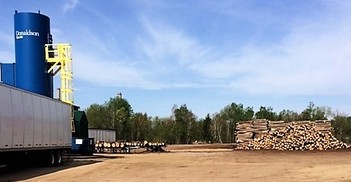 Nelson Wood Shims in Cohasset, the largest shim manufacturer
in North America, recently redesigned its sawmill production line to meet the
market share demands for its patented Beddar Wood® shims which are uniquely
processed in order to snap, nail and perform better than traditional pine or
cedar shims.
Nelson tested a proof-of-concept “u-shaped” production line
in a temporary location beginning in 2014, and the outcomes were positive. This
propelled Nelson’s purchase of a nearby building from Minnesota Power in 2017
that could accommodate “straight line” production and be a permanent location
for the sawmill. The reconfiguration enabled greater efficiencies and
additional growth potential of the Beddar Wood® shims. Nelson now produces the
lumber used to supply the Beddar Wood® shims in the new sawmill, while its
other products are still produced in the company’s original neighboring
production plant.
The new sawmill configuration also increases both the number
of wood species and overall volume of wood needed from local loggers within a
150-mile radius of Cohasset. According to Nelson leadership, this creates
additional logging and trucking jobs at the front end of the supply process.
“We are proud to provide additional volume and security for
our region’s logging community,” said Brian Peterson, Nelson’s chief financial
officer. “The loggers helped us create the Beddar Wood® product line in the
United States, and we have great partnerships with them that provide
opportunities for after-hour deliveries, mileage bonuses for traveling long
distances, and even volume contract guarantees with bonus incentives.”
Nelson has been producing shims for 58 years. The company
was founded in 1960 as a one-person operation, and 50 employees now produce its
products that are distributed nationwide. Nelson’s product sales are primarily
in the United States and Canada, however some distributors such as The Home
Depot, Lowes and Ace Hardware carry their products into Mexico, Australia and
other countries.
This project was supported by a development infrastructure
grant and a low interest bank participation loan from Iron Range Resources
& Rehabilitation. Email Scott Sundvall for
more information or call him at 218-735-3015.
Visit the Nelson Wood Shims website.
|
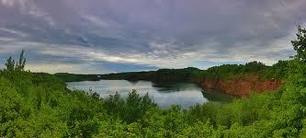 The City of Nashwauk is restoring and expanding a
heavily-visited landmark, Hawkins Mine Pit Overlook, which offers a sweeping and
breathtaking view of a once active iron ore mine. Like all communities on
Minnesota’s Iron Range, Nashwauk has a rich mining history. Thousands of
visitors each year stop at the overlook to view the open pit mine that has been
reclaimed into a lake with deep, blue water and rock ledges that showcase the
unique geological layers found in the region.
The overlook will receive a new elevated viewing deck with
an ADA-accessible ramp, kiosks with historical and project donor information, a
picnic area and mini mine-themed children’s park, bike racks, and a refurbished
parking lot. The project will be completed this fall, and a second phase
renovation is being considered that could include a pavilion.
Hawkins Mine established Nashwauk as the first mining
community to develop in Itasca County on the western Mesabi Range. The mine was
named after E.B. Hawkins of Duluth, a state senator who was a well-known
contractor and civil engineer in the region’s mining industry. The first iron
shipment from Hawkins occurred in 1902, and in 1903 Nashwauk was officially
incorporated with a population of 220. The town quickly flourished with homes
and businesses and by 1910 the population was 2,080. Hawkins first operated as
an underground mine and eventually as an open pit mine. The mine closed in 1962
after 60 years of mining and producing hundreds of thousands of tons of iron
ore that were transported by rail to the rest of the nation for the growth of
America.
“We’ve received $12,000 in private donations for this
community project. Many of the donors don’t live in Nashwauk, but their grandparents
and great grandparents worked in the Hawkins Mine,” said April Kurtock, City of
Nashwauk administrator. “Our community is very excited to honor Nashwauk’s
history for both our residents and tourists.”
This project was supported by a Downtown and Business
Corridor grant from Iron Range Resources & Rehabilitation. Email Whitney Ridlon for information or
call her at 218-735-3004.
|
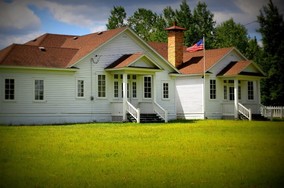 Situated along the Superior National Forest Scenic Byway between
Hoyt Lakes and Silver Bay is the historic Toimi School that was constructed in
1913 by Finnish immigrants who settled in northeastern Minnesota. Until 1942 the
building was a two-room schoolhouse for children grades first through eighth. It
now serves as a community center for the Toimi-Brimson residents as well as a
popular stopover point of cultural and historic interest for tourists traveling
between the North Shore and Iron Range.
The facility is managed by the Toimi School Community Center
(TSCC), a non-profit organization comprised of alumni, spouses and children of
alumni and local residents. TSCC acquired ownership of the building in 1991 from
Lake County and has since worked diligently to restore the building and manage
it exclusively as a community center for historical, recreational, cultural and
civic activities. TSCC also manages an adjacent wayside rest in partnership
with the Lake County Highway Department, which adds to the appeal of the scenic
byway’s stopover point.
School restoration efforts will continue this summer and
include work to the building’s siding, soffits, fascia and foundation, bringing
it to a pre-1942 configuration. Following the exterior work, future renovations
will focus on improving the interpretive displays in the building that showcase
numerous artifacts, pictures and memorabilia donated by local families such as school
report cards and oral histories about the school and growing up on a Finnish
farm.
According to TSCC volunteers, their restoration and
maintenance efforts are preserving one of the last historic schools in
northeastern Minnesota and the last vestige of the Toimi Finnish community.
The school is open 10:00 a.m. to 4:00 p.m. Saturdays now
through Labor Day and is the host site of the annual Kesa Juhla (midsummer Finnish
festival) on June 23.
The restoration project was
supported by a Culture and Tourism grant from Iron Range Resources &
Rehabilitation. Email Danae Beaudette for grant
information or call her at 218-735-3022.
|
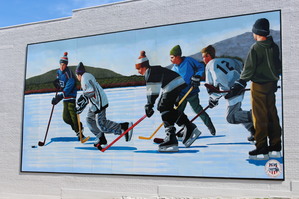 The City of Eveleth is enhancing
its downtown cityscape with “A Salute to Hockey.” The community beautification
project includes recent significant improvements to Big Stick Plaza and the
Eveleth Area Community Foundation Plaza.
Big Stick Plaza has long been the
city’s most popular attraction and home to the world’s largest hockey stick,
measuring 107 feet long and weighing more than three tons. A new hockey-themed
art mural created by Butternut, Wisconsin artist Kelly Meredith was installed
earlier this month, replacing the existing 25-year-old mural that had weathered
over time. A metal sculpture was also commissioned and will soon be installed
in Big Stick Plaza, mounted on a large piece of taconite. The sculpture is of
hockey legend John Mariucci, who grew up in Eveleth during the Great
Depression, played hockey and football at University of Minnesota, and then was
the head coach for the Minnesota Golden Gophers hockey team. Plans for a second
sculpture are underway, and its honoree has not yet been selected. Both figures
are being created by metal sculpture artist Jeff Kreitz of Brainerd, Minnesota.
A second art mural will be
installed in the Eveleth Area Community Foundation Plaza. This plaza last year
was enhanced with new planters, a park bench and signage.
The hockey-themed cityscape
project is a collaboration among the city and its economic development
authority, the Eveleth Area Community Foundation and the Eveleth Merchants
Association.
“A Salute to Hockey has engaged
both our citizens and businesses and created a lot of excitement in Eveleth,”
said Jackie Monahan-Junek, Eveleth city administrator. “When people think of
Eveleth, they think of hockey. Our community’s rich history is interwoven with
this sport, and it has positively impacted our people, youth, economy and
culture for more than a hundred years.”
This project was supported by
Downtown and Business Corridor grants from Iron Range Resources &
Rehabilitation. Email Whitney
Ridlon for information or call her at 218-735-3004.
|
 The Virginia, Hibbing, Cook and Tower Farmer’s Markets open this month. Area farmers and artisans will sell locally grown fruits,
vegetables, eggs, meats, canned goods and wild rice, along with homemade roasted
nuts, coffee, baked goods, bug repellent, crafts and soaps.
According to Iron Range Partnership for Sustainability (IRPS),
farmers’ markets enhance the quality of life in our communities by strengthening
agricultural economic development, fostering social gathering, and providing
access to fresh locally grown foods.
“Farmers markets create an affordable way for local growers
to generate product sales and revenue,” said Marlise Riffel, Virginia Market
manager. “The markets enable small farms to stay in business and sustain jobs without
incurring high costs that go along with distribution through a middleman.”
To increase fresh food access, several of the markets accept
EBT cards, which is part of a nutrition assistance program for limited-resource
families. In addition, the Power of Produce (PoP) incentive program will be
offered this year at some of the markets. All Iron Range children ages 4 to 12
can receive a $2 token to spend each week on fresh fruits and vegetables.
Market dates and hours are:
- Virginia: Thursdays, 1-5 p.m. beginning June 7
- Tower: Fridays, 4-6 p.m. beginning June 15
- Cook: Saturdays, 8 a.m.-1 p.m. beginning June 16
- Hibbing: Tuesdays, 2-5 p.m. and Fridays/Saturdays, 9 a.m.-1 p.m. beginning June 19
The four markets are collaborating their social media reach
and advertising this summer in order to attract more local and tourism-based
customers. The collaboration is being facilitated through IRPS and was supported
with a Culture and Tourism grant from Iron Range Resources &
Rehabilitation. Email Danae Beaudette for details or
call her at 218-735-3022.
|
 The Business Energy Retrofit (BER) grant program can help
alleviate energy upgrade costs for businesses located within the Taconite
Assistance Area. The next grant cycle will be open July 1-14, 2018 with
$750,000 available in total funding. A small business with an aging building
can benefit immensely from energy efficiency upgrades, benefits such as reduced
utility bills, improved building aesthetics and increased building life.
However, these upgrades can be financially cumbersome to small businesses that
often operate on smaller margins.
BER will fund projects based on the following criteria and
priorities:
-
A business located within a community that has
been previously underserved by BER
- A business that has not received a prior BER
grant
- A business
located within a downtown corridor
- Projects that are ready to begin
within 30 days of application submittal
- Projects that include construction/work bids
with the submitted grant application
Iron Range Resources & Rehabilitation funds the BER program, and it is administered through
a partnership with Arrowhead Economic Opportunity Agency (AEOA). To learn more
email Vince Meyer at AEOA or
call him at 218-735-6828.
Read a recent BER success story.
|
|
|
|
|
|
The Ranger is a publication of Iron Range Resources & Rehabilitation. Our mission is to promote and invest in business, community and workforce development for the betterment of northeastern Minnesota.
|
|
|
|