|
|
March 21, 2018
 The Iron Range will become one of two regions in the state (the
other is Rochester) taking part in the Certified Tourism Ambassador™ (CTA)
program, an industry-recognized certification for frontline staff that is
accredited through the Tourism Ambassador Institute.
Curriculum specially customized to the Iron Range was developed
and is open to all area businesses who are connected to the tourism industry
including hotels, restaurants, retailers and attractions. Businesses may send
their employees through the training for a one-time registration fee of $25 per
person. Through classroom and online training modules the employees will earn
their certification and join 12,000 other CTAs worldwide. Workers go through an
annual renewal process to ensure their knowledge and skills are continually
growing.
Coordinated by the Iron Range Tourism Bureau (IRTB), the program’s
goal is to drive visitor spending through in-depth knowledge of the region. “We
are confident this program will enhance the visitor experience and give the
Iron Range a competitive advantage among other Midwest destination areas,” said
Beth Pierce, IRTB executive director. “We want to give businesses and frontline
staff across the Range a tool to help them consistently create memorable
experiences for those visiting our region.”
A field-test of the new curriculum and a train-the-trainer
session will be held on April 17 at Mesabi Station. Area businesspeople and
front-line staff who participated in focus groups to help customize the program
will be invited. A class for the general public and hospitality workers will be
scheduled in May.
“Certified workers within the tourism industry may see some
great benefits,” said Pierce. “In other regions, certification has led to
higher tips, career advancements, and an additional qualification to add on a
resume. Employers also benefit because better customer service can result in
repeat business.”
Iron Range Resources & Rehabilitation supported this
project with a Workforce Development grant. Email Roy Smith for grant information or call
him at 218-735-3039.
View the Workforce Development grant guidelines.
Area businesses interested in the CTA program may email Beth Pierce or call her at 218-749-8161.
|
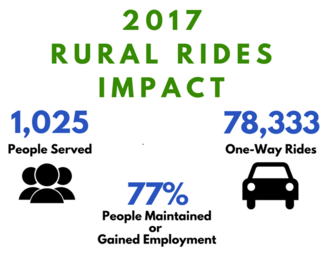 Rural Rides is a workforce transportation program that since
2008 has provided rides to disadvantaged workers, job seekers and persons
attending job training. The program’s service area today includes Aitkin,
Carlton, Cook, Itasca, Koochiching, Lake and St. Louis counties.
Administered through Arrowhead Transit and Arrowhead
Economic Opportunity Agency (AEOA), Rural Rides in 2017 served 1,025 community
members and provided 78,333 one-way rides. Seventy-seven percent of the
participants gained or maintained employment, and the remaining were seeking
work or attending career pathways training.
“Rural Rides is temporary support for workers who do not
have their own personal transportation but are gainfully employed or soon to be
employed,” said Marcia Mehle, AEOA community transportation manager. “Our
clients are working towards obtaining resources to acquire their own
transportation, and Rural Rides enables them to remain employed or continue
their job search during that time.”
Each person is provided an individualized transportation
plan that utilizes public transportation, taxis, volunteer drivers and ride
share resources. Because northeastern Minnesota is approximately 20,000 square
miles of rural, spread-out communities, transportation is a vital factor in the
economy. Per capita in 2016, out-state Minnesotans traveled 2,201 additional
miles than metro individuals.
Until 2017 Rural Rides was almost completely funded by
Minnesota Department of Transportation. However, that funding source
was reduced creating a $30,000 gap which was filled by Iron Range Resources
& Rehabilitation.
“Transportation is a key economic component for both
employees and employers,” said Mark Phillips, Iron Range Resources &
Rehabilitation commissioner. “Rural Rides fills a transportation need within
our service area that contributes to the overall economy.”
Iron Range Resources & Rehabilitation supported this
project with a Workforce Development grant. Email Roy Smith for grant information or call
him at 218-735-3039.
View the Workforce Development grant guidelines.
Workers or those seeking work who are interested in
utilizing Rural Rides, call 800-862-0175 or visit Rural Rides
online.
|
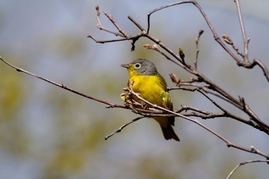 A new 900-foot long elevated boardwalk will soon be added to
Sax-Zim Bog Important Bird Area (IBA), a 300-square mile biodiverse natural
habitat stretching around the towns of Meadowlands, Zim, Toivola and Cotton that
annually attracts about 3,000 (human) visitors from all 50 states. The
boardwalk will enable visitors to access a newly acquired 60-acre black spruce
and tamarack bog located within Sax-Zim that is home to birds such as American
Three-toed Woodpeckers, Barred Owls, Nashville Warblers (pictured), Winter Wrens and Black-backed
Woodpeckers, along with Pink Lady’s Slipper wildflowers and moose sightings.
An IBA is an area that is globally important for the
conservation of bird populations. There are 12,000 IBAs worldwide, of which 2,832
are in the United States and 57 in Minnesota. All American IBAs are administered
by the National Audubon Society.
Eighty-five percent of Sax-Zim’s visits occur in the winter
months between December and March when its welcome center is open and staffed.
“The boardwalk creates the potential to attract visitors during the spring,
summer and fall,” said Sparky Stensaas, Friends of Sax-Zim Bog executive
director. “It provides safe access into the Warren Nelson Memorial Bog, a 60-acre
tract of land where entrance is currently swampy and rough.”
|
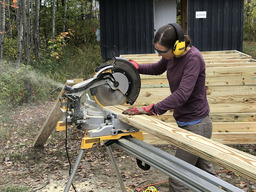 The framework for the boardwalk, whose name honors a passionate birder and photographer, was completed last fall by Friends of Sax-Zim Bog skilled volunteers (pictured). In May the platform will be professionally constructed and installed.
Sax-Zim has 244 known bird varieties and according to Stensaas is known among birders, photographers, naturalists and tourists as the best place in North America to view seldom-seen boreal bird species. The area attracts visits from as far away as China, Japan, Iceland, Norway, Sweden, England and the Philippines.
With three naturalists on staff, Sax-Zim offers public programs, field trips, naturalist hikes and workshops. A $25 annual membership includes all programs and field trips. Sax-Zim is also the site of a winter birding festival that is the largest winter festival in the Midwest and produced by the City of Meadowlands.
Iron Range Resources & Rehabilitation supported this project with a Culture and Tourism grant. Culture and Tourism grant applications are being accepted through March 30. Email Danae Beaudette for details or call her at 218-735-3022.
View the Culture and Tourism grant guidelines.
Visit the Sax-Zim Bog website.
|
 The Cook and Chisholm public libraries are offering personal
portable hotspot devices that may be checked out just like a book thanks to the
Blandin Broadband Communities (BBC) program. These hotspots can connect up to
10 devices to the internet at 4G speed enabling homes and people in rural areas
to have high speed internet access where it is not yet available.
The Cook Library launched the hotspot program in December
and its five devices have been checked out 39 times in three months. Each hotspot
may be checked out for seven days at a time.
“Cook and the surrounding area do not yet have expansive broadband
capability so these devices are very helpful to our local citizens and
families,” said Crystal Phillips, Cook Library Director. “The device has a
touch screen, is very user friendly and connects to the library’s Wi-Fi network
so data usage is not limited.”
|
 The Chisholm Library acquired 10 hotspots that have been checked out 58 times combined since December. “They are in such high demand that we are considering adding 10 to 20 more hotspots to our inventory,” said Katie Christenson, Chisholm Library supervisor. “The broadband grant has made a big impact in our community.”
In addition, WiFi capacity at the Chisholm Library was upgraded to make the library itself a hotspot that is open to the public with four access points within a specific physical range. An average of 65 devices per day (or 2,000 devices per month) are connecting to the WiFi when the user is physically inside the library or parked nearby within range.
The BBC program was supported in part by a grant from Iron Range Resources & Rehabilitation and involves an intensive two-year partnership between Blandin and area communities to advance broadband initiatives. This ongoing effort helps northeastern Minnesota rural communities develop high speed internet that is critical to economic development, education, healthcare and quality of life.
|
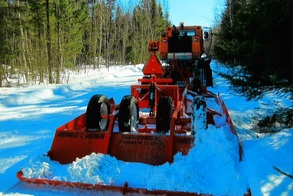 The 52-mile Laurentian snowmobile trail is being groomed
this season with a new Arrowhead Ultra drag. The pull-behind equipment keeps
the trail in smooth, enjoyable riding condition that local residents and winter
tourists have been enjoying since the 1970s.
The Laurentian trail winds around the central Iron Range
cities of Buhl, Kinney, Virginia and Biwabik near Giants Ridge Recreation Area.
The all-volunteer Range Trail Committee (RTC) began building the trail in 1973
and has maintained it since. The trail is typically groomed twice weekly by
four committee members volunteering about 32 hours combined.
“Our committee believes strongly in the economic impact of
snowmobiling in northeastern Minnesota,” said Robert Dethloff, RTC president
and groomer. “Every year beginning in mid-December tourists travel from the
Twin Cities and surrounding states to ride the trails in the Iron Range. They
patronize restaurants, grocery stores, gas stations, repair shops and hotels.”
Minnesota’s vast trail network has 22,000 miles of
interconnected trails with over 21,000 of those miles maintained by local
snowmobile club volunteers. RTC is one of those clubs, and according to
Dethloff he hears from avid riders that the Laurentian Trail is one of the
state’s best and safest due to its smooth terrain and unique width of 20 feet.
“Our former grooming equipment was very old and experienced
numerous breakdowns,” said Dethloff. “In order to uphold the trail’s reputation
we purchased a new groomer from Arrowhead Groomers of Wisconsin. Now our
volunteers can continue their work each winter to benefit the economy and
quality of life in northeastern Minnesota.”
Iron Range Resources & Rehabilitation supported this
project with a Culture and Tourism grant which helped pay for the grooming equipment.
Culture and Tourism grant applications are being accepted through March 30.
Email Danae Beaudette for
details or call her at 218-735-3022.
View the Culture and Tourism grant guidelines.
|
|
|
|
|
|
The Ranger is a publication of Iron Range Resources & Rehabilitation. Our mission is to promote and invest in business, community and workforce development for the betterment of northeastern Minnesota.
|
|
|
|