 Be Well e-newsletter covers HealthWorks health incentive information, activities and events.
Share your feedback and ideas for improving the health of Hennepin County.
HR Service Center
Email
Phone: 612-348-7855
HealthWorks
Email
Phone: 612-348-4628
FAX: 612-596-9984
Hours: 8 - 4:30 pm
Location:
300 S 6th Street
Government Center-A120
Minneapolis, MN 55487
Map It!
|
In an effort to reach benefit-earning employees and their spouses about the county's health insurance incentive, you are receiving the Be Well e-newsletter. If you no longer want to stay updated, please unsubscribe.
SandCreek Employee Assistance Program (EAP) is a professional, one-to-one counseling service available free to employees and household members. Counselors are experienced in relationship/marriage/divorce, alcohol/drug use, stress/depression/anxiety, grief/loss, parenting, work-related stress, elder care, legal and financial issues. SandCreek is available 24 hours a day, seven days a week (including holidays) by phone, and also by appointment (including at the Be Well Center, Government Center). Learn more about SandCreek resources at the HealthWorks website. To make an appointment, call 651-430-3383 or 1-888-243-5744.
Wondering how SandCreek EAP can help? Read this scenario.
Before SandCreek EAP:
Mary was feeling frustrated with her adult daughter and grandchild who have moved back home to live with her. Her daughter is separated, can’t afford to live on her own, so they now share a home. Mary and her daughter, Joan, have had a good relationship but since living together, Mary feels like she is the live-in nanny, cook, and cleaner while Joan ignores the household needs and has stopped communicating with Mary.
With SandCreek EAP support:
After two sessions with an EAP counselor, Mary figured out how to talk with Joan in a way that isn’t angry and blaming. She proposed to Joan that they have a weekly family meeting to talk about their needs and expectations for the coming week. EAP provided safe space for Mary to vent, sort out her reactions, and come up with a plan that would, hopefully, improve communication with her daughter rather than continue with the angry silence.
 Is 2014 your year to walk or run a 5k, 10k or half marathon? If so, join Hennepin County HealthWorks corporate team for the April 26, 2014 Get in Gear races. Save over 50 percent on registration fees by signing up for the Hennepin County corporate team. Registration is now open for the corporate team, review registration instructions here.
The 2014 races will include a 5k, 10k and half marathon and events will qualify as wellness activities for the 2015 health incentive. It’s a great wellness activity for co-workers and families!
|
Want better results with your health-care providers? Learn how to effectively communicate to save time and get the care you deserve. Learn to be your own health advocate and create your team to improve your health. ”Communicating Effectively with Health Care Providers” will be held January 7, 11:30 a.m. - 12:30 p.m. in the Government Center – Employee Development Classroom. To register, visit APEX.
Benefit-earning employees and retirees that made health insurance changes will receive new PreferredOne cards in December. Watch your home mail for your new cards and ensure all information is correct. If you have any questions or concerns, contact the HR Service Center at 612-348-7855 or email hr.servicecenter@hennepin.us
The HCMC Be Well Clinic at the Government Center offers a variety of basic medical lab tests, including strep throat, blood glucose, blood cholesterol, urinary tract infection, vitamin D and many others. Vaccinations, such as flu shots, are also available. The Be Well Clinic is free to employees with county health insurance and is open Monday – Friday, 7:30 a.m. – 3:30 p.m. To learn more or make an appointment visit the HCMC website or call 612-873-7373.
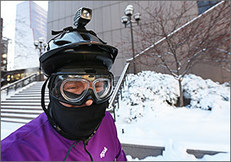 Name: John Villerius, Office of Budget and Finance
Commuting by bike has so many positives: better health, lower environmental impact, and lower transportation cost, to name a few. Those positives continue to be achievable during the winter. For me, winter bike commuting is one of the things that makes winter bearable and, at times, a blast of fun. I hate cold weather, but I dislike being indoors and inactive for 5-plus months of the year even more. As a result, some of my most enjoyable bike riding takes place in the winter. You can start on rather simple terms: moderate temperatures, dry roads, short distances, daytime riding. Or go full-tilt into lower temperatures, and on snow- or ice-covered roads or trails where your bike can act like a snowboard with wheels. Quite an adventure.
There are some key elements to successful winter biking whether for commuting or recreation – clothes, bike, traffic.
1. Dress in layers. The first layer next to your skin is fabric that transports any moisture away from your skin so that you don’t feel cold and clammy. Long underwear of polypropelene or smart wool will accomplish that. The middle layer is thermal. Depending on the temperature, I use one or more old sweaters or fleece. The number of thermal layers is a matter of personal comfort. The outer layer is wind protection. like a nylon windbreaker.
2. Keeping your extremities – head, hands, feet – warm and covered tends to be different for every person. One rule of thumb (rule of “toe” ?) is not to constrict circulation with ill-fitting gloves or shoes. Larger-than-normal gloves or mittens with liners and loose-fitting shoes with one or more pair of socks works. I also use a pair of nylon overmitts and ankle-height rubber shoe covers on the outside for the wind. I cover my face with a ski mask or balaclava and use ski goggles when it’s below 15 degrees. Some winter cyclists use hand/feet warming packets. Some use battery-powered heated gloves and socks. Some use bar mitts for the handlebar, originally made for snowmobilers.
3. If you venture beyond dry road conditions, definitely have studded tires put on your bike. I keep them on all winter, even when the roads are clear. Also, regular winter riding causes salt and grit damage, mostly to the chain, gears and brakes. Regular cleaning using a bike degreasing product and lubricant will save you from having to replace those parts as often.
4. Be visible to others. Get a small white LED light for your handlebar, and a red one for your rear fender or the back of your seat or helmet. They are not expensive. Some bicyclists wear reflective vests also. If you ride in places where the road surfaces are not well-lit by street lighting, you might choose a more powerful light that lights the road surface.
5. Traffic issues between bikes and cars can be greater in winter due to visibility and road surface conditions. When snow is falling, or when pavement markings are buried, I keep to trails, or ride only where roads are wide or have little traffic so that I have a greater-than- normal distance from any motorized traffic.
The website icebike.org and its email listserv are good for advice and endless suggestions to address any issue with winter bicycling. Give it a try.
For additional winter commuting tips, view this recent CBS story.
|
|