|
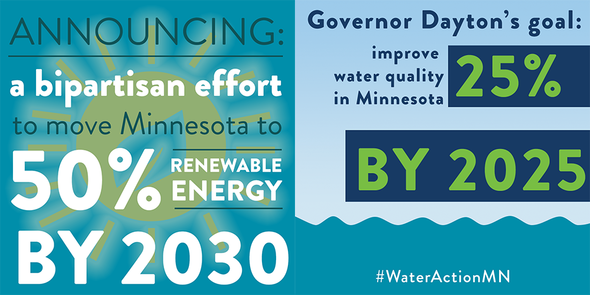
ST. PAUL, MN – Lt. Governor Tina Smith announced a new bipartisan effort to increase Minnesota’s Renewable Energy Standard from 25 percent by 2025 to 50 percent by 2030. Minnesota is already on track to surpass the current goals set by the bipartisan Next Generation Energy Act, which has moved Minnesota to more than 21 percent renewable energy. The new standard – supported by both Democrats and Republicans – would be good for Minnesota’s environment, health, and economy.
“Ten years ago, Minnesota enacted the bipartisan Next Generation Energy Act and proved that we can have affordable, reliable, and clean energy,” said Lt. Governor Tina Smith. “Today, because of bipartisan leadership and a sustained effort, more than 21 percent of Minnesota's electricity comes from renewable sources. If we redouble our efforts, and raise Minnesota’s Renewable Energy Standard to 50 percent by 2030, we will improve air quality, continue to drive down the cost of renewable energy, and generate thousands of new energy jobs.”
The bipartisan bill to advance this new standard is being authored in the Minnesota Senate by Sen. Nick Frentz and Sen. Karin Housley, and in the Minnesota House by Rep. Erin Maye Quade and Rep. Joe Schomacker. This new effort builds on the success of Minnesota’s Next Generation Energy Act, enacted by Governor Tim Pawlenty and an overwhelming bipartisan majority of legislators (97 percent) ten years ago.
[Read More]
MPR | February 27, 2017
Minnesota would have to generate half its electricity from renewables by 2030 under a mandate proposed Monday by the Dayton administration, a doubling of the state's current renewable standard.
Wind and solar now account for about 21 percent of the electricity total, putting it ahead of schedule for reaching the state's 25 percent by 2025 goal.
"If you don't set big goals for where you're trying to get to, you never get there," Lt. Gov. Tina Smith said as she announced the proposed 50 percent renewable standard.
Smith made the announcement at Riverland Community College in Albert Lea, a campus where the potential for renewable technologies is on full display.
[Read More]
Fox 9 | February 27, 2017
Lt. Gov Tina Smith said the proposed standard, called “50 by ’30," would build on that success and would improve air quality, drive down the cost of renewable energy and generate thousands of new clean energy jobs.
Clean energy jobs in Minnesota grew 78 percent between 2000 and 2014, growing steadily through the recession, according to a press release. By contrast, the state’s total employment growth was 11 percent.
The bill is authored in the Minnesota Senate by Sen. Nick Frentz and Sen. Karin Housley, and in the Minnesota House by Rep. Erin Maye Quade and Rep. Joe Schomacker.
[Read More]
|
ST. PAUL, MN – Governor Mark Dayton announced a new “25 by ‘25” Water Quality Goal, which would spur innovation and collaboration around strategies to improve Minnesota’s water quality 25 percent by 2025. Without additional action, the quality of Minnesota’s waters is expected to improve only 6 to 8 percent by 2034. If approved by the Legislature, Governor Dayton’s proposed new goal would engage local governments, farmers, scientists, environmental groups, and business leaders in a collaborative effort to address Minnesota’s water quality challenges.
“Without an ambitious, achievable goal, the quality of our water will continue to deteriorate,” said Governor Dayton. “Minnesotans must set this goal now, and then work together to achieve it. I ask all Minnesotans to join me in finding solutions that will ensure our children and grandchildren inherit clean water to drink, swim, and fish in. This is everyone’s challenge, and everyone’s responsibility.”
Achieving a 25 percent improvement in water quality statewide would require Minnesota to take aggressive, yet achievable action. It also would help Minnesota meet existing commitments to reduce phosphorus 12 percent by 2025 and nitrogen 45 percent by 2040 in the Mississippi River.
[Read More]
Star Tribune | February 06, 2017
Gov. Mark Dayton has set a bold new goal for Minnesotans: Slash water pollution 25 percent by 2025.
He announced the new benchmark at the Minnesota Environmental Quality Board’s annual conference in St. Paul, drawing applause from the audience.
Dayton argued that the threat to Minnesota’s fabled 10,000 lakes, rivers, streams and wetlands is “a wider, deeper crisis” than the threat that mining poses to the Boundary Waters Canoe Area Wilderness. It won’t be solved, he said, unless the public develops a clean water ethic.
“Clean water is your right, it’s also your responsibility — and mine too,” Dayton said.
[Read More]
Pioneer Press | February 03, 2017
Gov. Mark Dayton is making another push to clean up Minnesota’s waters — and says he’s learned lessons from his contentious battle two years ago to implement buffer strips along the state’s waterways.
In a speech Friday morning to the Minnesota Environmental Congress, the DFL governor said he’ll propose improving Minnesota’s water quality 25 percent by the year 2025.
But he’s not proposing specific tools to accomplish that reduction just yet. Instead, he says he’ll solicit citizen input around the state this summer and make proposals based on that input in 2018.
“One of the lessons I learned with the buffer legislation is that it was criticized as a top-down, one-size-fits-all mandate,” Dayton said Friday. “I have my own ideas. I can advance those next year. But I want to let this process unfold and get citizens themselves engaged and citizens themselves feeling their own investment in the outcome.”
[Read More]
|