|
Fall 2026

NATURE NOTES
Nature Notes is the Minnesota Scientific and Natural Areas Unit's quarterly newsletter.
|
In this issue:
Sprague Creek and Winter Road Lake Peatland SNAs: The Leading Edge of Minnesota’s Peatland Resilience Initiative
By Meredith Cornett, Peatland Restoration Program Coordinator
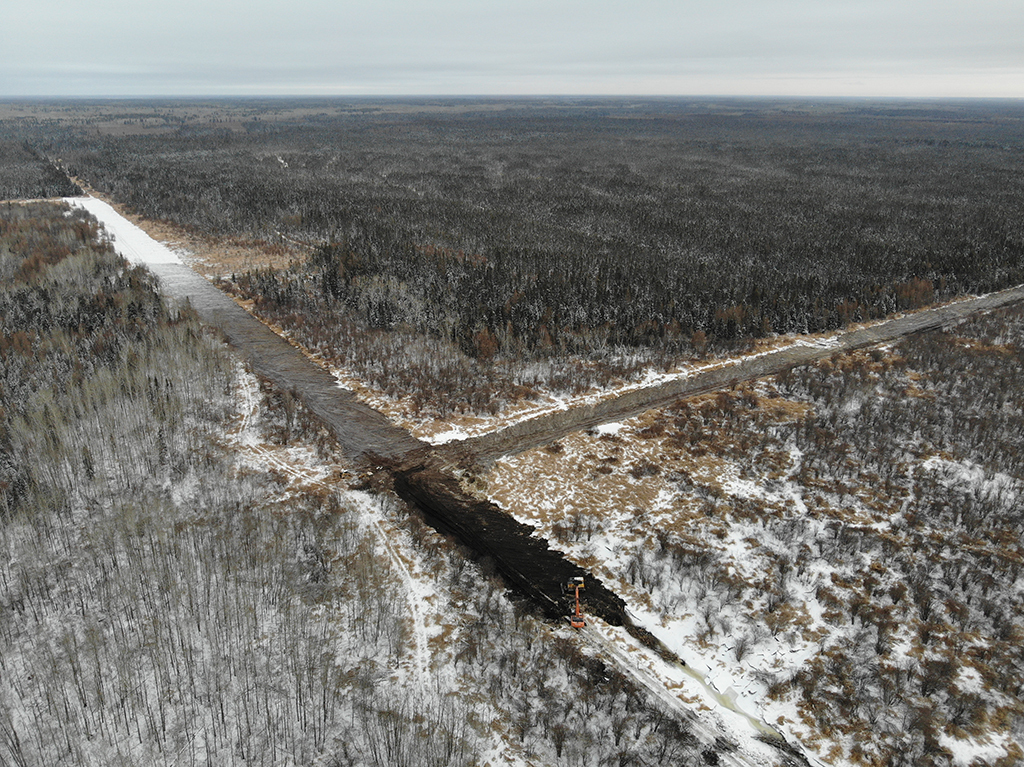 Restoration in progress at Sprague Creek Peatland SNA (December 2025). Photo taken just west of the SNA boundary and facing northeast. Photo Credit: Blaine Broten – district technician, Roseau River Watershed District.
Minnesota’s patterned peatlands are recognized worldwide for their biological, hydrologic and geologic significance. Peatland ecosystems cover around 10% of our state’s land surface—meaning that Minnesota boasts more peatlands than any other state in the contiguous 48 United States. Sprague Creek Peatland SNA (Roseau County) and Winter Road Lake Peatland SNA (Lake of the Woods County) brim with biodiversity and rare features.
Set deep within Minnesota’s Agassiz Lowlands, these SNAs represent what Minnesota’s Legislature aimed to protect in 1991, when they enacted the Peatland Protection Act. This landmark legislation created 18 Peatland Scientific and Natural Areas (SNAs)—including Sprague Creek and Winter Road Lake. Years of research underlie the selection of these 18 peatlands described as “the best examples of the peatland complexes in Minnesota and some of the most ecologically significant in the United States” in a DNR report, “Recommendations for the Protection of Ecologically Significant Peatlands in Minnesota” (1984).
Sprague Creek Peatland harbors one of only a handful of known spring fens in Minnesota—places where cool, mineral-rich waters well to the surface from seeps and springs. These upwellings offer the perfect niche for specialist plants, such as the rare twig rush and hair-like beak rush. Other rare plants at Sprague Creek, such as northern oak fern and ram's head orchid, occur in mossy areas under a canopy of northern white cedar and black spruce within the site’s lowland conifer forests.
At Winter Road Lake Peatland, water tracks and ribbed fens create a diversity of growing conditions, including “strings” (peat ridges) and “flarks” (pools), that give rise to unique groupings of plants, mosses and animal activity. Birds such as the Short-eared Owl, Nelson's Sparrow, and Yellow Rail thrive here. Peatland specialist butterflies make their homes at both SNAs include the Dorcas Copper, Frigga Fritillary, Bog Fritillary and Red-Disked Alpine.
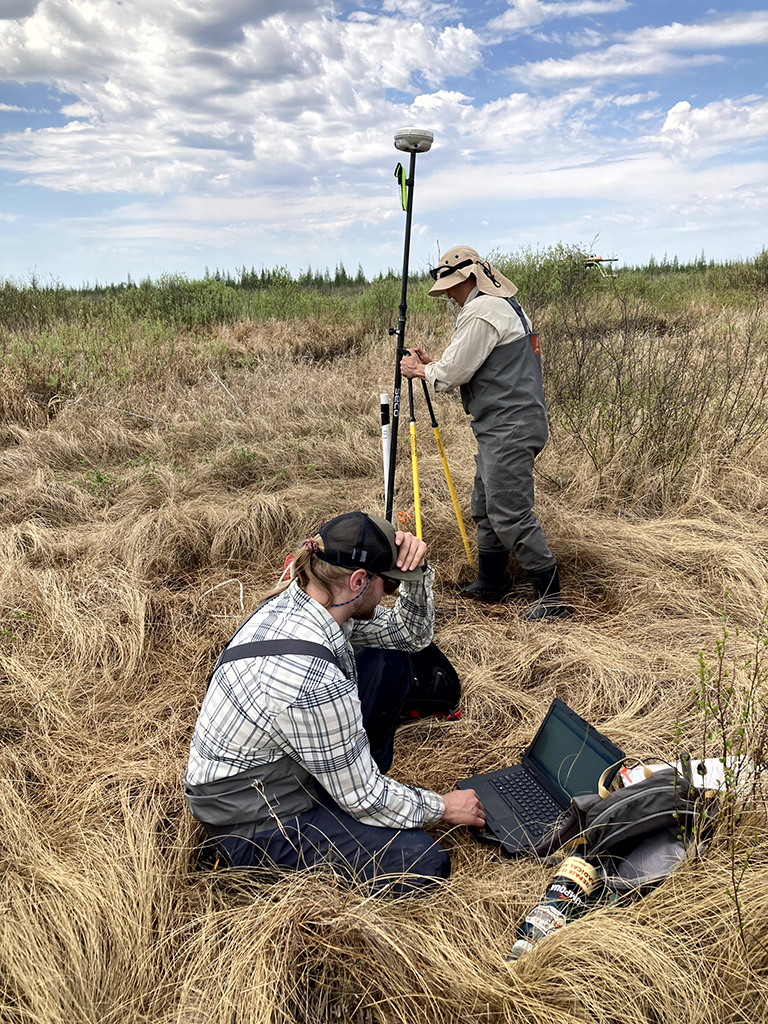 Hydrologists Adam Laehn (front) and Arne Wick (rear) collect water level and survey data from a proposed peatland restoration site at Winter Road Lake Peatland SNA. Photo Credit: Meredith Cornett, MNDNR.
As important as Sprague Creek Peatland, Winter Road Lake Peatland, and the entire system of 18 Peatland SNAs are for Minnesota’s biodiversity, they are now recognized for something the creators of the Peatland Protection Act did not foresee: they could be the key to unlocking one of Minnesota’s most potent climate solutions. Peatlands are powerful carbon sinks – troves of organic matter accumulated over millennia. As such, the state’s Climate Action Framework calls for peatland restoration as an important strategy to reach Minnesota’s climate ambition of getting to net zero emissions by 2050.
But if Peatland SNAs represent the best of the best, why would they need restoration? Many of northern Minnesota’s peatlands have experienced changes to water flow that trace back to a massive drainage program attempted by the Civilian Conservation Corps to make way for agriculture in the early 1900s. The effort failed but the ditches remain. Impacts from partial drainage persist across Minnesota’s northern peatlands—including SNAs. As peat dries, it breaks down, resulting in increased carbon emissions from partially drained areas. With just a few exceptions (e.g., Myrtle Lake Peatland) the state’s peatland SNAs are all impacted by historical drainage ditches.
Enter Minnesota’s Peatland Resilience Initiative. DNR and partners are working to reverse the trend of carbon emissions from degraded peatlands by restoring natural water levels—beginning with Peatland SNAs. The first projects are taking place at Sprague Creek Peatland and Winter Road Lake Peatland in far Northwest Minnesota. In keeping with the mission and management philosophy of the SNA Unit, working with natural, local materials is a priority. Most of the work is conducted in the winter with frozen ground for ease of access and to protect native vegetation and soil.
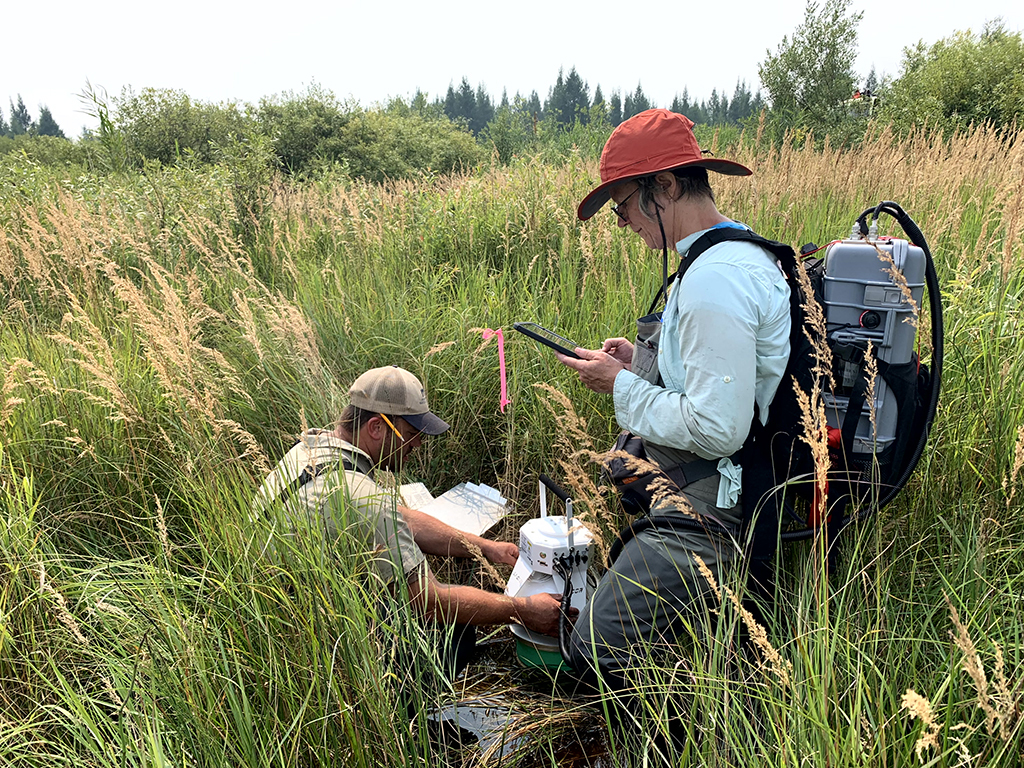 Jacob Boyd (Left, MNDNR) and Meredith Cornett (Right, MNDNR) measure greenhouse gases prior to restoration. Photo Credit, Charlie Tucker, MNDNR.
Plans for the restoration at Sprague Creek Peatland have been in the works for many years. The project centers on slowing the velocity of water, which in turn will help improve the condition of native plant communities and reconnect the natural flow through small fen channels that have been severed by drainage ditches for more than a century. In the winter of 2024-2025, crews used felled trees, brush bundles, and other natural materials to slow water flow, accumulate organic matter, and encourage peat-forming vegetation to regrow. The project wrapped up in December 2025, when a crew filled the final section of ditch with an adjacent spoil pile left from the ditching era.
The restoration at Winter Road Lake Peatland, planned for Winter 2026-2027, will involve bringing materials to the site. Unlike Sprague Creek Peatland, the project area lacks spoil piles, brush and trees. In this case, we will transport Excelsior bales (aspen fiber) to the site to create a series of plugs to slow drainage and allow the landscape to heal. See more information about the project.
Peatland restoration success in Minnesota hinges on partnership, shared goals, and creating best practices. Roseau River Watershed District and Roseau County guided the Sprague Creek Peatland project alongside DNR. At Winter Road Lake Peatland, local partners include Red Lake Nation, Lake of the Woods Watershed District, Lake of the Woods County, Warroad Watershed District and the US Fish and Wildlife Service.
The SNA Unit provides important living laboratories to pilot best practices. We are collaborating with the University of Minnesota, The Nature Conservancy, and other partners to accelerate learning from peatland restoration. Monitoring and evaluation of outcomes—including the effects of rewetting on greenhouse gases, water levels, and vegetation—are central to the initiative. Keep an eye out for results in future issues of Nature Notes!

Site Highlight: Beva Paulson Memorial Hardwood Forest SNA
By Kelly Randall, SNA Statewide Outreach Consultant
|
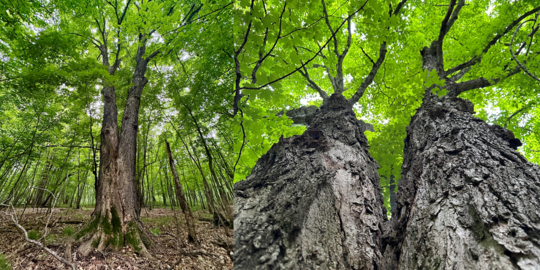 Twin trunked sugar maple at Beva Paulson Memorial Hardwood Forest SNA.
Within one of the largest remaining intact forest habitat blocks along Minnesota’s prairie margin in Clay County sits the new Beva Paulson Memorial Hardwood Forest SNA. Here you’ll find a native hardwood forest with abundant sugar maple, basswood, and bur oak, as well as several wetlands and lakes. Most of the habitat in the county, and this part of western Minnesota, is prairie, so finding a high-quality forest is not that common.
This site was a gift from Gaylord “Guy” Paulson in memory of his wife Beva. The family purchased the property in chunks beginning in the 1970s. Beva was largely responsible for the family finances, and that was why they were able to acquire the land. Guy said it was a gift to him and the family.
The Paulson family had many fond memories of “their own natural place,” including:
- bowhunting, fishing, and watching a wide variety of wildlife
- camping with the family
- planting trees
- and spending time with friends
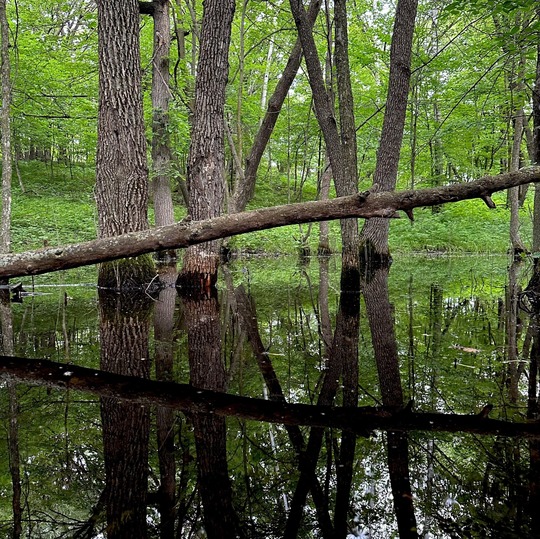 Forest pond at Beva Paulson Memorial Hardwood Forest SNA.
The decision to donate the land was made after Beva passed. Guy has a background in science and research. He wanted the site to be available for biological research. The family worked with the SNA Unit to transfer the land so all Minnesotans might enjoy this special place. Thanks to the Paulsons for the decades-long stewardship of this land, now protected for future generations. On May 4, 2026, the new Beva Paulson Memorial Hardwood Forest SNA became the newest SNA!
In Guy’s words, we now have this SNA to “honor Beva and honor nature.”
The Paulsons recommend visiting these spots on the property:
- “The Crossroads” of trails the family built over time, just south of the parking area.
- A clearing further south with wetland views and nice fall colors.
- A spring west of the parking area.
- Lakeshore throughout the property where you may see beavers, otters, and other wetland critters.
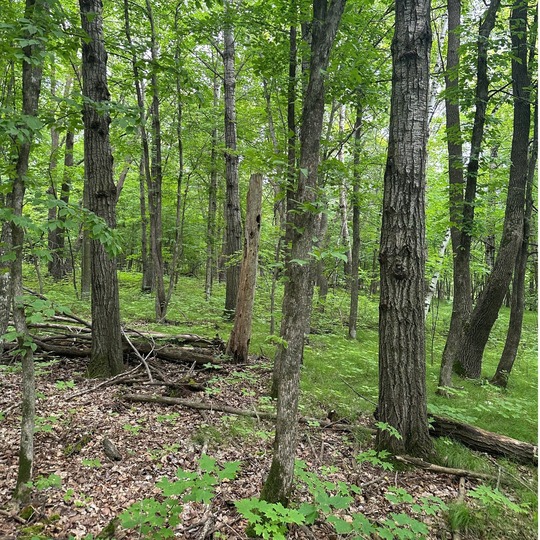 Hardwood forest at Beva Paulson Memorial Hardwood Forest SNA.
|