|
May, 2026
Currents Survey – Your Input is Requested
Help us make FDRWG Currents work better for you! We're gathering feedback from readers to better understand how this newsletter fits into your work and how we can improve it going forward. This anonymous survey takes about two minutes to complete.
Click this link to be taken to the survey: https://forms.cloud.microsoft/g/w3RTzpDdQv
Floodwater as a Resource: Highlights from the March 2026 Joint Conference
Attendees were put to work this year at the 2026 Annual Joint Conference of the Red River Watershed Management Board and the Flood Damage Reduction Work Group. Participants engaged in a facilitated workshop titled Water Supply Management: From Flood Problem to Regional Asset. Their goal was to identify emerging issues and opportunities for organizations to tackle over the next 5 years.
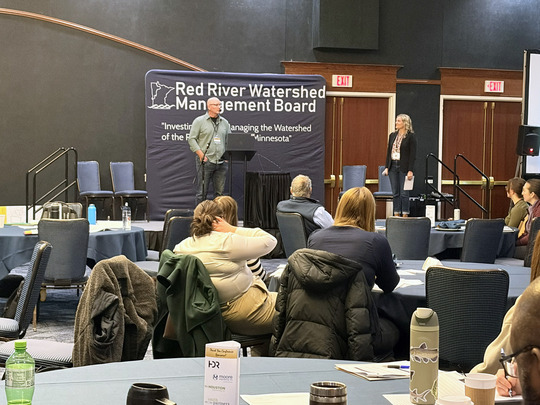 Paul Engelstad, who owns and farms land in the Red River Basin, provided an applied perspective on creative ownership models for farmland converted to floodwater storage. Photo credit: Bethany Bethke.
In one session, small groups worked through six questions and shared insights with the larger group where common themes emerged. The most prominent theme was finding ways to be more intentional about the use of floodwater, such as storing it for use later in the growing season. A close second was the need to streamline permitting by coordinating within jurisdictions.
Participants also identified shorter-term actions for organizations to explore over the next 12 to 18 months, including gaining a better understanding of regional storage opportunities using existing data and models, maximizing funds by designing projects with documented multiple benefits, pursuing feasibility studies, consulting with landowners early in project development, continuing to deepen interjurisdictional collaboration, and standardizing regulations more consistently across borders.
Longer-term opportunities that could gain traction within 5 years included more intentional and coordinated use of floodwater for agricultural or community use, improved coordination across agencies and jurisdictions, investment in water management technology and on-farm infrastructure, and demonstrable improvement in cross-border relationships and shared planning frameworks.
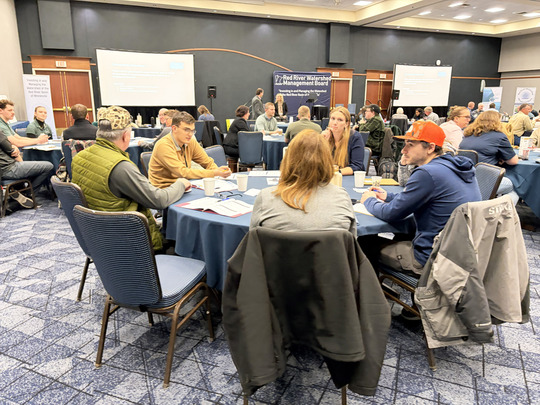 Conference participants in small groups identify emerging issues and opportunities to tackle over the next 5 years. Photo credit: Bethany Bethke.
The facilitators' post-session report also revealed hidden agreement and disagreement running beneath the discussion. Areas of quiet common ground included the ideas that water is simultaneously a problem and an opportunity, environmental quality is a priority, landowners are partners, cross-border collaboration is necessary, and the science and tools for positive change already exist.
Unresolved tensions also persist. The definition of "upstream" is relative and often shapes how people view costs, benefits and regulatory responsibility. Opinions differ on the value of regulatory flexibility versus the predictability that comes from consistent rules. Engaging non-operator landowners remains a challenge. The sacrifice of productive agricultural land for floodwater storage is not universally embraced. And while climate variability was referenced, not all acknowledge the underlying trend in regional hydrology beyond normal weather variation.
The thoughtful participation of conference attendees resulted in useful identification of themes, action items and opportunities. Comments from conference evaluation forms identified this session as a highlight for many and has merit for repeating at future conferences. To obtain a copy of the report generated from the session, please email the Red River Basin Coordinator at fdrwg.coordination.dnr@state.mn.us.
Announcements
The next FDRWG meeting is scheduled for the morning of June 23, 2026, at the Sand Hill River Watershed District in Fertile, MN. For more information, contact the DNR’s Red River Basin Coordinator.
Rural Flood Mapping Project. A court order has reinstated the FEMA grant program called Building Resilient Infrastructure and Communities (BRIC). In 2024, a grant from that program was awarded to conduct this project, but it was terminated in April of 2025. With the funding available again, several sub-watersheds in the Red River Basin will receive maps of farmland inundated by 10-year summer storms.
Five-Year Monitoring Program. The FDRWG’s third season of field work has begun. A contractor will continue collecting field and laboratory data from project sites across the basin. Data collection will continue through 2027 and then information will be summarized in a report and presented in a workshop in 2028.
|