|
Winter 2025

NATURE NOTES
Nature Notes is the Minnesota Scientific and Natural Areas Unit's quarterly newsletter.
|
In this issue:
A Walk Through Time at Boot Lake SNA
By Nick Partington, Central Region SNA Management Specialist
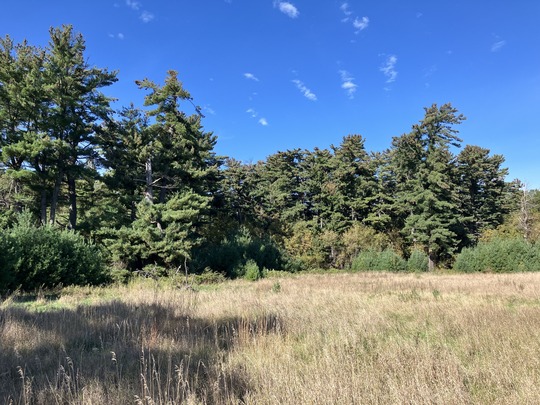 Looking northwest toward the forest at Boot Lake SNA from the southeast corner of the site.
Approaching the forest of Boot Lake Scientific and Natural Area through the historic homestead site in its southeast corner, one encounters a towering wall of white pine (Pinus strobus) before entering a closed canopy of old-growth oak-maple-pine forest. The site boasts a variety of trees and vegetation, and is particularly rewarding to visit in the fall when colors are at their peak, as I recently did with Lee Frelich, Researcher and Director of the Center for Forest Ecology at the University of Minnesota’s Department of Forest Resources. A characteristic of Boot Lake SNA that stood out to me during our mid-October visit is its display of ecological succession – the process an ecological system undergoes over time as it reacts to disturbances such as wind, fire, and herbivory (animals feeding on plants), or even simply from the normal growth of its photosynthesizing residents. A walk through this 650-acre site reveals many stages of forest growth and signs of succession – some more obvious than others.
 Aerial imagery from (left) 1938 and (right) 2023 of what is now Boot Lake Scientific and Natural Area. Arrows indicate locations of agricultural fields.
In the mid-twentieth century, what we now know as Boot Lake SNA looked quite different. Aerial imagery from 1938 shows several agricultural fields within the site that had since been abandoned when the SNA was designated in 1980. Naturally, once these fields were no longer maintained, they provided fertile ground for the early stages of forest succession. No longer having to compete with the plow, seeds from nearby trees could germinate in the fields to start the long process of growing a forest. Indeed, 85 years later, aerial imagery (now in color!) shows some of the fields completely filled in by trees.
Assuming those fields remained relatively treeless until 1980, the oldest trees that have since filled in would be around 45 years old. In these areas that were once wide open with full sun, we now see an intermediate stage of succession, with dense trees of consistent size and age crowding out other potential competitors. As we observed one of these white pine stands, I learned that Lee affectionately refers to the stand as the Class of Pinatubo, in reference to the 1991 volcanic eruption of Mount Pinatubo in the Philippines. Apparently, the eruption was so strong that it led to a global drop in temperature in the summer of 1992, just as these white pine trees on the other side of the planet were gaining their footing. Lee hypothesizes that the drop in temperature – even if small – allowed the white pine seedlings (a species well-suited to cooler northern climates) to have a particularly successful growing season that year.
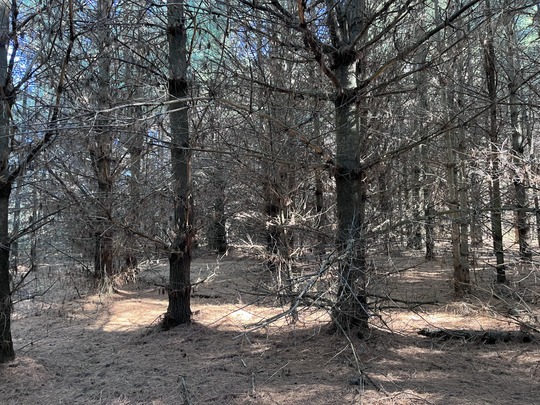 The “Class of Pinatubo,” a white pine stand approximately 40-45 years old at Boot Lake SNA.
Moving ahead on the successional timeline, we find other areas in the SNA that are further along and have started to develop more age diversity. Wind, insects, and disease can often drive this change. For example, if an older tree succumbs to disease or insect damage, it might be more likely to come down in a windstorm. This can leave a sunny patch where the tree once stood, allowing other younger trees in the understory to claim that growing space for their own. Often, countless seedlings of shade-tolerant species will occupy a shady understory, poised to rapidly grow into canopy gaps as they open up, adding age and structural complexity to a stand. We noticed these phenomena more in areas of the site where white pine was more evenly mixed with other species like northern red oak (Quercus rubra) and red maple (Acer rubrum).
 Remnants from a recent windstorm at Boot Lake SNA.
A final stop in our visit included a stand that recently sustained substantial windthrow. A white pine stand that was likely mid- to late-succession before the wind event is now occupied by a few surviving tall pines, many snags (dead standing trees) and open areas filled with sun-loving, early-successional, difficult-to-walk-through species such as raspberry (Rubus spp.) and prickly ash (Zanthoxylum americanum). This stand, which likely had a closed canopy just a few years ago, illustrates how quickly nature can reset succession.
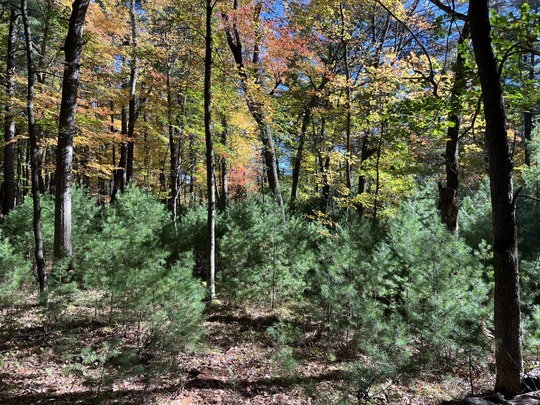 White pine regeneration under a canopy of oak and maple at Boot Lake SNA.
Considering the site after our visit, I’m reminded that a forest – or any ecosystem for that matter – is made up of many small-scale characteristics that, taken together, paint a picture of the site on a landscape-scale (dare I invoke the “see the forest for the trees” idiom?). When I think of Boot Lake SNA, I don’t think of just the abandoned fields or the towering pines or the oak-maple stands. I think of a mosaic that is constantly changing with time and will continue to have ecological treasures for years to come. Personally, I’m excited to see what another 25 years will bring for the Class of Pinatubo.
Back to top

Site Highlight: Recreation and Research at Lutsen SNA
By Arika McGraw, Northeast Region SNA Naturalist
|
Lutsen Scientific and Natural Area, located right next to the popular travel destination Lutsen Mountains ski resort, is a travel destination unto itself. With its old growth northern hardwoods and upland white cedar forests, it provides a peek into what the north shore looked like before human development changed the landscape of northern Minnesota. The DNR designation of Old Growth in these particular forests means that there is a complex stand structure containing trees over 120 years old with plenty of downed and standing dead trees and the area is relatively free of invasive species. The trees on this site surpass the minimum age requirement for their respective old growth communities, with documented trees that include a 221-year-old white cedar, a 143-year-old yellow birch, and a 131-year-old white spruce.
Lutsen SNA provides enjoyment for many different types of outdoor recreationists. The snowmobile and cross-country ski trails are used by more than just their intended audiences; hikers and wildlife regularly use them to amble across the site. As the regional naturalist, I have also used the trails for a unique purpose: research monitoring.
From October 2020 to January 2022, a trail camera on the interpretative kiosk captured the intersection of the ski and snowmobile trails. This turned out to be a great spot for capturing wildlife photos. The most common animal seen was unsurprisingly white-tailed deer, but a close second were wolves. The camera also caught coyotes, black bears, bobcats, red foxes, moose, snowshoe hares, and a grouse. One particular black bear was very interested in the camera and the first photo captured was a close-up of its eyeball.
 Trail camera images of wildlife at Lutsen SNA: moose (top left), black bear (top right), gray wolf (bottom left), black bear's eye peers into the camera (bottom right).
The trail camera also gave insight into how many and in what ways humans use the SNA. The camera caught roughly 700 people visiting Lutsen SNA. Of those 700, about 280 were riding snowmobiles and trail groomers, 25 were hunters (which is allowed on this site), and the rest were cross country skiers, snowshoers, and hikers. Joining their human companions were about 75 dogs (allowed at this site as well). Based on a rough count, about 157 people took the time to stop and read the interpretive kiosk. Most of those people were cross-country skiers, snowshoers, or hikers, but a few snowmobilers also took the time to stop and read the kiosk.
 The trail camera captures a pair of Labrador Retriever dogs chewing on a stick at Lutsen SNA.
In addition to the trail camera, I assisted with a couple different bee surveys at Lutsen SNA. One of them was part of the Minnesota Bee Atlas through the University of Minnesota Extension. Through various volunteer projects they aim to gather basic information about Minnesota’s bee species such as which ones live here, what are their habitat needs, what are their food and nesting material preferences, and more. I helped with the wood-nesting bee section of the project by setting up and monitoring a bee block at Lutsen SNA in the summers of 2022 and 2023. At the end of each summer, the bee boxes went back to the scientists at the UMN Extension. To see if the bees preferred specific species of plants, they identified the bees and the types of plant material used in some of the nests. A sample of the bees were hand reared to be identified once they were adults, and the rest were released back where they were collected. The Lutsen bee blocks were utilized primarily by mason bees such at the blue orchard mason bee (Osmia lignaria) and multiple types of nest parasitizing wasps such as a cuckoo wasp (Chrysura pacifica or kyrae).
 A bee using a wooden bee block at Lutsen SNA.
Back to top
|