|
Fall 2025

NATURE NOTES
Nature Notes is the Minnesota Scientific and Natural Areas Unit's quarterly newsletter.
|
In this issue:
Celebrating Minnesota's Old-Growth Forests
By Nick Sanchez, Old-Growth Forest Network network manager
The national Old-Growth Forest Network inducted three Minnesota forests near the north shore of Lake Superior in June of this year. Home to gnarly sugar maple, sprawling yellow birch with thick branches, ancient white cedar, and white spruce dangling with strings of grey-green lichen, Lutsen Scientific and Natural Area, Tettegouche State Park, and George H. Crosby Manitou State Park showcase the glory of the northwoods near the shoreline. Rare and teeming with life, Minnesota's old-growth forests are full of secrets and wonder.
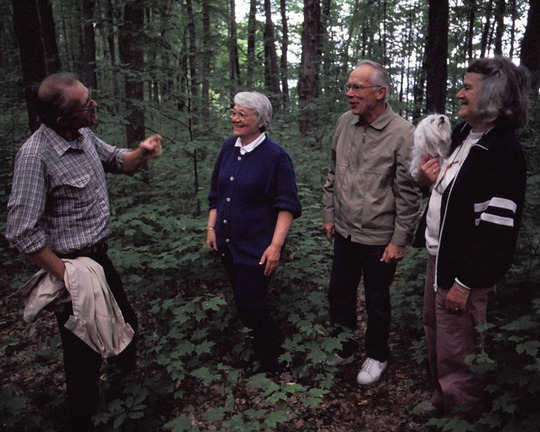
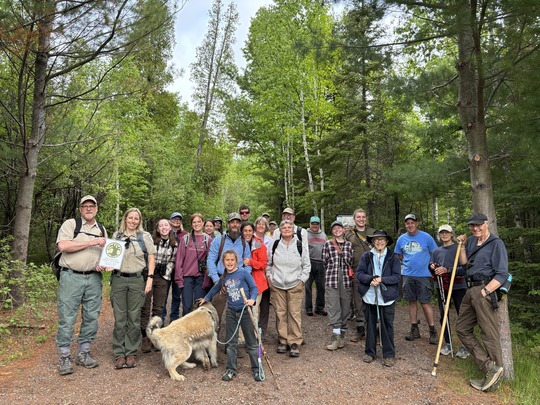 Participants gather for a hike to welcome Tettegouche State Park into the Old-Growth Forest Network. Photo by Nick Sanchez, OGFN.
Across the country, old-growth forests are becoming increasingly rare, with less than one percent remaining in the eastern U.S., and less than five percent in the west. In response to these shocking statistics, Dr. Joan Maloof, ecologist, professor and writer, established a nonprofit called the Old-Growth Forest Network (OGFN) in 2012. The organization's goal is to create a national network of protected and publicly accessible old-growth forests. With the goal of recognizing and showcasing at least one forest in every forested county in the country, OGFN works with conservation partners like federal and state agencies, local governments, and land trusts along with an army of volunteers to build a rapidly expanding Network that now includes over 300 forests across 39 states. Candidate forests are nominated and then vetted to ensure their protection, access and the quality of their visitor experience. Each eligible forest is welcomed into the Network with a celebratory educational community hike. Each forest then gets a profile on OGFN’s website which includes information about where to go, what to expect when you visit, and which trails to take to experience some of the oldest parts of the forest.
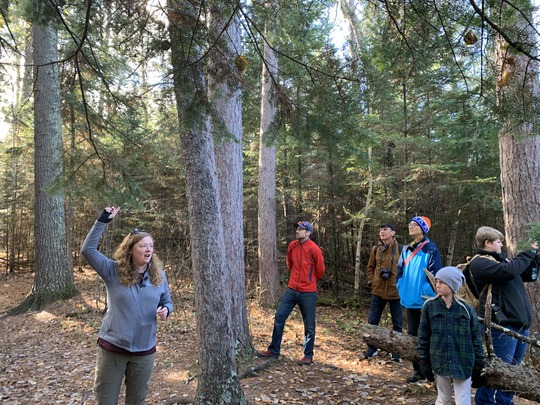 AmberBeth VanNingen, SNA’s northeast region specialist explains the ecology of the magnificent pine forest at the Lost 40 SNA. Photo by Nick Sanchez, OGFN.
Once covering more than 51 percent of Minnesota's forested area, old-growth forests now primarily exist within remnant patches across the state’s 17.7 million acres of forest. In 2021, OGFN connected with the Minnesota Department of Natural Resources (MN DNR) to understand where and how old-growth forests were protected and managed on Minnesota’s state-administered lands. From the oak and maple forests of the Big Woods to the sub-boreal lowland conifers, the MN DNR stewards a 44,000-acre network of protected old-growth and future old-growth forests across state-administered lands such as state parks, state scientific and natural areas, and state forests. Together, scientific and natural areas and state parks have coordinated the induction of eight sites to the national Network to date, with more to join in the coming years.
While huge, mossy trees may come to mind, old-growth forests are diverse and complex, existing across multiple spectrums of influence from dry to wet forests, warm to cold, to those frequently burned by fire or long periods without. Despite their structural differences like tree density and size, tree species, and lifespan, they have a few things in common. Relative to their location and influences, old-growth forests have abundant large old trees, dead standing trees called snags and fallen logs. This community structure and its processes provide an ever-evolving source of shelter and food for species that rely on habitat within, below, and upon the trees and logs.
In Minnesota, many species of wildlife depend on the habitat provided by old forests. American martens rely on larger trees for denning and large fallen logs that provide access to the layer beneath the snow for hunting and shelter. Northern flying squirrels depend on tree cavities and through their foraging play a critical role in the dispersal of ectomycorrhizal fungi found in complex older forests. Red-shouldered hawks depend on large trees with sturdy horizontal branching for nesting amongst large contiguous tracts of mature forests. Old forests are also home to species that have limited means of dispersal. These species thrive here due to their relative stability. Long periods uninterrupted by severe winds, fire, or logging allow these species to establish, reproduce, disperse and thrive in their respective niches. These species include certain types of land snails, salamanders, shingle moss, and tree lungwort lichen which grow on the trunks of larger older trees, raining down critical nutrients to the forest floor.
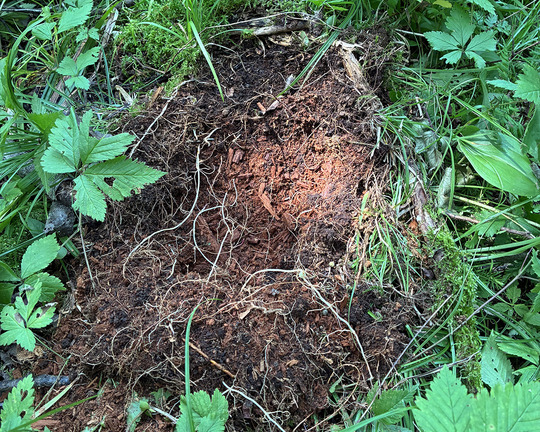
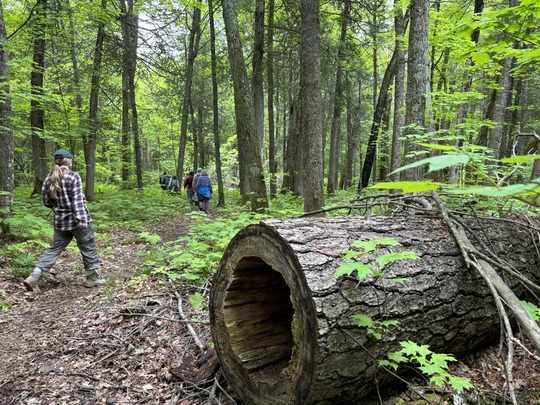 Storm cleanup provides a rare peak at the habitat within a massive old-growth white pine that fell across a trail at Tettegouche State Park. Photo by Nick Sanchez, OGFN.
Anyone can visit these forests, experience their diverse old-growth features, and get a chance to spot the creatures that depend on them. From the deep-cushioned forest floor built by cryptic soil dwellers over hundreds or even thousands of years, to the earthy aromatics, to the unique, time-warped trees that live within them, there’s a lot to love about old-growth forests. If you’re planning a visit, it's important to practice leave no trace principles and prevent the spread of invasive species when visiting Minnesota’s natural communities. Anyone can volunteer with the MN DNR to help take care of these incredible forests. Forest lovers can also nominate a forest for consideration in the Network or volunteer to help search for suitable candidates in places not yet represented at www.oldgrowthforest.net.
Minnesota forests that have been inducted into the Old-Growth Forest Network:
Lost 40 Scientific and Natural Area, Itasca County, 2023
Itasca Wilderness Sanctuary Scientific and Natural Area, Clearwater County, 2023
Wolsfeld Woods Scientific and Natural Area, Hennepin County, 2024
Townsend Woods Scientific and Natural Area, Rice County, 2024
Sakatah Lake State Park, Le Sueur County, 2024
Lutsen Scientific and Natural Area, Cook County, 2025
Tettegouche State Park, Lake County, 2025
George H. Crosby Manitou State Park, Lake County, 2025
Back to top

Site Highlight: Hidden Color in the Heart of Iron Springs Bog SNA
By Hayley Larson, Northwest Region SNA Specialist
|
My visit to a northern Minnesota peatland was like stepping into another world — one shaped by stillness, mystery, and an overwhelming wash of green. At first glance, the landscape seemed uniform, a quiet sea of mosses, sedges, and spruce blending into a single verdant tone. But as I moved deeper into the soft, spongy ground, I began to realize that this muted canvas was far from colorless. Hidden among the ambiguous green hues were bursts of unexpected color.
Across the northern half of Minnesota, a vast, undisturbed landscape of patterned peatland complexes persists. Peatlands are freshwater wetlands formed from layers of decaying plant matter. Despite many similarities, not all peatlands are alike: water source, nutrient availability, and unique land formations distinguish one peatland from another. This unique anaerobic system (lacking oxygen) of spongy organic soils provides a saturated substrate for some of the state's most intricate flora.
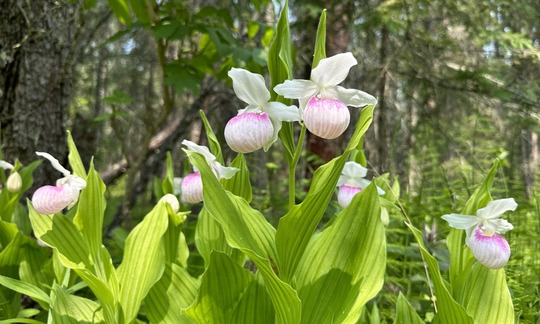
Iron Springs Bog SNA doesn’t give up its treasures easily. I had to slow down. Look closely. Listen. The hush of wind through black spruce branches seemed to whisper encouragement. As my eyes adjusted to the subtle language of this place, I began to see the gems it holds. Hidden between the labrador tea (Rhododendron groenlandicum) and twinflower (Linnaea borealis), the pink blush of wild orchids like the small round-leaved orchid (Amerorchis rotundifolia) and the orange and yellow sunset hues of the hairy honeysuckle (Lonicera hirsuta) revealed themselves. Bright red common strawberry (Fragaria virginiana) nestled low to the ground, easy to miss unless you knew where to look. Even the golden glow of round-leaved sundew (Drosera rotundifolia), its dewdrops glistening in the sun, felt like a reward for patient observation.
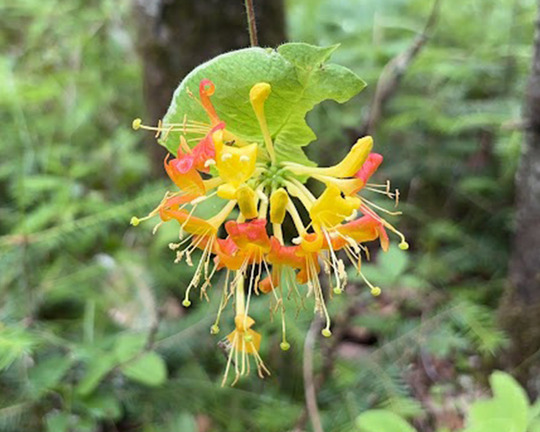 A vibrant hairy honeysuckle (Lonicera hirsuta) flower at Iron Springs Bog SNA.
What struck me most was the way color in a bog is not loud or showy — it’s intimate. It invites you into a closer relationship with the land. In our world so often dominated by instant gratification and sensory overload, the bog teaches stillness and wonder. The deep greens and silvery lichen tones are a backdrop for these vivid, fleeting moments: a flash of blue from a dragonfly’s wing, the white fringed petals of a hidden one-flowered pyrola (Moneses uniflora) intertwined between the sedges and graminoids.
The experience reminded me that beauty is often tucked away in quiet corners, not screaming for attention but waiting to be discovered by those willing to look closer. The northern Minnesota peatland, with all its ambiguity and subtlety, revealed itself not as a place of monotony, but of intricate detail and hidden color.
As I walked back from the heart of the bog, I felt transformed. Not by what I had seen, but by how I had seen it. The SNA offered not just a glimpse of its hidden palette, but a reminder to notice — to really notice — the world around me.
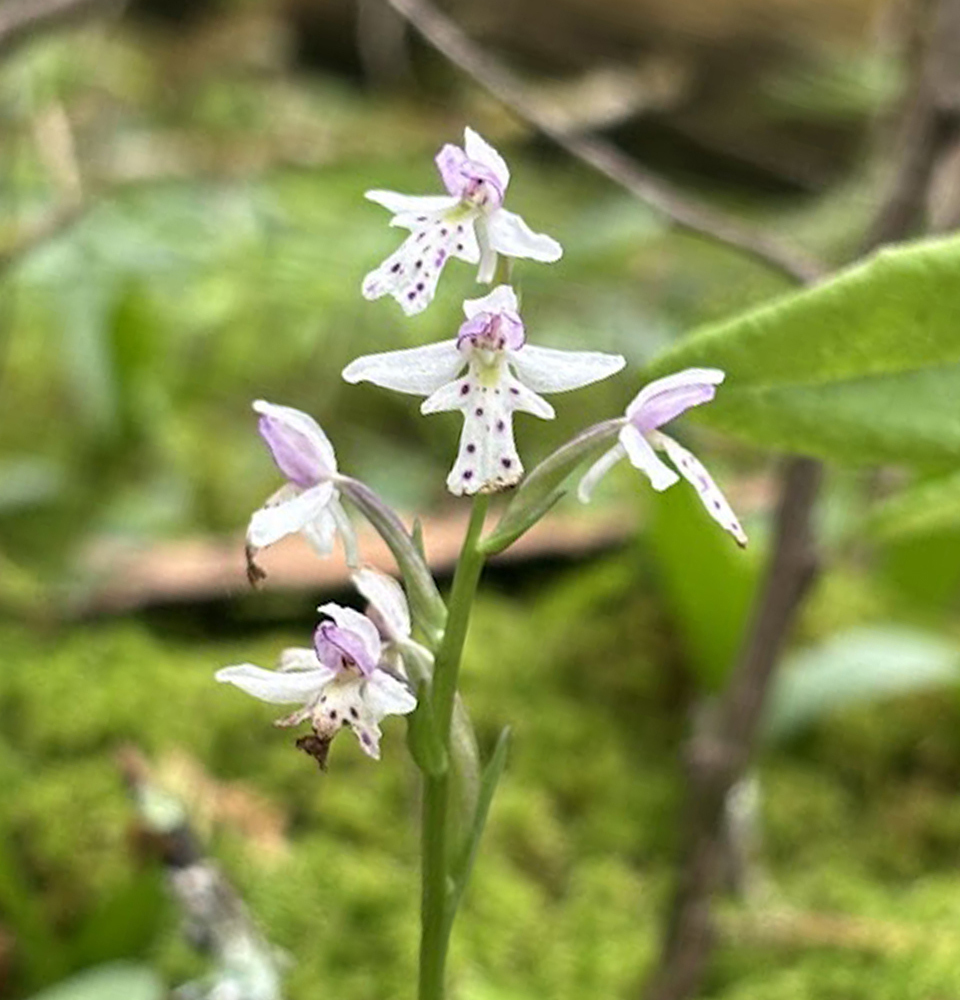 A small round-leaved orchid (Amerorchis rotundifolia) at Iron Springs Bog SNA.
Iron Springs Bog SNA is characterized primarily as a lowland conifer forest or forested peatland and is nestled along Sucker Creek and a nameless tributary that flow into the Mississippi River in Clearwater County. Groundwater rich in calcium, magnesium, and iron surfaces in forms of springs and upwellings. This unique groundwater feature and its mineral makeup led to the site's designation as a Scientific and Natural Area (SNA).
Back to top
|