|
Summer 2025
NATURE NOTES
Nature Notes is the Minnesota Scientific and Natural Areas Unit's quarterly newsletter.
In this issue:
|
|
 |
A Forever Wild Legacy
By Mary Enright, SNA Communications Outreach Specialist
Many of my earliest and fondest memories of the outdoors take place around the aquamarine waters of Siseebakwet (Sugar) Lake in Itasca County. Every 4th of July, my family and I would pull our boats into a shallow, sandy area of the lake to spend the day soaking up the sun. This is one of the places I first connected with wilderness. Watching loons swim by in the crystal-clear water, inspecting mussel shells with curious eyes, and feeling the tickle of minnows nibbling at my legs, the natural world was magical to my young self. As I grew up, I continued to cultivate my love of nature, eventually beginning a career in natural resources. Soon after starting my position with Minnesota Scientific and Natural Areas, I realized that the special place from my childhood was Boltuck-Rice Forever Wild SNA! As I read about the site, I learned the story of Mary Boltuck, Jeanne Rice, and their families who donated this piece of land for the exact same reason that I began my career in natural resources – to preserve wild places for the enjoyment of future generations. Mary Boltuck and Jeanne Rice donated their land with the premise of keeping it “forever wild”, leaving a legacy of preservation for generations to come.
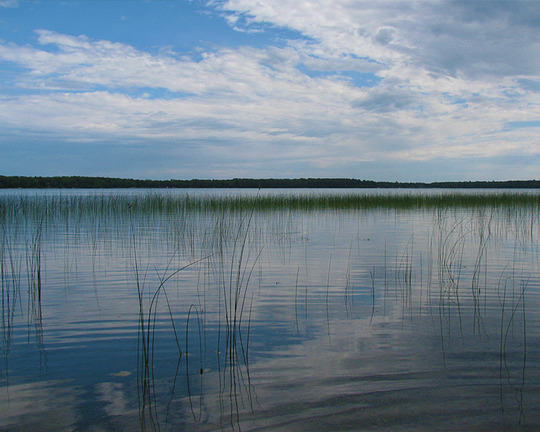 Looking out towards Siseebakwet Lake from the shores of Boltuck-Rice Forever Wild SNA.
Boltuck-Rice Forever Wild is located along the shore of Siseebakwet Lake, 9 miles southwest of Grand Rapids. The site is the only undeveloped stretch of shoreline on the lake, protecting multiple unique natural features. Of geologic interest, this site preserves a series of exceptionally well-preserved ice-push ridges. These ridges emerge as ice expands in the winter and pushes sediment from the lake onto the shore. As these ridges develop, they reveal how lake levels have changed over time. Lakeshore development often leads to the destruction of these features, making this site a unique record of the lake-levels lowering on Siseebakwet over time. Inland, this SNA has a complex of old-growth and old northern hardwood forest, side-by-side with an old-growth white cedar (Thuja occidentalis) swamp. The site’s shoreline hosts Siseebakwet Lake’s only significant wetland communities, providing habitat for a variety of aquatic plants and animals. As retired SNA specialist Steve Wilson puts it, “The site is of significant value for wildlife habitat and water quality, but also to the quality of life for the people who live or recreate in the area.” With its old-growth forest and flourishing wetlands, Boltuck-Rice Forever Wild provides a haven for humans and wildlife alike.
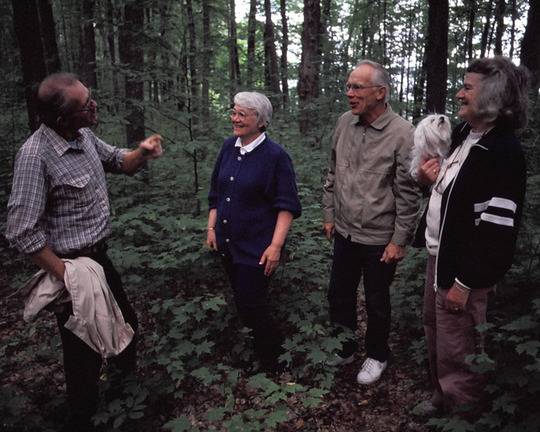 (From left to right) Carrol Henderson, Mary Boltuck, Jack Mooty, and Jeanne Rice at Boltuck-Rice Forever Wild SNA.
The journey to designate this site as a Scientific and Natural Area was long in the making. Sisters Mary Boltuck and Jeanne Rice first entered their property into a conservation easement. They generously donated the majority of the land’s value to preserve the undeveloped site. This became the first conservation easement accepted by the DNR in the early 1990s. Nearly two decades later in 2011, the Boltuck-Rice families donated the remaining interest in the land as an SNA. Mary Boltuck shared her outlook in a story by Margaret Haapoja in the September/October 1995 issue of the Minnesota Conservation Volunteer, saying “each time we walk in the woods, we’re absolutely convinced this is the right thing to do. The idea that when we’re gone – and 150 years from now – this place will still be the same way is a fantastic thing to think about.” Today, her vision holds true. Without the dedication and perseverance of the Boltuck-Rice sisters, the old-growth forest, undisturbed shorelines, and ancient beach ridges would not be protected and available for the enjoyment of all Minnesotans. Former DNR Nongame Wildlife Specialist Jack Mooty, who worked with the sisters in the donation process in the 1990s, said, “people are going to look back on the Rices and Boltucks and see them as very enlightened, farsighted, gracious and generous people.” Over thirty years later, we are doing just that.
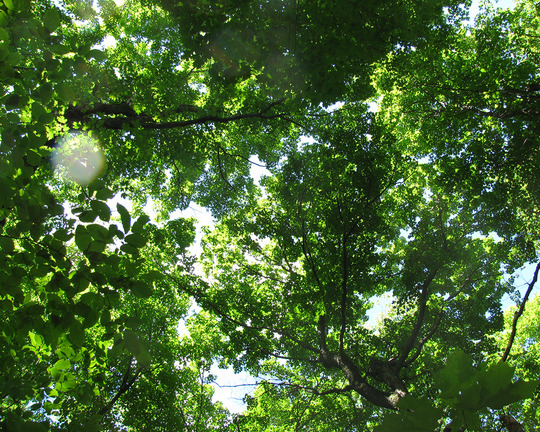 Maple-basswood forest canopy on a summer day at Boltuck-Rice Forever Wild SNA.
Mary Boltuck, Jeanne Rice, and their families leave a legacy of preservation with Boltuck-Rice Forever Wild SNA. In their diligent efforts, this site protects a piece of Minnesota’s natural heritage which can be enjoyed for generations to come. The tranquil yet untamed nature of this site sparked my personal interest in the outdoors as a kid, setting me on a path to devote my career to natural resources. I think this is exactly what the Boltuck-Rice families were hoping for in their generous donation. I hope future generations of young outdoor explorers will experience such special connections to Minnesota Scientific and Natural Areas, carrying on the state’s tradition of passion for the Great Outdoors.
Back to top

Site Highlight: Wolsfeld Woods SNA
By Liz Weir, Friends of Wolsfeld Woods
|
I believe what people most love about Wolsfeld Woods SNA is its relatively unspoiled beauty and, for me, its ancient tug to the conscience of how this part of Minnesota once looked, before our pioneer ancestors arrived to clear the forest cover for farming.
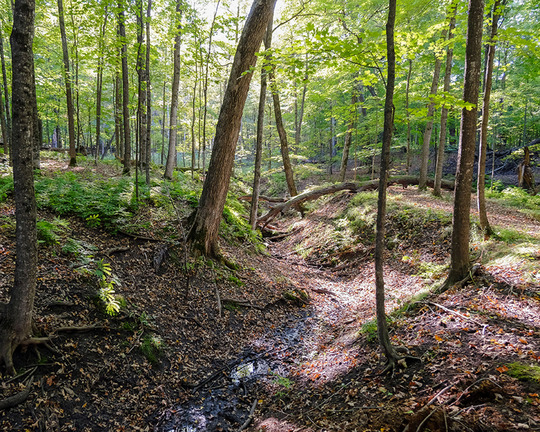 Sunlight shines through the canopy of Big Woods at Wolsfeld Woods SNA.
The woodland's bears and wolves are long gone but, although they are rarely seen, coyotes are present and sometimes call at dusk and dawn; and I have watched a red fox hunting in grasslands adjacent to the Woods. Although we don't often see raccoons, we see their thumbed tracks in spring mud and snow. Likewise, we see more white-tailed deer tracks than deer, perhaps because the day time woods are busy with walkers, runners and bird watchers.
Spring is an exciting time for birders, who try to catch the warbler wave as these jeweled birds, all decked out in their courting plumage, move through Wolsfeld Woods. One fortunate year, we identified 21 different warbler species on an early May morning. My favorite is the Blackburnian Warbler.
A stunning summer bird in the woodland is the scarlet tanager, and a more subtle but lovely summer visitor is the Northern flicker. Year-round resident birds are the crow-sized pileated woodpecker, barred and great-horned owls, ospreys, bald eagles, egrets, red-bellied woodpeckers, cardinals and the delightful chickadees, nuthatches and downy woodpeckers, who seem little perturbed by humans.
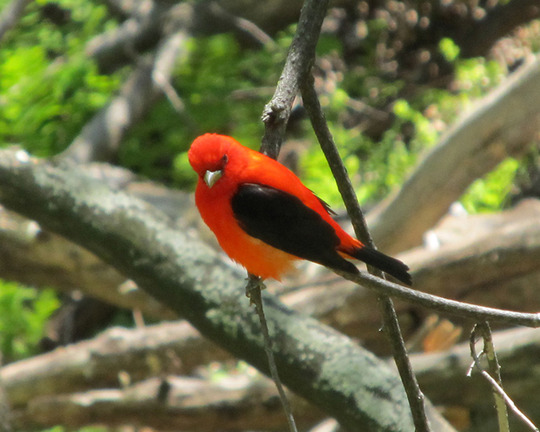 A male scarlet tanager (Piranga olivacea) perched on a branch. Photo by Karen Schik.
Along the stream that drains from Wolsfeld Lake we see mallards and wood ducks in the summer months and, in streamside mud, crawfish chimneys. Typical amphibians are the leopard and wood frogs, spring peepers, American toads and blue-spotted salamanders.
Every other year, a bat specialist leads a bat walk through the woods. She carries an echo-locator and explains how bats, commonly little brown bats, use sound waves to find their insect prey in the air.
Wolsfeld Woods is being steadily invaded by buckthorn, and few wildflowers, sedges or mushrooms survive where this invasive shrub is dense; but along the still open trails, delicate spring ephemeral flowers, like bloodroot, rue anemone and Dutchman's breeches still thrive and bloom in May.
In a wet fall, mysterious fungi push up through the leaf litter, mushrooms such as dead-man's fingers and, growing from fallen logs, wood-ear, turkey-tails and coral-comb.
Keep your eyes peeled and your ears alert and Wolsfeld Woods will begin to reveal its many wonders to you.
|