DNR earns sustainability award for greenhouse gas emissions reductions
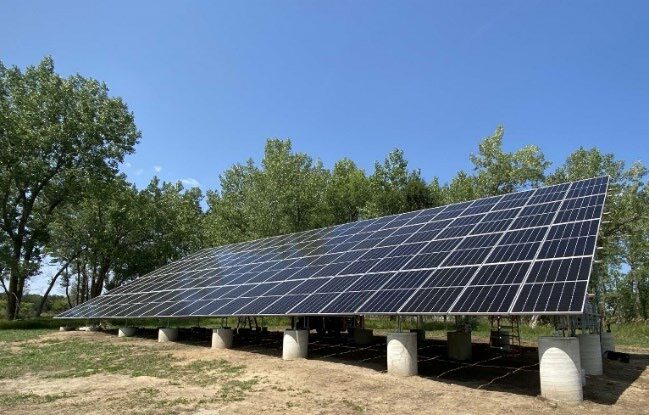
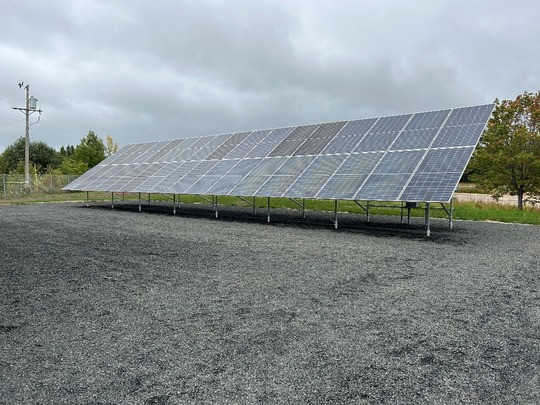
In July, Commissioner Sarah Strommen accepted a 2023 Sustainability Award for the Minnesota Department of Natural Resources from the Enterprise Sustainability Steering Team chaired by Lt. Gov. Peggy Flanagan for greenhouse gas emissions reductions. Specifically, for solar projects at Camden State Park and Iron Range Off-Highway Vehicle State Recreation Area.
The DNR's total solar capacity reduces greenhouse gas emissions equal to those produced by 568 gasoline-powered passenger vehicles driven for one year, or 6.1 million miles driven by an average gasoline-powered passenger vehicle. The next site planned to get a solar array is Buffalo River State Park.
Camden State Park
Camden was originally home to a 10 kW wind turbine but it was removed in 2021 due to high maintenance and operational expense. As a replacement, a 39.9 kW solar array was installed. The solar array will save 244 metric tons of greenhouse gas emissions annually, equivalent to 58.1 gasoline-powered passenger vehicles driven for one year or 624,492 miles by an average gasoline-powered vehicle.
 Iron Range Off-Highway Vehicle State Recreation Area
This site already had three different solar arrays with a 10.2 kW solar capacity. In 2023, an additional 29.7 kW array was added and the site is at max capacity for solar. The new greenhouse gas emission savings are 135 metric tons, equivalent to 36.4 gasoline-powered passenger vehicles driven for one year, or 391,285 miles driven by an average gasoline-powered vehicle.
Mini-forest partnership in Rondo neighborhood strengthens community bonds
 How many volunteers does it take to plant a forest the size of a tennis court – and what value does a forest of that size have for a community?
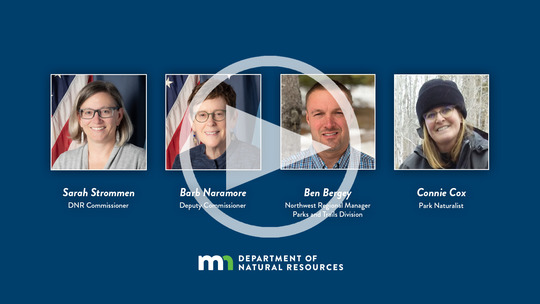
Find out in this video about a recent mini-forest project in the Rondo neighborhood of St. Paul, by DNR Videographer Nick Frantzen.
Volunteers and partners include:
- Maxfield Elementary, Engineers Without Borders USA, Ramsey County Master Gardeners, Renewing the Countryside, Urban Farm and Garden Alliance, Great River Greening, DNR – Urban and Community Forestry Program, Pilgrim Baptist Church in St. Paul, and the Rondo community.
Save the date for upcoming 4 The Outdoors open houses
Since 2021, the DNR has been leading the 4 The Outdoors project, a transformational effort, in collaboration with a diverse cross-section of people, to identify what Minnesotans value for the future of conservation and outdoor recreation and what steps we collectively need to take to reach that future.
Please save the date for one of the upcoming "open house" events for DNR staff, where you can learn more about what we're hearing from Minnesotans about how to create a stable and predictable base and operational funding for conservation and outdoor recreation in Minnesota, ask questions, and share your own thoughts and insights.
Option one:
Option two:
Help spread the word
The 4 The Outdoors questionnaire is currently open for public input. Please share with your networks and anyone you think would like to contribute to helping co-create the vision for sustainable, long-term funding for conservation and recreation in Minnesota. The purpose of this questionnaire is to explore Minnesotans' values and preferences related to possible future funding models. The questionnaire should take less than 10 minutes to complete. This input will help us identify specific funding solutions that best meet Minnesotans' needs.
Learn more about 4 The Outdoors by reading the 4 The Outdoors report, visiting the DNR website, and watching the July 30 Wireside Chat.
Explaining the IT outage, CrowdStrike
 CrowdStrike is a company that develops tools to protect computers and networks from cyber threats like viruses and hacking attempts. However, a recent update that CrowdStrike released caused widespread IT outages and unexpected problems for many users.
Imagine having a security system in your home that suddenly malfunctions and locks you out instead of keeping you safe. That's a good analogy for what happened here, but on a much larger scale. The update meant to enhance security inadvertently caused computers worldwide to crash, disrupting critical services like air travel, hospitals, and banking systems.
While this event was an operating issue and not a security issue, threat actors are taking advantage of the opportunity by creating malicious websites claiming to be able to resolve CrowdStrike related operating problems. If you are still experiencing service issues, please do not attempt to troubleshoot on your own – work with the MNIT Enterprise Service Desk (651-297-1111).
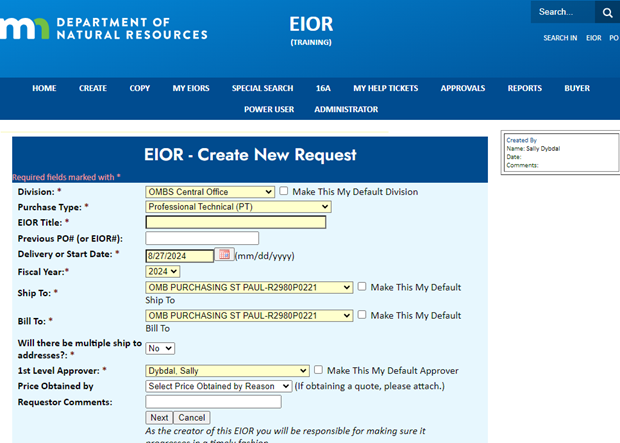
In case of another such outage, the state of Minnesota has the ability for you to continue to do your work by accessing Microsoft tools online without being on a state network or virtual private network (VPN). To do so requires the use of Multi-Factor Authentication (MFA) using the Microsoft Authenticator application. Information about how to set up MFA to allow access to Microsoft tools can be found on the Multi-Factor Authentication (MFA) webpage of the DNR Intranet under the “State of Minnesota Required Use of MFA” heading.

Lily pads
From a DNR Instagram post on June 30:

Lily pads are just part of the story when it comes to Minnesota’s floating-leaf plants. These native species are surprisingly diverse, uniquely beautiful and provide benefits for the waters and wildlife around them.
All native floating-leaf species are covered under Minnesota DNR regulations, and some species are endangered or threatened. Let’s take a look at a few of them!
White water-lilies appear across much of the state except the southwest. The plant provides coverage for largemouth bass and sunfish. Its seeds are eaten by waterfowl and its rhizomes are eaten by beavers.
Yellow water-lilies have large heart-shaped leaves and yellow ball-shaped flowers that stand a few inches above the water. Waterfowl eat the fruit, and muskrats and moose eat the rhizomes, stems, leaves, and fruit.
Duckweeds consist of tiny floating leaves with small roots dangling into the water. Ducks may sometimes eat duckweed and watermeal.
|
Free mental health trainings and well-being webinars available for staff
 By the Well-being Action Team
The Organizational Health Team’s Well-being Action Team encourages employees to enroll in free online training available through Health Partners’ Make it Ok program and webinars provided by the State Employee Group Insurance Program (SEGIP). Sessions may be attended on work time. Obtain supervisor approval and enroll through the links provided below.
Include well-being in your Growth Opportunity Plan
GO Plans are a tool for you to set learning goals and discuss them with your supervisor. Adding well-being learning goals to your Go Plan can help you prioritize learning in the areas you are most interested in. Visit the Well-being Intranet webpage and review the handout: Well-being learning goals for Growth Opportunity (GO) Plans.
Make it Ok Trainings
If you are interested in reducing the stigma of mental health and illnesses, supporting others and finding care resources, attend an upcoming online session. Read more about each session and enroll on the Make it Ok events webpage.
Session options include:
- Make it OK to Talk About Mental Health and Illnesses (one hour): Aug. 7, Sept. 13, Oct. 7, Nov. 6, Dec. 3
- Ambassador training (two hours) upcoming sessions: Aug. 14, Oct. 25, Dec. 11
- Mental Illnesses and Substance Use Disorders (one hour): Sept. 25, Nov. 19
- Question, Persuade and Refer (QPR) Suicide Prevention Training (one and a half hours): July 10, July 25, Aug. 8, Aug. 20
- QPR Suicide Prevention Training for Agricultural Communities (one and a half hours): July 24
Wednesday Well-being Webinars
All sessions are held from noon to 1 p.m. If you are unable to adjust your schedule to attend on work time, consider watching recordings outside your lunch hour. Schedule, registration links, and recordings are available on the SEGIP Wednesday Well-being Webinar webpage.
Upcoming sessions:
- How to Shake a Bad Mood: Aug. 7
- Art of Decision Making: Aug. 21
- First Aid Kit for the Mind: Sept. 11
- Personal Resilience: Sept. 25
- Expanding your Sphere of Influence: Oct. 9
- Building Self-Esteem Through Positive Self-Talk: Oct. 23
- Foods that Fuel Immunity: Nov. 6
- Loneliness and Social Connectedness: Dec. 4
- Behavior Change and the Brain: Dec. 11
- Living Longer: Quality and Quantity: Dec. 18
Contact Laura Grunloh or any Well-being Action Team member if you have questions.

Intoxicated boating, flower-eating deer, and more
Warm weather has led to high numbers of people on Minnesota’s lakes and rivers, while at the same time bringing out off-highway vehicle riders to take advantage of the state’s numerous opportunities to ride. Conservation officers have seen a variety of common violations and continue working to ensure everyone who leaves home returns safely at the end of the day.
The following are several highlights from the weekly Conservation Office reports.
July 29
CO Anthony Bermel (Babbitt) spent most of the week instructing at the CO Academy. Time was spent on the water and working ATV/OHM enforcement. Enforcement action was taken for expired ATV registration, no helmets on operators and passengers under age 18, no ATV safety certificate, and no non-resident OHM trail pass. Numbers of ATV injury and fatality crashes continue to happen in the Arrowhead, and helmet- and juvenile-operation violations will not be tolerated.
CO Mitch Lawler (Marine Unit - Alexandria) continued working on a background investigation this week. Additional time was spent working with other COs on a busy Lake Minnewaska during the annual Waterama Festival. Numerous boating and alcohol violations were handled. Lawler arrested an intoxicated boater who was nearly twice the legal limit but insisted they were not impaired.
CO Tony Salzer (Ham Lake) patrolled Anoka County for angling and boating activity. Salzer continued to deal with nuisance nongame animal complaints and assisted the county in dealing with complaints. Salzer attended a regional meeting and training. Salzer also spent time instructing at the ongoing CO Academy and attended a meeting with the new officers.
|
July 22
CO Jake Homan (Alexandria) spent the week patrolling Douglas County. Time was spent following up on shoreline complaints and checking anglers and recreational boaters. A TIP was received of an individual within city limits shooting a fawn. The individual eventually admitted to shooting the deer because it was eating his flowers. Enforcement action was taken on a variety of violations.
CO Justin Frisch (Cambridge) received several nuisance-bears calls in the last week. Callers all reported issues stemming from bird feeders and garbage cans. Callers were reminded to remove those types of attractants. Frisch also continued enforcing boating and fishing laws in the area. Enforcement action was taken for several violations such as fishing without a license, no Type IV throwable on board, no fire extinguisher, and registration violations.
CO Tyler Ramaker (La Crescent) responded to urban-wildlife calls involving deer and rattlesnakes. With water levels rapidly decreasing on the Mississippi River, boaters and anglers are back out in force. However, some river users forgot some of the basics. Among the things forgotten were life jackets, fishing licenses, and how to measure 15-inch walleyes.
|