Congratulations to the 2023 Commissioner's Award recipients!
 Congratulations to the recipients of the 2023 Commissioner’s Awards and thank you to the DNR employees who nominated their colleagues!
This year, we received 87 nominations. From those nominations, the commissioners selected 17 individuals and 27 teams to receive awards. The full list of recipients is available on the Intranet.
There will be eight award ceremonies and employee listening sessions (Central Office is split into an awards ceremony and listening sessions on two different dates) held in April and May. The dates, times and locations are listed below. Stay tuned to the Intranet webpage, the DNR Spotlight newsletter and other communications from the Commissioner’s Office and regional directors for updates and specifics about the sessions.
Tuesday, April 16, 12:30- 3 p.m. — R2 Eastern Iron Range:
Bear Head Lake State Park Trail Center, 9301 Bear Head State Park Rd.
Tuesday, April 23, time TBD (morning) — R3/R4 Owatonna:
TBD
Thursday, April 25, 2-4:30 p.m. — R3 and CO St. Paul:
Central Office cafeteria, 500 Lafayette Rd.
Friday, April 26, time TBD (afternoon) — R4 Marshall:
TBD
Monday, April 29, time TBD (afternoon) – R3 and CO St. Paul Listening session:
Central Office cafeteria, 500 Lafayette Rd.
Tuesday, April 30, time TBD — R1 & R2 Brainerd:
TBD
Wednesday, May 1, 10 a.m. - 12:30 p.m. — R1 Bemidji:
Beltrami Electric Community Room, 4111 Technology Dr. NW
Friday, May 3, 1-3:30 p.m. — R3 St. Cloud/Sauk Rapids:
TBD
Join an upcoming webinar on intentional connections to support team well-being
 Staff across the agency are using creative ways to connect and build relationships in our evolving work environment.
The Work EVO Upskill Challenge and the Organizational Health Team’s Well-being Action Team are hosting a session on Wednesday, March 27, from 10:30 to 11:30 a.m. to share success stories of intentional connections across the agency.
Join us to hear examples and identify opportunities to connect with each other more effectively.
Join us March 27 from 10:30 to 11:30 a.m. Visit the Event page to add the event to your calendar.
The session is open to all employees and may be attended on work time. It will be recorded and made available on the Upskill Challenge Teams channel.
Questions? Contact Laura Grunloh or the Learning and Development team.
Reminder: join the DNR's softball team
Sign up by March 18
If you're in the metro area (or willing to drive), join the DNR's softball team the Grand Slamphibians!
The team will be playing in the state of Minnesota softball league this summer on Tuesday evenings from May 21 to Aug. 13 at the Dunning Sports Complex in St. Paul (near Concordia University). Games will start at either 5:45 or 7 p.m.
The goals of the league are to build camaraderie with fellow state and DNR employees, show good sportsmanship, and have fun! Anyone who wants to can have a role on the team — no previous softball experience is required. You can also still be on the team even if you can only make some games and not all.
There will be a cost to play in the league, which is expected to be about $20 depending on how many people sign up to play. Optionally, t-shirts can be purchased featuring the Grand Slamphibians logo.
If interest and space allows, there's the potential for a second DNR team or for players to sub on another team in the league.
To be a member of the 2024 Grand Slamphibians team, fill out a short survey by March 18 at noon. After you fill out the survey, you will be added to the Teams channel for the Grand Slamphibians to get updates and more information.
Questions? Please contact team co-captains Kenny Blumenfeld, Maggie Snyder or Nathan Moe.
|
Submit comments by end of March for S-Rank updates
The DNR is initiating a re-evaluation of the state list of endangered, threatened and special concern species, which was last revised in 2013. The agency, which has not yet developed a proposed list revision, has posted a request for comments to formally initiate the rulemaking process.
The DNR has invited interested parties to provide any information on the risk of extinction of any native species in the state, in particular their rarity, trends and threats. Comments received at this time will contribute to the development of possible rule amendments. DNR staff expect to develop the revised list over the coming year, with additional opportunities for input. More details can be found on the DNR rulemaking webpage.
The Ecological and Water Resources Division has also been working on a project updating conservation status ranks (S-Ranks) for native species in Minnesota. The S-Rank and list revision efforts are related, as assigning S-Ranks is the agency's first step in the list revision process. Staff are using the NatureServe Conservation Status Assessment method to assign S-Ranks, which will provide background information for the list revision. More information on the S-Rank Project can be found on the project’s SharePoint site.
Preliminary S-ranks for all taxa groups are now posted for review and comment. DNR staff are invited to review and comment on the preliminary S-Ranks. Please follow the instructions on the project page to submit your comments in the preliminary S-rank review form and submit any comments on preliminary S-Ranks by the end of March (or April 15 for plants and fish). Revised S-Ranks will be used to develop the list of Species in Greatest Need of Conservation for the 2025 Wildlife Action Plan. Species S-Ranks will be finalized by taxa teams in fall 2024 and then considered in the revision of the state list of endangered, threatened and special concern species.
If you have any questions on reviewing S-Ranks, please reach out to Julia Geschke. If you have any questions on the list revision, please reach out to Bridget Henning-Randa.
Nature stepping in: a state trail and a nest
 By Deborah Locke, Parks and Trails information officer
Sometimes eagles call the shots on the Blazing Star State Trail.
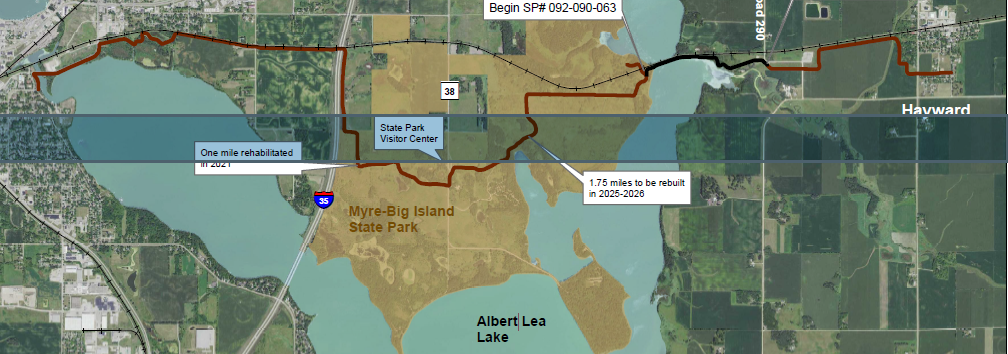
In mid-February, tree cutting was slated to begin as part of trail construction, which included a 100-foot trail bridge across Albert Lea Lake from Myre-Big Island State Park to Hayward. The entire construction project, consisting of an expanded trail, a bridge and fishing access, was expected to be finished in 2025.
Then mother nature stepped in with an alternative timeframe. Parks and Trails Division staff spotted a new eagle nest in a tree within 50 feet of the project clearing limits. After years of planning between municipalities, a railroad company, a power company and various state agencies, and years of hard work on legislative funding and approvals, land acquisition, and environmental and archeological testing — two nesting eagles lowered the boom. At least for now.
“It’s not unusual for construction to start and then to have an issue arise,” PAT Area Supervisor Joel Wagar said. “But this is a bit unusual.”
Since bald eagles and occupied nests are federally protected, PAT staff is working with the U.S. Fish and Wildlife Service to obtain necessary permits so that clearing work can proceed with some level of mitigation for project-related impacts.
Like most trail projects, the Blazing Star State Trail evolution moved forward in fits and starts, Wagar said, starting in 2003. Land acquisition is a big challenge as sometimes owners decide not to sell. The railroad and powerline presence added complexities to the project. The first segment connecting to the park was finished in 2003. The second segment, from Hayward to the lake, was finished in 2016.
More immediately, near Albert Lea Lake, contractors will build a temporary road for worksite access. Once the trees are cleared, work starts on the trail grade and bridge abutments. After allowing the newly constructed grade to settle over the winter, paving begins in 2025.
The $4 million segment, funded mostly through the Minnesota Department of Transportation, is eagerly anticipated by Albert Lea and Hayward residents. At a February community meeting in Albert Lea, the resident’s frustration over the wait period was replaced with excitement for the new trail connecting the two communities and the park.
But they’ll need a little more patience. One or two eaglets received the right of way.

Mysterious morphs
There’s only one species of lake trout in Lake Superior, but this shape-shifting fish has at least four distinctive morphotypes — and there may be more.
By Chris Pascone
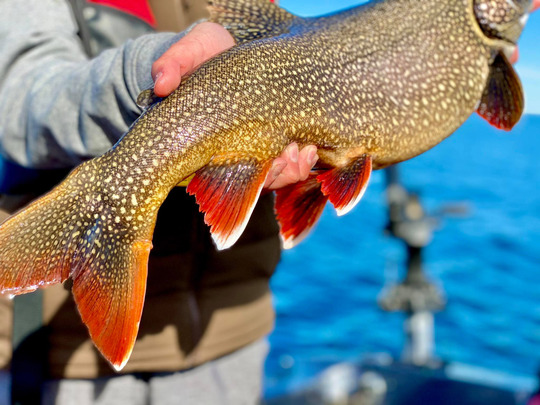 Photo credit: Grant Sorensen
The redfin morphotype of lake trout is named for its colorful fins.
"Reel up fast!" my buddy Ethan Waytashek and fishing guide Grant Sorensen yell to me. We’re jigging for lake trout from a boat 120 feet above an offshore hump on Lake Superior, and the guys see a fish rocketing toward my lure on the scanning sonar. The moment I’ve been waiting for is here. I crank the reel to impart a fleeing action to the jig, triggering the naturally aggressive trout to chase and hit it. I instantly feel a tap and sweep my rod tip upward to set the hook. The rod doubles over, and the fight is on. My arms tire from a long tug of war before I finally reel the fish up to our waiting net. It’s definitely a lake trout — but not just any laker.
“Look at that short snout and that bulging belly,” Sorensen observes, admiring the fish.
“Check out that small head and those oversized eyes,” Waytashek adds.
We immediately discern it is likely not a lean lake trout, the most commonly caught and most studied type of lake trout in Superior, named for its slender, tapered shape. Instead, we believe the fish is a humper, a distinct form, or morphotype, of the same species, Salvelinus namaycush — which despite its widely used common name of lake trout, is scientifically a separate genus known as char. Leans and humpers are two of the four different lake trout morphotypes, distinguished by their body shape, coloration, size, or other physical features, that fisheries biologists have identified in Lake Superior. The other two morphotypes are known as siscowets and redfins. This fascinating genetic biodiversity within the species has begun to attract the attention of fish experts and a few obsessive anglers like us — but in many ways the morphotypes still remain a mystery.
Minnesota Conservation Volunteer is the magazine of the DNR. Supported by reader donations, its mission is to encourage conservation and sustainable use of Minnesota’s natural resources. For more info, visit mndnr.gov/MCV or subscribe.
|