'Tis the legislative season
 The 2024 legislative session kicked off last month. In an email to Minnesota Department of Natural Resources staff on Feb. 26, Assistant Commissioner Bob Meier shared some of the DNR's 2024 legislative priorities.
At the top is the bonding or capital investment bill. Gov. Tim Walz's bonding recommendation for the DNR includes $100 million in capital investments, or 10% of the total capital investment proposal — and endorsement of the DNR's work and an example of the Walz-Flanagan administration's commitment to natural resources and outdoor recreation.
The investment would address priorities such as improving access to the outdoors, safety and community well-being, and rehabilitating aging (in some cases, failing) infrastructure.
The proposal includes:
- $71.55 million for preserving existing assets
- $12 million for acquiring, constructing and improving offices and facilities
- $7 million for investing in public lands
- $6 million for the flood hazard mitigation grant assistance program
- $2 million for improving accessibility of DNR-managed lands and facilities
- $2 million for Parks and Trails local and regional grant programs
For policies, the DNR is working on bills which cover a range of issues, all with the goal of helping the agency proactively address conservation and natural resources needs in the state, including:
- The policy and technical bill, which focuses on changes related to sustainable forest management, ecosystem management, and improving DNR business and policy practices.
- The lands bill, which proposes amendments to several state statutes to provide for changes to certain state park boundaries and grants the DNR authority to sell certain riparian lands which would otherwise be withdrawn from sale.
- The game and fish technical bill, which focuses on changes related to game and fish management, including fisheries management, elk and deer management, and improving access for new trappers.
- The cannabis use on state lands proposal, which would allow the DNR to establish restrictions on the use of cannabis-derived products in state parks where children are present.
State accessibility standards to be updated July 1
 Accessibility matters. Everyone has a right to equal, barrier-free access to all state services and information and digital accessibility is a key tool in ensuring that access.
Since Sept. 1, 2010, the state of Minnesota Digital Accessibility Standard has guided our digital accessibility work. Fourteen years later, the time has come to update the standard to better reflect our digital world.
Standard background
The current standard consists of:
Section 508 and WCAG provide specific, measurable criteria which help everyone plan, design, create, and test to ensure accessible products and services. Minnesota Statute 16E.03, subd. 9 affirms that every agency must support the Digital Accessibility Standard and that every document and digital product created by state government be usable by all Minnesotans.
Updated standard
The updated standard increases our compliance to WCAG 2.1, Level AA. The change keeps everything already in WCAG 2.0, but adds 12 new success criteria addressing things like mobile accessibility, low vision and cognitive disabilities.
For most staff, there is only one new success criteria which will affect your work — 1.4.11 non-text contrast, which ensures there's sufficient contrast used in images, graphs, presentations, etc.
Prepare for WCAG 2.1
Ensuring accessibility is a shared responsibility that extends to all DNR staff. Each of us plays a role in determining whether something is accessible. Whether you're drafting initial ideas, establishing project specifications, or creating a presentation, your contributions directly influence the accessibility of our work.
Here are some steps you can take now to prepare for July 1:
- Explore the Office of Accessibility’s WCAG 2.1 information.
- Identify your role and learn how the standard affects you.
- Read how to apply the new standard to your work.
- Sign-up for free training.
- Look for future communication with more information to help you with the transition.
Questions?
Contact Rebecca Blomquist or Kim Lanahan-Lahti.
Cybersecurity attacks on the rise
Be vigilant online
 Every year, digital security attacks increase due to the growth of the cloud, mobile, Internet of Things, and other remote technologies. Cyber crime is becoming more sophisticated with each passing day and requires increased vigilance to stop and counter the effects of attacks, which can cause mass disruption to the daily lives of people.
For instance, the Minnesota United Healthcare Group experienced a nationwide outage of its healthcare billing system due to a suspected nation-state sponsored cyber attack. Hospitals, insurance providers, pharmacies, and most importantly, patients were unable to get their prescriptions filled during this time due to the unavailability of the systems.
Other recent types of attack include:
- Phishing emails which pretend to be a voicemail service or OneDrive page announcements.
- Misappropriation of quick response (QR) code technology, which is designed to bypass spam filters. Malicious QR codes, in email or in real life, can send users to phishing websites which then attempt to gather a user's credentials. These "quishing" attacks have been targeting Microsoft 365 and DocuSign users.
If you get a suspicious email, use the "Report Phishing" button in Outlook. If you click on what you believe to be a malicious link, stay calm and report the incident by calling the MNIT Services Desk at 651-297-1111 or toll-free at 888-717-6638.
To reduce risk of a cyber attack:
- Verify if a QR code is official and has been created by a trusted source.
- Be suspicious if a password or other login information is requested after scanning a QR code.
- Don't rush to respond to an email. Stop and think before you click on the link. Verify the URL is legitimate.
- Call the person who sent you the email to confirm its origins.
- Be wary of unknown sites or "sponsored" search engine results.
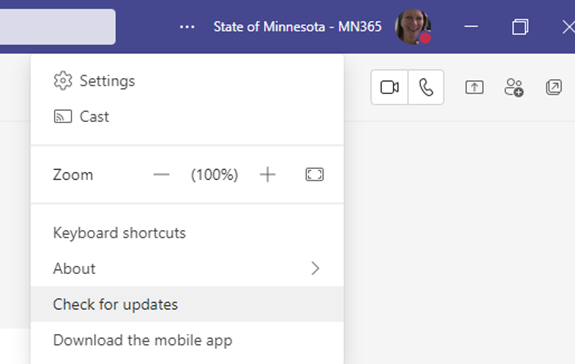
- Install weekly updates from the DNR's Software Center to maintain application security.
Join the DNR's softball team
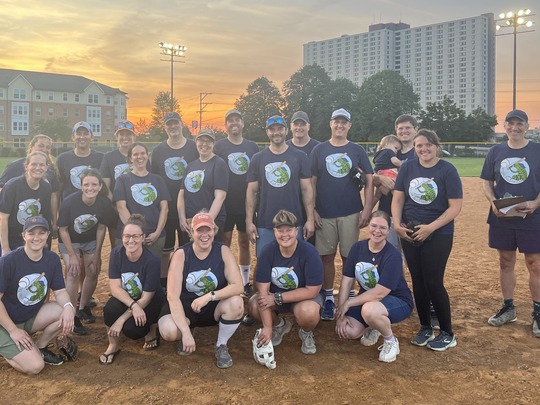 Some of the Grand Slamphibians team at the final game in August 2023.

If you're in the metro area (or willing to drive), join the DNR's softball team the Grand Slamphibians!
The team will be playing in the state of Minnesota softball league this summer on Tuesday evenings from May 21 to Aug. 13 at the Dunning Sports Complex in St. Paul (near Concordia University). Games will start at either 5:45 or 7 p.m.
The goals of the league are to build camaraderie with fellow state and DNR employees, show good sportsmanship, and have fun! Anyone who wants to can have a role on the team — no previous softball experience is required. You can also still be on the team even if you can only make some games and not all.
There will be a cost to play in the league, which is expected to be about $20 depending on how many people sign up to play. Optionally, t-shirts can be purchased featuring the Grand Slamphibians logo.
If interest and space allows, there's the potential for a second DNR team or for players to sub on another team in the league.
To be a member of the 2024 Grand Slamphibians team, fill out a short survey by March 18 at noon. After you fill out the survey, you will be added to the Teams channel for the Grand Slamphibians to get updates and more information.
Questions? Please contact team co-captains Kenny Blumenfeld, Maggie Snyder or Nathan Moe.
|
DNR sinks car in frozen lake to share important ice safety message
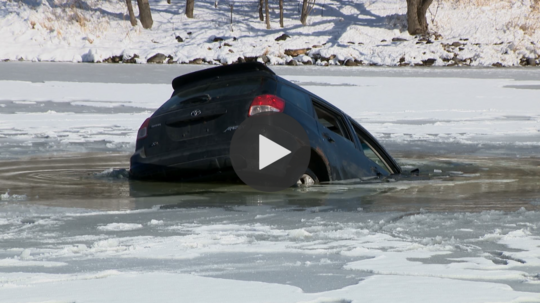 Ice on the lakes has been anything but reliable this year and so far, the number of people who died falling through the ice on Minnesota lakes is on track to be double what it was last year.
To share ice safety information, the DNR worked with KARE 11 and the Ramsey County Sheriff's Department to sink a car in a lake and show people what happens when the car breaks through, how to survive, and what to keep in mind. The car was emptied of fuel or other contaminants before going into the lake.
From the time the front wheels broke through the ice to the time the cabin filled up with water was one minute, 41 seconds. It took under four minutes for the entire car to slide under the ice and for heavier vehicles, it would be even faster.
This means it's important to be prepared when driving your vehicle on ice to get out as fast as possible if needed, which includes rolling your windows down, wearing ice picks around your neck, keeping your cellphone in your pocket, having a life jacket next to you (not on you), and consider taking off your seatbelt or having a seatbelt cutter on your visor.

Red and black and layered all over
 From a DNR Facebook post on Feb. 5:
What’s red and black and layered all over? Why, Minnesota’s banded iron formations, of course!
In the area that became known as the Vermilion Iron Range, these mottled or layered rocks formed more than 2 billion years ago. Slightly younger iron formations in the Mesabi or Cuyuna ranges formed more than a billion years ago. Identified by thin alternating beds of bright silver hematite, white chert and richly red jasper, banded iron formations formed when volcanic activity and plate tectonics squeezed and folded layers of rocks. Over time, weathering and erosion exposed these colorful rock layers.
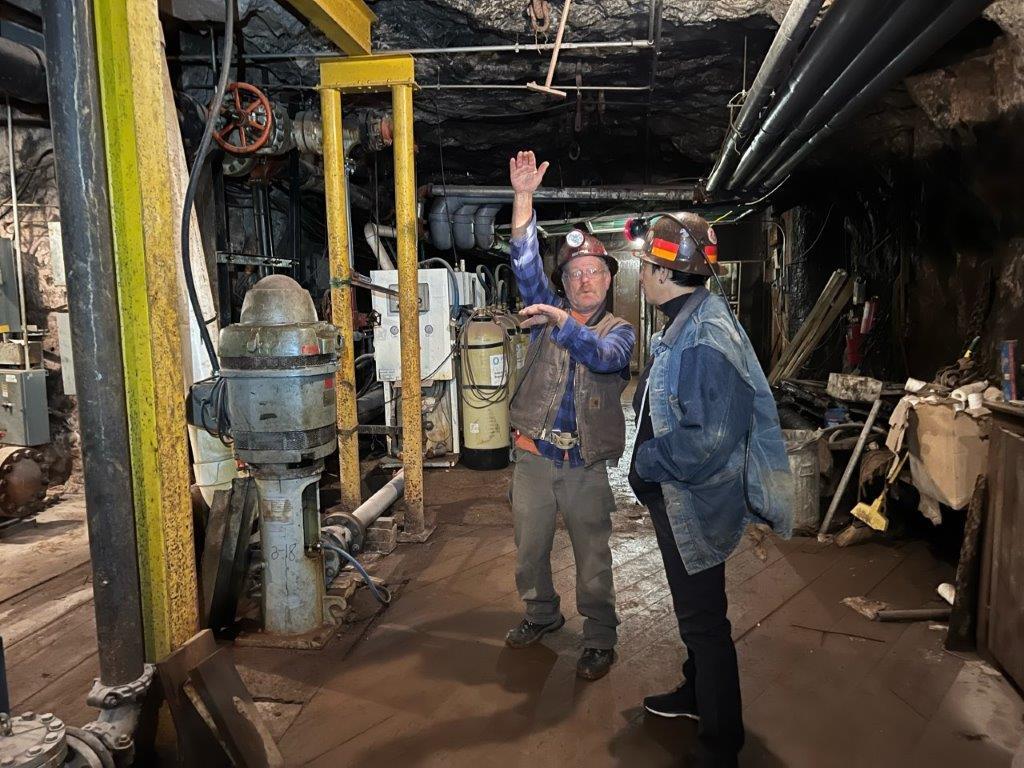
If you're up for a geology scavenger hunt, use these pictures to help you identify banded iron formation the next time you're out in nature! Here's a hint: you can see these vividly folded rocks at Lake Vermilion-Soudan Underground Mine State Park. Slabs of the local “swirly rocks” are located throughout the park land.
2024 DNR All-Staff Climate Conversations event
to be held March 5
 The DNR CLIMATE Team will host the 2024 DNR All-Staff Climate Conversation event from 9 a.m. to noon Tuesday, March 5. This year’s topic is “Tools and Partnerships for Climate Adaptive Natural Resource Management."
The event will feature an update on the state of the climate from DNR Senior Climatologist Kenny Blumenfeld and an opportunity to learn from a panel of our climate partner organizations on available tools and resources for climate adaptive natural resource management.
Event agenda:
- 9 a.m. - Welcome
- 9:05 a.m. - Kenny Blumenfeld: State of Minnesota’s climate
- 9:35 a.m. - Heidi Roop: UMN Climate Adaptation Partnership
- 10:05 a.m. - Allison Leidner: NASA tools and opportunities for collaboration
- 10:35 a.m. - Break
- 10:45 a.m. - Katie Frerker: Northern Institute of Applied Climate Science, Superior National Forest Assisted Migration Plan
- 11:15 a.m. - Olivia LeDee: Midwest Climate Adaptation Science Center
Questions? Contact Leah Shepard.
Subject matter experts list available on intranet
The DNR subject matter experts list is now available as a searchable tool on the intranet.
The list can be found on the right side of the intranet homepage under the "links" section. The list can be sorted by topic, division and location.
The Information Center manages and updates this list at least weekly, but often daily. The latest edit date can be found at the top of the page.
If you know of DNR staff who are leaving, retiring, or taking on a new position in the DNR, please let the Information Center know so the list can be kept current.
Application deadline extended for the next cohort of IDEC program
Deadline is now March 15
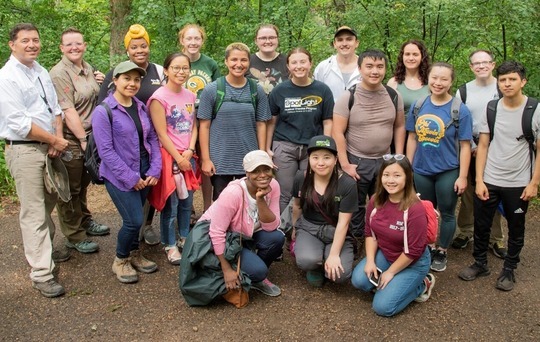 A recent Increasing Diversity in Environmental Careers cohort at Afton State Park.
The application deadline has been extended to Friday, March 15 for college students to be considered for a career pathways program promoting natural resource careers.
The Increasing Diversity in Environmental Careers program offers a 10-week paid summer rotational internships for underrepresented college freshmen students including women, racial/ethnic minorities, and individuals with disabilities who are interested in learning about environmental and natural resource conservation careers. The program is designed for those interested in obtaining a career in the public sector post graduation.
The program is a strategic partnership between the DNR, Conservation Corps Minnesota and Iowa, the Minnesota Pollution Control Agency and the Minnesota Board of Water and Soil Resources.
If participants are interested, they can be considered for continuing the program after the summer rotational internship. Additional experiences include fellowship and mentorship, and an additional agency internship the following summer.
Through participation in the program, participants receive the following:
- Resources to support future academic success (i.e. networking and professional development opportunities).
- Hands-on experience through paid summer rotational internships both outdoors and in the office.
- Information about environmental and natural resource conservation careers.
- Enhanced personal and professional skills.
To be considered for participation in the IDEC program, students must:
- Be accepted to or currently enrolled in a two or four-year fulltime undergraduate program at an accredited state, community, private, or tribal college or university in Minnesota.
- Be an undergraduate freshmen transitioning into sophomore year by the fall
- Be interested in learning more about a natural resource and environmental careers.
- Be legally authorized to work in the United States.
- Have proof of admission or enrollment and unofficial transcript are required.

Speeding motorists, thin ice, and more
Conservation officers continue to speak with the media, anglers and people at various events about staying safe on the ice. With recent warm weather, there have been a number of instances of fish houses and recreational vehicles breaking through the ice.
The following are several highlights from the weekly Conservation Office reports.
Feb. 26, 2024
CO Coby Fontes (Warroad South) assisted with the funeral for Sgt. Ryan Piper of the Minnetonka Police Department, as well as the funeral for retired police chief and LEMA founder, Jim Crawford. He took enforcement action against a motorist who was traveling around 40 MPH over the posted speed limit.
CO Jordan Anderson (Osage) responded to an ATV which had gone through the ice on an area lake. Luckily, the operator had ice picks and was able to get out of the water.
CO Sean Cannon (Cook) responded to a report of an ATV going through the ice. Everyone made it out fine, albeit wet and cold. There were rumors of others going through in other areas of the lake as well.
|
Feb. 20, 2024
CO Derek Peterlin (Brookston) demonstrated the use of ice safety gear at an ice safety event hosted by the St. Louis River Alliance and presented the laws and ethics portion of a snowmobile safety class. He encountered violations for failure to renew ATV registration, failure to display ATV registration, and no license in personal possession.
CO Matthew Brodin (Brainerd) attended the 44th annual Special Olympics Winter Carnival at the Confidence Center. The Confidence Center provides outdoor education for all ages with cognitive and developmental disabilities. Brodin brought a TIP trailer and worked with the Brainerd Wildlife staff to have furs for the attendees to touch and handle. Brodin also met with Crow Wing County Land Management to discuss wetland and shoreline cases.
CO Tyler Ramaker (La Crescent) fielded calls about urban wildlife and dogs chasing deer. He reminded pet owners that it is illegal to allow dogs to chase or kill deer and dog owners are entirely responsible for the behavior of their pets.
|